
Home
About Us
Newsletter
Photos
Brewing 101
Links
NEW!
Buy
Alers Gear!
Buy
Larry's Gear!
Contacts
Overlord
Vice
Overlord
Scribe
Pillager
WebMistress
The Impalement Post
The Official eVersion of the Impaling Alers Newsletter

|
Next meeting: Thursday, August 16th, 7:30 pm
August 2001 Issue by Kevin Fawcett
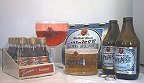
Another month gone by already??? We finally got a little warm weather to stimulate plant growth. The hops have cones, the tomatoes have tomatoes, and I’m already eating peppers, onions and basil from the garden. It is also the season for a bit of summer brew. I whipped up a batch of lawnmower beer last week. Much to my surprise, my yeast culture did not take off so I was forced to use dry yeast in my American-style wheat beer. I pitched a couple packages of Danstar Nottingham and (just to be sure it was active) also a package of Edme. This sucker took off in a little over an hour and went CRAZY for two days straight. On the third day I took a gravity read and found the beer all the way down to 1.006. Fresh beer in three days?? Almost... I transferred to secondary and let it sit just long enough for things to clear a bit, about three or four days. On the one-week mark it was in the keg and now I’m drinking it. I love it when they do that. I wish every beer would finish in three days! I’ve become an advocate of pitching LARGE quantities of yeast slurry. It seems most all beers finish faster when they get off to a flying start. The old beer-fridges have been starting to look empty lately (mainly the result of a contamination that migrated from one keg to the next (more on that later) so I’ve been brewing up a storm. Three ten-gallon batches in the past ten days. One of American-style wheat beer and two different types of pale. Next up is a witbier. I tried brewing a Berliner Weisse a few weeks back and it is now in the keg and continuing to ferment. I didn’t quite get enough of the sour flavor that is supposed to be associated with a Berliner Weisse, so I’m hoping an extended fermentation in the keg at room temperature will bring the lactobacillus along in time. I have never brewed a beer where you intentionally pitch lactobacillus culture into your wort. I usually spend a lot of time and effort trying to avoid Lacto contamination so this is a bit weird for me. The target starting gravity for this ultra-light brew is 1.032. I hit 1.034 and called it good. The intent is to produce a very light, sour, thirst-quenching beer.
I took the recipe and procedures for mashing directly from book #7 in the Classic
Beer Styles series: German Wheat Beer. 8 lbs wheat Mash-in with 4 3/4 gallons liquor @
104F, hold ten minutes. Add 1 oz Perle hops 30 minutes into
boil. Continue boiling for 30 more minutes,
chill to below 90F and pitch healthy starter of Lactobacillus Delbruckii. Beer should be primary fermented for
only about four days, or until activity decreases substantially. Cheers!
For those who missed the Impaling Alers campout this year, you missed a great time. Buck Lake is the perfect place for us and I don’t think I’m alone in saying that I hope it will become the traditional spot for our campout in the future. I think we’ve found a home. On Friday, Terry, Heidi, Randy and I (and a load of kids) took my boat out on Hood Canal and came back with thirteen Dungeness crab to munch on that night (they disappeared in a hurry). Felix was kind enough to provide us with a huge container of water (There is no running water at the group-camp area. There are showers and bathrooms just a convenient five-minute walk away).
Several musical instruments showed up this time including guitars from Tom, Dave, Travis, and myself as well as Rob’s acoustic bass and a little battery powered amplifier to go with it. We dubbed ourselves “the Five-Drunks Acoustical Band” and proceeded to play well and sing terrible (as usual). We were heartily welcomed by everyone we came in contact with at Buck Lake and everyone had a lot of fun. Several of our members have already purchased campsites at the Lake, so I’m sure we’ll see more of Buck Lake in the future. Don’t miss it next year!! Brew-a-thon Beers As of yet, we still have not had a judging of the Brew-a-thon Scottish Ales we produced. I heard from several who lost theirs to contamination (I think there was some bad yeast floating around) so there may not be a lot of entries left for this. If you have a Scottish that was brewed on National Homebrew Day at Larry’s, please get a few samples in and store them in the cooler so we can have our in-club competition!
I finally visited the annual Oregon Brewers Festival. The weather was VERY nice the first day. Mary and I stumbled into Dave Meconi and Terry within just a few minutes after arriving. It wasn’t long before we hooked up with Brian Thatcher also. I didn’t find any brews that really stood out at this festival, though there were a few tasty ones that I went back to sample twice. It seems that local brewers used to brew up something special for local festivals. Such did not seem to be the case this year. A lot of breweries serving their regular stock ales and even a few sending beers that I would consider inferior compared to what I have tasted in the past from said breweries. Not to say that a good time wasn’t had, but the variety just wasn’t up to snuff, and there were not a lot of specialty beers.
I found a few beers worthy of mention. One was McCoys IPA from McCoy, Kansas City, MO. Elysian also had a saison that was quite enjoyable. Anderson Valley offered up their pale ale. (I would rather have had a Hopottin IPA, but the pale was good). I remember very little about the fest after the first hour or so as the only beers I was really fond of were high-test IPAs, saisons and the odd barleywine here and there. We ended up going out for dinner afterward (somewhere) and then hit another pub nearby. I was soon asking to be taken home because I’d had enough to drink and stopping while around the boys just wasn’t an option. Mary and I didn’t even attend on Saturday. The weather was TERRIBLE in the morning (dumping rain like crazy), so we packed up and headed for home. The strangest comment I heard about the OBF came when I got back home and found several beer geeks posting messages about the “cry of the American Moron” (a reference to the inevitable “woooooooooo” that arises when someone drops or breaks their glass). Several of these guys were quite adamant about calling Americans “morons.” I tried to make it clear to them that just because someone yells at a brewfest it does not make them a moron. I was greeted with long tirades about the “proper” way to act in decent society. I don’t know about you, but I’ve been searching all my life for someone to decide for me the “proper” way to act when drinking beer. I am obviously not capable of making this decision for myself. The most vociferous about this was a gentleman by the name of D. P. Brockington who resides (apparently) in the Netherlands. He quite obviously holds himself to be above the ramblings of us “morons,” a term he continually uses to describe American festival-goers. I suggest we have old Brockington arrange to give a speech at the GABF and tell all of us “American Morons“ how to behave respectably. I really want to be there to see the crowd reaction to that one!! If you would like to voice your
opinion to D. P. Brockington about “morons” and the traditional “woooooooooo”
yell, here is his e-mail address: D.P.Brockington@bsk.utwente.nl I said I’d speak more about contamination so here it is...You may have seen Terry squirting Bright-san or another sanitizer on his connectors when changing kegs or just carbonating them with CO2. I had a very disturbing experience which relates to this just a few weeks back. Let’s go all the way back to Brew-a-thon on National Homebrew Day for the beginning of this tale.... Many breweries supplied yeasts for us to use on National Homebrew Day this year. One of them was Harmon Brewing from Tacoma. I needed to brew a batch of beer for a friend’s wedding but I had no yeast starter going at the time. I was going to have Terry pop a new smack-pack of yeast for me and then I was planning to pick it up later that day. Terry informed me that there was plenty of yeast left over from Homebrew Day the previous weekend. I opted to take the whole jar of Harmon yeast slurry and pitch the whole mess in this blonde ale hoping it would ferment quickly. The beer took off right away and finished quite soon, in about three or four days. I was happy about it because the wedding was coming up in a few weeks and I wanted to make sure the beer had plenty of time to condition before being served. I kegged the blonde and was keeping it at room temperature to allow it to try and carbonate it self. I took a few samples off of the kegs and it had a slight green flavor but I figured it was nothing that wouldn’t condition out in a few days. Meanwhile, a few friends came over and I was really proud to have them taste my new Imperial Stout that was conditioning in the same room as the blonde ale, along with my Scottish ale from homebrew day. We popped the tap off the blonde ale and transferred it to the Stout keg. MMMM! Imperial Stout, smooth, chocolaty, roasty!! I had never been more proud of a stout. My Scottish from National Homebrew Day was quite good also. Finally, I had a Brew-a-thon beer that I thought was worth sharing with others. We sipped away happily taking samples from each as we pleased, using the same tap. A few days later the blonde ale went South in a hurry. It was obviously contaminated with something that gave the beer a REAL cidery finish. It was ruined! Low and behold, a few days after that the Scottish began to take on that cidery character exactly the same as the blonde had done. I was devastated. How could this have happened? I’ve been trying to brew a decent Scottish Ale for some time now. I had finally done it and now it was ruined. A few days after that, I took a sample from the Imperial Stout and to my horrific surprise, it was ruined too!! All of these beers were brewed with different yeasts, at different times and even in different places. The infection began with the blonde ale and was immediately evident, I just didn’t recognize the signs. The only common thread between all of these kegs of beer was the tap that had been blatantly moved from one keg to another without sanitizing in between. One simple mistake in procedure ruined 30 gallons of homebrew!! Had I known that the blonde ale was contaminated, I would never have used the same tap to sample from other kegs. The problem was, quite plain and simple, the blonde didn’t show signs of going bad until it was too late. The infection was already spread via keg taps. A great lesson to be learned here! This is why Terry sanitizes his taps and CO2 connections every time one changes position. There is NOTHING wrong with overkill when it comes to protecting your beer from contamination. I often get overconfident about beers that have completed their fermentation. By the time a beer has finished, it’s alcohol content is so high that very little will ruin it. Be aware, however, that there ARE bugs out there that can overcome just about anything. This was a nasty one. Protect yourself and your brew. If you keg your beer, use plenty of sanitizer on taps when changing kegs or supplying CO2. Clean your cobra heads, hoses and keg connectors regularly and soak them in sanitizer for ten minutes or so when you are done cleaning them. I remember Rich Webb writing that he keeps all of his siphon hoses, airlocks and such floating in a cooler full of bleach and water solution when they are not in use. Such precautions make good sense, especially if you want to keep from losing 30 gallons of your finest beer all in one week.... like I just did.
"The young lady is lying on a bed of barley. Her charms are hidden by hop vines. This poster, in its thousands, is being distributed in Britain by the Campaign for Real Ale. The campaign is financed out of a fighting fund among members. Its intended message is that "real ale" is "stylish and fashionable." The visual idea is distantly reminiscent of a poster revived in 1986 by the Hibernia (previously Walters) Brewery, of Eau Claire, Wisconsin. The original poster had been used by Walters in the 1930s." Article and picture borrowed from Michael Jackson's web site.
Scotland has 11 million acres of wild heather that slowly turn the summer landscape lilac, and then purple as the plant comes into flower. The heady scent fills the air, exciting the bees and the people. The flowering of the heather heralded a season of rejoicing and self-indulgence for the Celts. For the brewers of heather ale it means HARVEST TIME!
When & where: August 24, 2001, 6 pm, The Arches, Glasgow, Scotland Information:
Bruce Williams – (44) 01357 529529 Brian Thatcher was kind enough to write us another review for the Portland Beerfest, one that I was not able to attend. Here it is...
On the weekend of July 20th – 22nd I had the pleasure of attending the inaugural Portland International Beerfest at the North Park Blocks in downtown Portland. On tap were almost 130 beers from around the world, although the great majority hail from Europe. There was a good-sized selection of Belgian beers, which only increased the appeal for me. I was at the Friday evening (4-10) and Saturday (11-10) sessions, and there was also Sunday (12-7). The beers I concentrated on were those that I had never had before, especially any that I wasn’t sure I could get at one of the local bottle shops. For being a first time event I though it was organized quite well, maybe the responsible parties have previous experience in this sort of event. There was a decent crowd there both days, but wasn’t really overcrowded. There were food vendors for when one needed to soak up some excess fluid in the stomach. The beers were divided between bottles and on tap, beyond that I believe they were arranged according to distributor, but am not sure. The event guide had a map in it and was a great help when searching for a specific beer to try. There were two rows of tables, each along opposite sides of fenced off area, with bottled beers served on the first ones and those on tap spread across the rest. There were tables and chairs set up in the middle and park benches scattered around, and it usually wasn’t too hard to find somewhere to sit down if needed, but there were times where the grass was the best I could do.
Listing all the great beer I tried this weekend would take up too much space, so I will try to mention a few standouts without feeling guilty about the ones left out. Probably the favorite was the Abbaye Des Rocs Grand Cru, which was very complex and balanced. It malty and spicy, slightly sugary in aroma with hints of caramel and possibly cinnamon in the flavor. The EKU 28 is the biggest Dopplebock I have ever tried, with a sugary, caramel malt flavor that was quite tasty. Another Dopplebock deserves mention; Moretti La Rossa Malto Doppio from Italy was very good. I had a chance to sample George Gale’s Millennium Barley Wine, which was fairly tart in addition to the other wonderful flavors associated with a good BW. They were serving Samichlaus there, and even though I have had it before, couldn’t resist the temptation to try it again. The Kasteel Trippel and Delerium Tremens from Belgium would also deserve some deeper exploration. The beer labeled as the “Mystery Belgian” by one of the distributors leading up to the event was called Loterbol, I heard it claimed that it is the first time it has been poured in the US. It had some similarities to a nice Belgian Golden Ale with a spicy hoppiness and noticeable bitterness, I was quite impressed. I could go on about the beers I tried but will leave your mouth watering imagining what I left out (or go to www.portlandbeerfest.com for the complete list). The people I talked to throughout the weekend seemed to be enjoying the event, the only real issue was its proximity to Oregon Brewer’s Festival the following weekend (I had an issue with it being during American Beer Month, but don’t know how widely that is recognized yet). I hope this event was successful and becomes an annual event so I can do it again next year. [Scribe: After reading Brian’s review I’m beginning to wish I went to this brewfest instead of the OBF!]That’s it for this month. Don’t forget to be at the club meeting this Thursday, the 16th at 7:30 PM, and remember to bring HOMEBREW! |
 Summer Beer


 Club
Campout!!
Club
Campout!! Many of the kids (and adults alike)
got up early on Saturday morning and caught quite a few nice-sized trout from
the lake. Kevin Graden, a Buck Lake Association member, was kind enough to
procure three coolers full of oysters in the shell from a relative who works at
an oyster farm.
Many of the kids (and adults alike)
got up early on Saturday morning and caught quite a few nice-sized trout from
the lake. Kevin Graden, a Buck Lake Association member, was kind enough to
procure three coolers full of oysters in the shell from a relative who works at
an oyster farm.
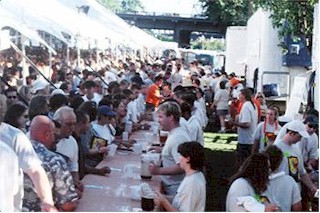 One
thing that seems rather strange to me is the setup at this festival. There are
huge tents for the attendees to gather in but the beers (and those pouring them)
are left out in the hot sun all day. The booths are set up in such a way that
everyone has to stumble over or navigate between all the anchor lines for the
big tents. I would think a little re-design would be in order for this fest.
I’m sure those who pour the beer wouldn’t mind a little shade and the beers
would certainly suffer less for lack of pitchers sitting in direct
sunlight.
One
thing that seems rather strange to me is the setup at this festival. There are
huge tents for the attendees to gather in but the beers (and those pouring them)
are left out in the hot sun all day. The booths are set up in such a way that
everyone has to stumble over or navigate between all the anchor lines for the
big tents. I would think a little re-design would be in order for this fest.
I’m sure those who pour the beer wouldn’t mind a little shade and the beers
would certainly suffer less for lack of pitchers sitting in direct
sunlight. 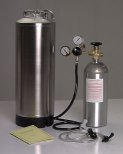




 In the two days that I was there, I
was able to sample about a third of the beers being served.
In the two days that I was there, I
was able to sample about a third of the beers being served.