|

Art
plus physics? Sheer Chemistry.
"Sein,
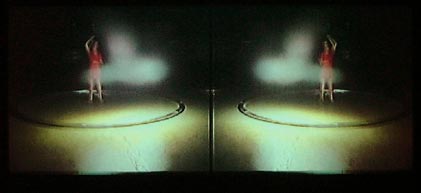
oder nicht sein. Das ist die Frague," repeats a woman in a cadmium -red
dress standing in the dark as she swings a large luminous bulb in a
circle. The looping bulb at the end of an electrical cord whirs through
the air leaving a circular trail of light. It is an oddly entrancing
and eerie image. And as you are drawn deeper into the rhythm, it becomes
increasingly uncertain how much the woman is indeed propelling
the light source, and how much she herself is being controlled
by it's centrifugal forces.
I am in Geneva watching a film of a woman uttering
those famous opening lines of Hamlet's soliloquy in German, and hearing
an artist talk about science...
The revolving light bulb symbolises those experiments
at CERN, in which subatomic particles are hurled around a 27km
- long tunnel, colliding at the speed of light.
What we are witnessing is being billed as the
crossing of two academic cultures, no less, a meeting of artistic and
scientific minds, 40 years after CP Snow warned of a damaging divide
between the two intellectual communities, separated by misunderstanding
and mistrust.
The woman in the red dress is modern art with
a new twist. I must confess that I find much of today's abstract art
baffling at the best of times. But here armed with a doctorate in theoretical
physics from a dim and distant past, I am in my element. Those Shakespearean
words speaking of being and not being, you see refer to the formation
of antimatter and matter in the gigantic circular atom-smashing machine
at CERN. For once, I can see the light. Yet there is still some explaining
to do. So I ask Professor ken McMullen, artist, film director and creator
of this film, "Lumen de Lumine", about his new work.
McMullen appears as well versed in Einstein
and Heisenberg as Emin and Hirst; he kindly answers my questions. Why
German? it is of course the language of Shrodinger, einstein and 20th
Century physics. mcMullen reveals how the film took place in a deep
underground bunker at CERN, and the surroundings were actually once
part of the tunnel walls that witnessed those high speed particle collisions
which reveal to physicists the tracks of the basic building blocks of
nature.
A Cern theorist, John March Russell, who worked
with McMullen on the project, argues that theoretical physicists have
much more in common with artists than, say, social scientists, approaching
problems in a similarly abstract fashion. This is how things used to
be before the two cultures split during the 20th century. Polymaths
such as Leonardo Da Vinci were not so constrained by disciplinary boundaries.
These days there are also very pressing practical reasons for scientists
and artists to set up mutually beneficial partnerships. It is a
straightforward deal: art yearns for academic respectability, while
science desperately seeks popularity. The academic formalisation
of research in the visual arts in particular is relatively recent, but
the arts community is campaigning for more recognition and funding.
"We see artistic creation as analogous to research in that it involves
an original contribution to knowledge," says Michael Benson, director
of communications at the institute, which secured a world-class research
rating of 5 in the 2001 research assessment exercise.
But can art help science to be more creative? One reason for the declining
interest in science is that it has become so specialised now that it
takes too long to do all the groundwork needed to reach the cutting-edge
boundaries of knowledge. And scientists have assumed a more business-like
and conservative approach to their work: committees find it near impossible
to fund truly adventurous research proposals; and a minuscule number
of academic papers are now genuinely groundbreaking. McMullen says:
"Institutional life for the scientist or artist can be difficult if
you are an experimenter, simply because there is no clear path or precedent.
Artists are trained to lose themselves, and then find something out
from this, breaking down presumptions. It is not so easy to do that
in science."
Lee
Elliot Major. Extract Guardian, Feb. 2002
|