If you have arrived at this page via a search engine, and you cannot see the navigation frame on the left, click here. It will redirect you to Carol Haney Home complete with frames!
"Miss Haney- well- She's still just grand."- BOSLEY CROWTHER, New York Times 1957. Read full review.
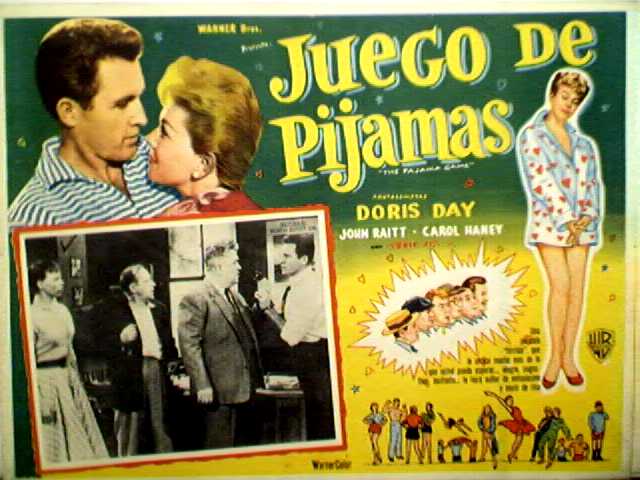 Carol would be involved in the 1957 film version of the Broadway hit, "The Pajama Game". The OBC was transferred to Hollywood virtually unscathed, except for the axing of the original "Babe", Janis Paige, who was replaced by Doris Day. This film would be the only record on film of Carol Haney's unique and versatile talent. This film captures her vocal, comic, and dance abilities in one neat little package. i remembered being excited at being able to get hold of a copy of this film because first time I would hear Carol not only talking, but singing and dancing!
General review
The film is an important one for so many different reasons. We can first of all go through the cast and see that it is one of those rare occasions where the studio is generous and trusting of the talent of the OBC, and allow almost the whole of the original cast to strut their stuff on film. For this, admirers of Carol Haney and John Raitt must be thankful of Warner Bros., because the film would be the only record of, firstly, Carol Haney: solo dancing, then as jackpot bonuses, even talking and singing. Carol's past as a choreographic assistant and part time dancer granted her a "mute dancer" status in her film appearances. In fact, she has never had a fully developed role in a film or a theatrical production, before the Broadway and film versions of "The Pajama Game" ("TPJG"). "TPJG" would also be John Raitt's only chance to display his singing talents on film.
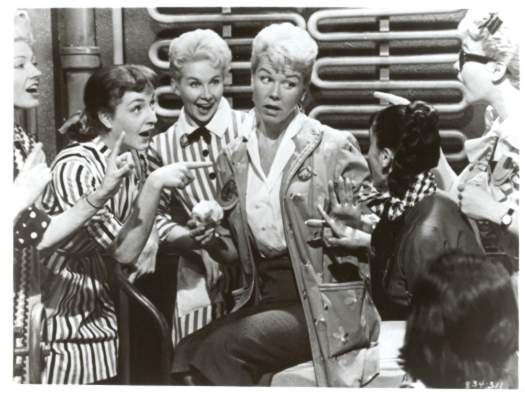 There is not a weak performance in this experienced cast, and although Janis Paige, the original Babe Williams, was axed from the film production (Paige would instead be a supporting player in MGM's 'Silk Stockings' in 1957), we as an audience do not lose a strong performer because she would be replaced by the seasoned, and much more "bankable" film musical performer, Doris Day. Day turns in an exceptional and complex performance as Babe, and combines the roughness of almost a "Calamity Jane" but also winning the audience's sympathy with a well played out internal vulnerability. Eddie Foy Jr., as Hinzie (oft spelt Hines... I'm gonna do it my way!) the jealous-as-hell time study man tackles his big moments with enthusiasm and is duly effective, but loses scenes due to the musical's transferral from stage to film. The part of Gladys, Hinzie's flitatious girlfriend, played by Carol Haney, is also reduced in the transfer to film, most probably due of the still effective Production Code and contempoary moral standards. Haney's modified striptease with Stanley Prager in "Her Is", and slapstick "Jealousy Ballet"- a witty play number that spins out of Hinzie's suspicions of Glady's infidelity, was cut from the film. However, Haney, like Foy, latches on to every one of her big moments and almost steals the show from Doris Day. In fact, Day, who was reportedly in the midst of personal problems at the time of filming, was also reported to have felt like an outsider during the making of the film, as she found it hard to find her place within the tight knit group of the original Broadway cast. Reta Shaw (Mabel) and Ralph Dunn (Hasler, the boss) also contribute effective performances.
The film also captures Bob Fosse's choreography from his first venture at choreographing on Broadway, and also captures on film one of Adler and Ross' two hit musicals, for Jerry Ross died at 29 in 1955, and Richard Adler never really recovered from the loss of his song writing partner. Adler never wrote a hit musical after his next with Ross after "The Pajama Game", "Damn Yankees".
There are downsides to this deliberately faithful adaptation. It could be said that the adaptation is a trifle too faithful to the original show. Of course, Bob Fosse and the directors did a marvellous job in making use of the increased time and space by making the scale of each musical number absolutely grand, but in the dialogue scenes, the players seem confined spacewise. The directors appear never to have gotten rid of the proscenium arch. "Hey There", in particular, stands out as merely a filmed record of John Raitt's singing. Only one or two filming points of view also seem to exist in the office scenes, and full/half body shots are the major ones used throughout the film, giving the viewers a feeling of a filmed stage musical. Although Stanley Donen and George Abbott were given a short amount of time and a low budget to make this film, prehaps the book scenes could have been livened up a little, so to say.
However, one cannot have everything! Counting on the strength of the cast's performance, the lively musical numbers, Stanley Donen and George Abbott's able direction, and Bob Fosse's choreography, this film is a real gem, but is also an oft neglected member of Doris Day and Stanley Donen's remarkable repertoire.
Carol's involvement
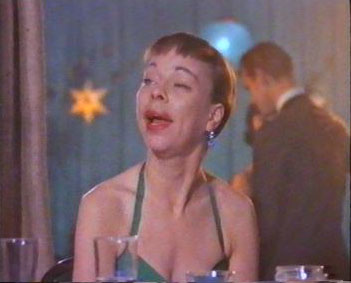
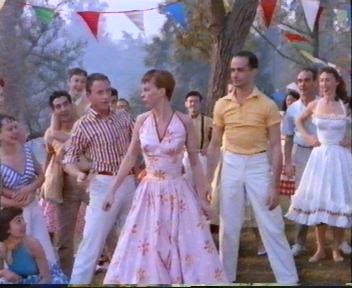
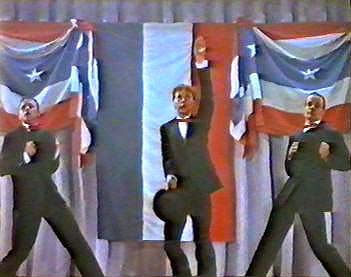
Carol participates in all but two of her numbers from the Broadway show- Once a year Day, Steam Heat and Hernando's Hideaway.
Carol puts in a grand performance as Gladys, but because of omissions of certain scenes and dialogue because of censorship reasons, Carol's characterisation in one particular scene may be seen as a blatent piece of overacting. When Hasler (Ralph Dunn) gets mad at Gladys for forgetting to lock a ledger book up, Carol cries, almost breaking into tears, "Yes, Mr. Hasler". The moment is left hanging open with Hasler leaving the scene, chasing Gladys for an explanation, with Sid (John Raitt) commenting, "That man's got a serious case of bookitis...". When I first saw the film I thought "woah, bad.". What we don't know is- in the Broadway version, Hasler returns from off-stage and explains Gladys' hysterics, and even mocks Gladys crying. This prehaps I should have put in the above review, but another scene where I thought dialogue is left hanging in the open is at "Hernando's Hideaway", where Prez (Jack Straw) is handed some money from Sid to take Gladys home and he says, "Her is the cutest one". The line is gone, because with Prez's song "Her Is" cut out of the film, there has been little suggestion in the film of Prez's "innate horniness", which was so much emphasised on Broadway. The "Jealousy Ballet" being cut out also prevents any interesting elaboration of Gladys' line "And I'm glad I never married you!", at the end of the "Hernando's Hideaway" sequence. I personally feel that Eddie Foy Jr. is left looking like a perverted father figure in the film because of a mismatch of casting, and Glady's flirtiness is never accentuated. Jack Straw, who gives a solid performance as Prez, is left looking like a lovable geek without the original Broadway numbers.
As per usual, Carol's dancing is brilliant in "Steam Heat" and "Once a Year Day". She is partnered with Broadway converts Buzz Miller and Kenneth (Ken) Le Roy (who was one of the replacements for Peter Gennaro, and also, by the by, played Bernando in the original Broadway production of West Side Story) in the film. Carol comments in the August 1957 edition of Dance Magazine, quoted in Billman on the transition from stage to screen of the Bob Fosse dances:
My "Steam Heat" number, for example... was done exactly as we did it in the theatre. It was supposed to be presented on a stage... and I thought Stanley was very wise not to try to trick it up for the movie. On the other hand, for a scene like the big "Once a Year Day" number- the picnic dance which we did on location in a park- Bob Fosse rechoreographed his original dance completely to involve more people and all the space you can cover with a camera. And Stanley, who knows about dance, photographed it in wonderful travelling shots that captured all of the dynamism of the movements and at the same time provided enough air around the performers to make their movements significant. You see, you just can't set up your camera and photograph a dance... You have to know just where to place it, which angle will make it exciting and alive...
Many would agree that Carol's performance in this film repeated her stage success in the role of Gladys, in that pretty much every appearance of the oddball secretary stole the scene. I still feel somehow that because of the omissions made in the transistion process, Carol, and also Eddie Foy Jr. are left cold and underused in the film. This maybe because "The Pajama Game" was to be Carol's last appearance on film in her short career.
Continue on to a snippet of Carol's family life


