chapter 18
chapter 19
Diffraction and Interference of Light
Francesco Maria Grimaldi noticed that the edges of shadows were not perfectly sharp, so he
named the slight spreading of light waves, diffraction, which is the bending of waves around the
edges of barriers. According to Christian Huygens, you can replace the crest of any wave by equally
spaced wave that produce new waves with one another. In his experiment, light fell on two closely-
spaced narrow slits. The light that passed through each slit was diffracted. As a result, the
spreading light from the two slits overlapped when the light fell on an observing screen, the overlap
produced a pattern of bright and dark bands called interference fridges.
When colored spectra is seen when white light is used in a double-slit experiment
The position of the bands depend on the wavelength, so that the light is seperated by diffraction
into a spectrum of color at each band
Light that passes through a single slit, produces many bright and dark bands that are spaced
around a bright central band
When the width of the opening is the same as the wavelength of light, diffraction is at its maximum
When looking for the distance of the central band to the dark band, use the equation
x=wavelength multiplied by the L divided by the W
^=Light Wavelength
L=distance to screen
w=slit width
To solve the wavelength:^=(x)(d)/L
Diffraction Gratings
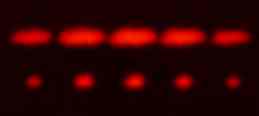
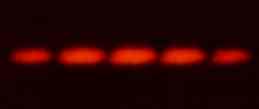
Do you know that beetles and butterflies produce their colors
through diffraction. The tiny ridges that cover the butterfly's wings each diffract the light
each diffract the light hitting them, producing interference effects. The slits that make
The slits that make the interference pattern of two slits stronger is called a diffraction grating.
these are made by scratching very fine lines with a diamond point on glass. Diffraction gratings
are used to create interference pattern sto analyze light sources. As a result, colors are easily
distinguished, which means that wavelengths can be measured more precisely than with double slits.
The same equation can be used for a diffraction grating where d is distance between lines
X divided by L=wavelength divided by d
This equation is used for diffraction grating
(x)(d)=(wavelength)(L)
the lens diffracts the light, so the smaller the lens, the wider the diffraction pattern
Diffraction limits the resolving power of lenses. The effects of diffraction on the reolving power
of the telescope can be reduced by increasing the size of the lens. Even though the wavelength of light
can be reduced, the objective lens of a microscope cannot be enlarged
References
electron9
Holography for the New Millinium
Why Things Are The Way They Are
Merrill-Physics Textbook-Principles and problems