Radicals
Terminology
In the expression  ,
,
 is called the index,
 is the radical,
what is inside the radical,  ,
is the radicand.
,
is the radicand.
Remember: The radicand is positive when the index is an even number.
In other words, we will be taking the even roots of positive quantities
in order to exclude the case of complex numbers.
The even root of a negative quantity is a complex number.
Definition



The denominator of the rational exponents gives the root
and the numerator gives the power.
Using these definitions, we can express rational exponents as radicals,
and radicals as rational exponents. Often, it is easier to work with rational
exponents because we can use the rules for working with exponents.
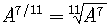
The denominator of the exponent is 11, so we use the 11th root.
The numerator is 7, so we use the 7th power.
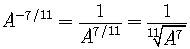
Negative exponents are defined as reciprocals.
Here is an example of a problem that is easier to work out
by using rational exponents:
Write  in terms of a single radical expression.
That is, we want to rewrite it as  .
.
We must determine what numbers will replace the question marks.
First, rewrite the radicals as rational exponents,
 .
.
Since the denominator gives the root, all we need to do is rewrite the exponents
so they have the same denominators and our problem is solved.
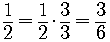
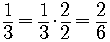
The algebra problem with radicals becomes the arithmetic problem of rewriting
the fractions  and
and  as equivalent fractions
with the lowest common denominator (LCD).

So,

Use a law of exponents to rewrite,
 .
.
The dominator gives the root, so we use the 6th root,
and the expression inside the parentheses gives the radicand.

Finished!
Properties of Radicals

The root of a product is equal to the product of the roots.

The root of a quotient is equal to the quotient of the roots.
Warning:


It is a very common mistake to write
 .
.
This is wrong !!
The radical can not be further simplified.
See Examples 1 - 6, pages 59 - 64.
top
next Linear
Equations
Module
2