Rational
Exponents
Definitions
Rational exponents are defined in terms of roots.
They are defined so that all the rules in the previous section for working
with integer exponents also work for the case of rational exponents.
For  any real number
(except that cannot
be negative when the root is even),
any real number
(except that cannot
be negative when the root is even),
 and
and  natural numbers,
 is defined as the
principal
is defined as the
principal  root
of .
root
of .
When is an even
number and is positive,
the principal root is always a positive number.
For example,
 .
.
When is a negative
number, an even root of
is not a real number.
Look at  , which
is the square root of
, which
is the square root of  .
.
Suppose it has an answer  within the real number system.
Then we want to find a real number  such that
  ,
,
by the definition of square root.
If the square root exists in the real number system, the root must be either
a negative number, zero, or a positive number. But the square of a negative
number or a positive number is positive, and the square of zero is zero, so
there is no number within the real number system that works.
Square roots, in general even roots, of negative numbers are called complex,
or imaginary, numbers.
Later in the course we will learn much more about complex numbers.
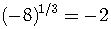
When is an odd
number, can be
positive or negative, and the root is a
real number.
For example,
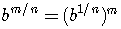
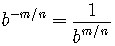
In general,
Note that  is not a real number because
is not a real number.
See Examples 1 - 4, pages 53 - 56.
For the definition of rational exponents in terms of radicals, see the next section,
Radicals.
top
next Radicals