Arithmetic
and Geometric Sequences
The simplest example of an arithmetic sequence is
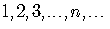
To get the sequence, start with the first term, add one to get the
second term, add one to the second to get the third term, and so on.
Arithmetic Sequence
A sequence  is an arithmetic sequence
if there is a constant  ,
called the common difference, such that
,
called the common difference, such that
 .
.
That is,
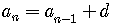 .
.
The simplest example of a geometric sequence is
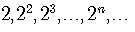
To get the sequence, start with the first term, multiply it by two to
get the second term, multiply the second term by two to get the
third term, and so on.
Geometric Sequence
A sequence
is a geometric sequence
if there is a nonzero constant  ,
called the common ratio, such that
,
called the common ratio, such that
 .
.
That is,
 .
.
See Example 1, page 814.
nth-term Formula for Arithmetic Sequence

nth-term Formula for Geometric Sequence

See Example 2, page 815.
Sum Formula for Finite Arithmetic Series
The sum of the first  terms is
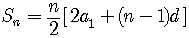 .
.
Notice that we can write
 .
.
The expression within the braces is just the expression for the nth-term
of an arithmetic sequence,  ,
so a second form of the sum formula is
,
so a second form of the sum formula is
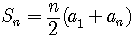 .
.
See Examples 3 - 5, pages 817 - 818.
Sum Formula for Geometric Series
The sum of the first
terms is
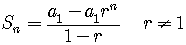 .
.
The nth-term of a geometric sequence is
 ,
so we can write the second term in the numerator as
,
so we can write the second term in the numerator as
 .
.
A second form of the sum formula is
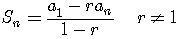 .
.
See Example 6, page 819.
Sum Formula for Infinite Geometric Series
Write the formula for the sum of the first
terms of a geometric
as two fractions,
 .
.
Let us study the behavior of the second term 
as the number of terms
increases beyond all bounds, that is,
as the number of terms in the series goes to infinity.
For  .
.
As  ,
,
 also
will blow up
also
will blow up
because raising higher and higher the power of a number
whose absolute value is greater than one produces numbers
bigger and bigger in magnitude.
For example,  gets bigger and bigger as
  gets bigger and bigger.
Similarly,  gets bigger and bigger in magnitude as
gets bigger
gets bigger and bigger in magnitude as
gets bigger
and bigger.
The sum of the geometric series blows up as the number of terms of the
series goes to infinity.
Conclusion:
The series diverges.
For  .
.
For  ,
,
the infinite series is  forever.
No matter how small  may be,
if you add together an infinite number of them the sum will blow up.
Conclusion:
The series diverges.
For  ,
,
the infinite series is 
The value will oscillate between  and
and  ,
depending on
,
depending on
whether the number of terms is odd or even, so the series does not
have a definite sum.
Conclusion:
The series diverges.
For  .
.
Raising higher and higher the power of a number whose absolute value
is less than one produces numbers smaller and smaller in magnitudes
that tend towards zero.
For example,
as
 and
and  .
.
Therefore, as
the term  ,
and
,
and
 ,
,
where
 The sum of an infinite geometric series.
Conclusion:
The series converges.
See Examples 7 - 8, pages 820 - 821.
top
next Binomial
Formula