Rules
Integrals of the Squares of sin x and cos x
Integration by Substitution
Power Rule
Rules for Indefinite Integration
1.] Constant Multiple Rule

where  is a constant
with respect to
is a constant
with respect to  .
.
We can move a constant that is factor to a position outside of the integral
sign.
Examples
a)

b) But in
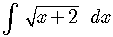
the  can not be
moved outside of the integral sign because the
is not
can not be
moved outside of the integral sign because the
is not
a factor in an appropriate product, an appropriate product being a product of
the form
 .
.
c) In
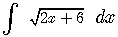
you can do algebra to rewrite the integrand so that it is in the appropriate
product form.
 .
.
The  is a constant
and a factor in a procduct.
is a constant
and a factor in a procduct.
We can use the constant multiple rule for integrals.

2.] Rule for Negatives

This is just Rule 1 with  .
.
3.] Sum and Difference Rule

We can distribute the integral sign across sums and differences.
Example
d)




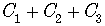 is a constant.
We can simplify the expression by letting

and writing the final answer as
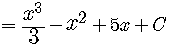 .
.
From now on, when possible, let's do this when we integrate.
See Examples 1 - 2, pages 323 - 323.
The Integrals of sin2x and cos2x


See Example 3, pages 324 - 325.
Integration by Substitution
The integral formula (Table 4.1, page 315)
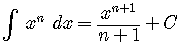
applies only when the integrand is precisely  .
.
It does not directly apply to
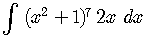
because what is being raised to the power 7 is not  ,
but
,
but  .
.
Also, there is the factor  ,
a factor which does not appear in the
,
a factor which does not appear in the
simple integral formula.
The integrand in the formula is just  .
.
However, the simple formula can be generalized to include this more
complicated integrand..
By the Chain Rule, if  is a function
of
is a function
of  ,
,
 ,
,
then

 .
.
Rewriting this in the context of antiderivatives, it becomes
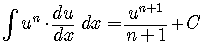 .
.
If we think of the differentials  on the left side of the equation cancelling, we get
the General Power Rule in integral differential form
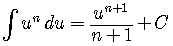
 .
.
This is the form of the Power Rule we need to work out
.
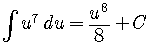
If we let  , then
  ,
so the integral is just
,
so the integral is just
 .
.
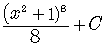
Back in terms of ,
this is
 .
.
The formulas in Table 4.1 involving
similarly can be generalized by
replacing by
and  by
by  .
.
For example,

generalizes to

Example
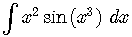
Find
 .
.
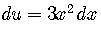
Let  , then
  .
.
The integrand already contains  ,
we only need a factor
,
we only need a factor  in front of it
to have the combination
 .
.
is a constant.
We can move constants back and forth across the integral sign
by the Constant Multiple Rule.
Multiply by
and divide by
to get the form we want.
Nothing, except the form of the integrand has changed, because
 .
.


 .
.
This is the final answer in terms of .
See Examples 4 - 9, pages 326 - 328.
next
Riemann Sums
and Definite Integrals
Top
