

(Saturday 3rd May 2003: Fuschia Room, Jabula Center, Sandringham)
Chris Els brought along his now completed skip truck.
The truck uses 14 batteries to run all the components including the infra red remote :
- There is a flashing led as the warning beacon on top of the cabin.
- There are two rams that extend down at the rear of the truck as stabilizers when the truck lowers the skip.
- The truck is infra red controlled for driving and steering using the Meccano infra red kit.
- A hydraulic system is fitted with two hydraulic rams raising and lowering the skip using a hydraulic pump system.
Workshop Crane Jig

Jan Jordaan brought along a scale model of a workshop crane building jig.
These frames are used in workshops to build sections of crane booms etc..
The jig ensures that the booms are true and all angles of bracing and frames etc.. are correct.
The above jig shows a section of a boom being built in it.
In real life this jig would be about 8 meters long and weigh about a ton.
4 Function controller


Dave Heathcote built a unit that uses a motor and a cut off switch to change a driven shaft output to 4 different outputs.
It is a 2 channel servo control unit that uses one channel to give power and the other to change to one of 3 power output shafts.
Meccano Graphs


Dave Heathcote also brought along two Meccanographs. He brought them in to show us how he has modified the one
to make a shorter Meccanograph. The smaller Meccanograph has the same mechanisms and dimensions as the larger
one, only it is shorter. The drawing plate is smaller though.
He said he did this as the larger one took up too much space!
Miniature blocksetter

Dave showed us the base of a miniature blocksetter crane that he has started on.
He comments that it looks simple, but it has taken a while to get this far.
Rolling ball clock
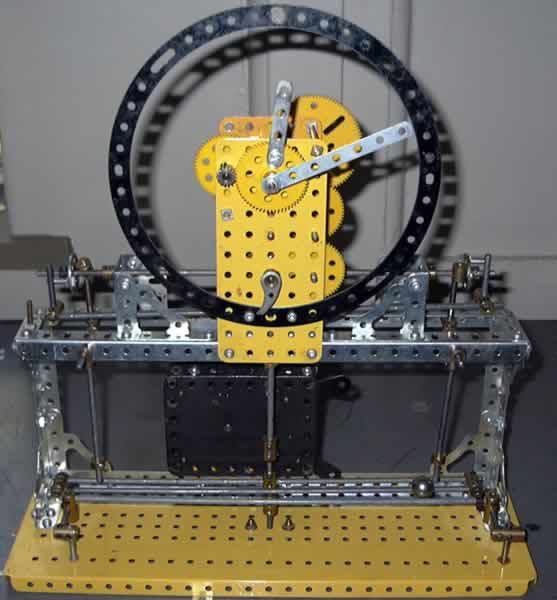


Daves rolling ball clock uses an rolling ball as the escapement actuator.
The ball rolls from left to right on the rods in the front of the clock. As the ball hits the rod on the end, it
activates the escapement.
The clock uses 1/60 of the power of a normal clock and it takes the ball 3 seconds to roll from end to end.
He comments that the clock is accurate to 5 minutes in and hour! This is due to the clock running slower
and slower as the clockwork motor runs down.
Rolling ball clock #2


This is a work in progress by Dave.
It is a rolling ball clock that uses an electromagnet to move the ball roller up and down.
A ball bearing rolls back and forth in the grooves of two angle girders on a pivot at the bottom of the first picture.
The electromagnet pushes the roller up and down to move the ball bearing along. The ball bearing acts as the escapement actuator.
It will be interesting to see how it progresses.
Plastic Man

A plastic man by junior member Werner Venter.
Winch

A winch mechanism by junior member Werner Venter.
Fowler Lion crane engine


Dick Anstee demonstrated a Fowler Lion crane engine, based on one that has been restored by Sandstone Estates.
The model was inspired by Dick's visit to the Great Working 400 in April 2002.
Dick has since returned to visit the owner of the original to show him his representation of the Fowler in Meccano.
Dick is pictured on the left with the owner on the right. In the background is the original Fowler.
Tram seats

Dick Anstee made a model of tram seats. He comments that he had yet to see a Meccano representation of this.
The idea is that the seats can be reversed when the tram runs back the other way on the track so that passengers can
always face forward.
They look pretty comfortable!
Horizontal Twin Cylinder Steam Engine
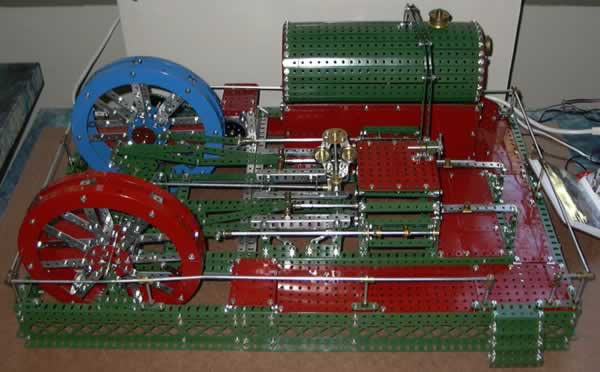
These engines were used to run generators to provide power to factories.
The flywheels have a ratchet system that allows them to coast to a stop as power to the electric motor is cut so as not to
strain anything on the model.
Differential Analyzer


Andries Botha had his model demonstrated in proxy by his colleague.
Andries has begun building a mechanical Differential analyzer out of Meccano.
Basically it is a mechanical device for calculating formulas.
The device consists of a few key components :
- Two input tables using a stylus reading a graph.
- The integrator. It is a series of round plates driving the gearing
- The torque amplifier. Used to amplify the output from the plates to the gears.
- The gears. The gears take care of the addition, subtraction etc..
- The output module.
The torque amplifier was demonstrated as well as the frame for the plates.
The first differential analyzer was built in 1930 at MIT.
In the 1930's two were built from Meccano, still in existence today.
One is kept at the Museum of London.
The other is at the New Zealand transport museum.
The third picture is an Meccano differential analyzer built by Tim Robertson.
Visit his website at www.meccano.us to get more information on these machines.

Spotted at the meeting, Dave Heathcote and his custom made Meccano Shirt!!

