| Name -
the word that means you |
When a baby is born, its
family gives it an important gift - its first name.
In Greece, first names are so important
that people celebrate name days instead of birthdays. Every person is
named after a saint and each saint has a special day. Greeks celebrate
their name day on the day of the saint for whom they are named.
|
|
A
newborn baby is given a special name |
| |
|
|
|
| Birthday |
The idea of putting
candles on birthday cakes goes back to ancient Greece. The Greeks
worshipped many gods and goddesses. Among them was one called Artemis.
Artemis was the goddess of the moon. The
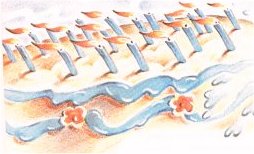
Greeks celebrated her birthday once each month by bringing special cakes
to her temple. The cakes were round, like a full moon. and, because the
moon glows with light, the cakes were decorated with lighted
candles.
|
|
A round
cake decorated with candles |
| |
|
|
|
| Happy
New Year |
For most people, the first
day of the year is January 1. But this was not always so. The ancient
Greeks started their year on the first day of Winter - December 21 or 22.
Then they changed the calendar and moved the start of the year to January
1.
Families in Greece share a New Year's cake
called peta. A coin is baked inside the cake. Whoever gets the coin is
supposed to have good luck for a whole year.
|
|
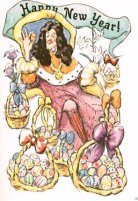
Wishing
happy new year with various presents |
| |
|
|
|
| Seasons |
Here is how according to
the Greeks we have the seasons.
Demeter, the goddess of farming had a
beautiful daughter named Persephone. Hades, god of the Underworld,
fell in love with her and carried her off. With lighted candle, Demeter
roamed the world in search of her daughter. While Persephone was with
Hades, all the world turned cold and barren. Nothing would grow. Finally,
Zeus, the king of the gods arranged for Persephone to return to her mother
for part of the year. Persephone's return was a sign of spring and
Persephone's absence was a sign of winter.
|

|
Changing
of seasons |
| |
|
|
|
| Independence
Day |
In Athens, the capital of
Greece, there is a big military parade on March 25 to celebrate
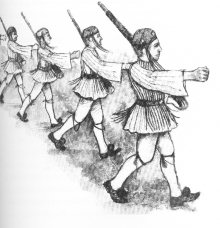
Independence Day. Among the marchers are the world-famous evzones. The
evzones are special and very colourful Greek soldiers. They wear a red cap
with a black tassel, a coloured vest over a white shirt, a white pleated
skirt over white tights, and red shoes with a black pompon at the toe |
|
The
marching of the evzones |
| |
|
|
|
| The Gods |
In Ancient Greece, the
Greeks believed there were lots of gods and goddesses. The important ones
were supposed to live on the highest mountain in Greece - Mount Olympus.
The Greeks believed the gods looked like humans but were immortal. The
gods looked after things such as war, wisdom, beauty and even music. |

|
Poseidon
was god of the sea. His brother Zeus was king of the gods. A third
brother, Hades, ruled the underworld. |
| |
|
|
|
| Greek
Olympics |
The Ancient Greeks'
favourite sport was athletics. The most important of the many sporting
competitions they made were the Olympic Games in honour of Zeus, King of
the Gods.
These were stopped by the Romans but in
1896 they began again. The first modern Olympic Games took place in
Athens. |

|
Ancient
athletes weren't awarded medals. They won wreaths of olive leaves and jars
of olive oil |
| |
|
|
|
| Mythical
animals |
The Greeks believed that
beasts with magical powers lived. These monsters often had mix-and-match
bodies - a body from one animal and a head from another. Centaurs had the
head and bodies of men and the legs of horses. The Minotaur had the head
of a bull and the body of a man. |

|
Mythical
monsters |
| |
|
|
|
| Snake
heads |
Gorgons were really
ghastly Greek monsters. They had huge wings, wriggling snakes for hair and
their eyes turned anyone who looked at them to stone. Gorgons were
beautiful women who upset the goddess Athena who turned them into hideous
monsters. |

|
Gorgon |
