
"I can teach you with a quip, if I've a mind; I can trick into learning with a laugh".
|
"I can teach you with a quip, if I've a mind; I can trick into learning with a laugh". |
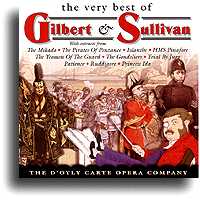
The Very Best of Gilbert and Sullivan
Excerpts from eleven of the operas - John Reed/Colin Wright/Valerie Masterson/Kenneth Sandford/Donald Adams/D'Oyly Carte Opera Company/various conductors (DECCA 460 010 2)
The most popular songs..as voted by the experts!!
 In February 1999 members of Savoynet, an internet mailing list dedicated to Gilbert and Sullivan, and related discussions, were given the opportunity of voting on what they considered were the most popular G & S songs in the canon. The results were very interesting. Many numbers that one would have thought were popular did not even get a look in.
The following is the list of what scored six or more votes. Check out whether your favourite is among them...
| H.M.S. PinaforeWe sail the ocean blueHours creep on apace |
The MikadoI am so proudBrightly dawns our wedding day |
| The Pirates of Penzance Ah leave me not to pinePoor wandring one |
RuddigoreMy eyes are fully open When the night wind howls |
| Patience I hear the soft note So go to him Sad is that woman's lot If Saphir I choose to marry |
The Yeomen of the GuardOvertureWhen our gallant Norman foesStrange AdventureFinale Act 2 |
| Iolanthe Overture Nightmare SongFinale Act 1 March of Peers |
The GondoliersOpening chorus/etcIn a contemplative fashion |
| Princess Ida Woman of the wisest wit World is but a broken toy |
Utopia LtdA tenor all singers Society has quite forsaken Eagle high |
The Nightmare Song from 'Iolanthe' was voted the most popular song over all.
In August 2001 members of Savoynet again were given the opportunity of voting on what they considered were the most popular G & S songs in the canon. Surprisingly there were not all that many differences between the original voting and this follow up.
Although we got a slightly larger return the voting was more concentrated. The following is the list of the numbers which scored six or more votes...
| PatienceAct 1 Finale (Incorporating 'I hear the soft note') |
RuddigoreWhen the buds are blossomingWhen the night wind howlsMy eyes are fully open |
| Iolanthe OvertureAct 1 FinaleThe nightmare songIf you go in |
Yeomen of the GuardIs life a boon I have a song to sing, OThe prisoner comes to end of Act 1Strange adventureWhen a wooer goes a-wooing |
| Princess Ida The world is but a broken toy |
The GondoliersTake a pair of sparkling eyes |
| The Mikado I am so proud The sun whose rays |
Utopia LtdSociety has quite forsaken |
The Finale to Act 1 of Patience was voted the most popular song over all. This incorporated several votes for just the Sestette.
Since the beginning of the century there have been many many recordings of the complete operas. Some are exceptionally good - some are fairly dull. Here follows a list of recordings of the complete operas now on Compact Disc. I have included mainly recordings made in stereo although there were many excellent ones made in the days of mono. In fact some were a lot better. I have noted these in my comments.
Soloists/Welsh National Opera/Sir Charles Mackerras. (1995) (TELARC)
* * * * Four Stars. This could have been the best recorded version of the Operetta but unfortunately it lacks the atmosphere and sparkle of the Gyndebourne recording. Richard Suart is an exciting Judge and bounces wonderfully through his opening song. Barry Banks and Rebecca Evans as the Defendant and Plaintiff are delightful.
Glyndebourne Festival/Sir Malcolm Sargent (1961) (EMI)
* * * * Four Stars. Full of atmosphere and wonderfully recorded this would get the full five star works if it was not for a disappointing George Baker as the Judge. Congratulations to the producers for the excellent stereo separation. I particularly like the chorus reactions and for once the Usher actually interrupts with his 'silence in court!'.
D'Oyly Carte/Isidore Godfrey (1964) (DECCA/LONDON)
* * * (*) Four Stars. An exceptionally strong cast makes this quite a good recommendation. Thomas Round is probably the best Defendant out there and John Reed is a delightful Judge. The soloists could have been placed a little more forward and there could have been some 'added' atmosphere. Coupled with the 1964 Yeomen of the Guard. (See below)
Soloists/BBC National Orchestra of Wales/Richard Hickox (2005) (CHANDOS)
* * * (*) Four Stars. A lively performance with one of the best choruses on disc - every syllable can be heard. There is a nice spacing of the soloists although the defendant remains on the left throughout as does the plaintiff on the right. James Gilchrist (Defendant) has a great voice and really seems to be enjoying himself. The Judge's song is taken at break-neck speed which works fine. The main problem with the production is the large orchestral forces used. Too many strings drown out some of Sullivan's marvellous wind orchestrations. Coupled with a lively, but generally disappointing, Cox and Box.
D'Oyly Carte/Harry Norris (1927) (EMI/SOUND ON CD)
One of the very best performances of 'Trial' on disc. A supurb cast lead by the very wonderful Leo Sheffield (Judge) and Derek Oldham (Defendant). The reproduction by Chris Webster is very full bodied and spacious. The surface noise has, for the most, been eliminated and all the soloists are crystal clear.
Coupled with the famous 1927 Gondoliers (see below).
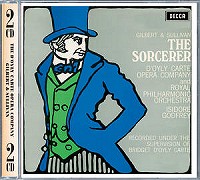
D'Oyly Carte/Isidore Godfrey (1966) (DECCA/LONDON)
* * * * * Five Stars. A very strong cast including Donald Adams as Sir Marmaduke and Valerie Masterson as Aline. John Reed makes a believable John Wellington Wells - every line of diction clearly heard. The opening of Act Two is absolutely stunning and a good place to demonstrate the recording. It will be hard to beat this performance.
D'Oyly Carte/Isidore Godfrey (1971) (DECCA/LONDON)
* * Two Stars. A very competent cast who sing all the notes but lack any emotion. All the dialogue is included which irritates as all sound as if they are at an afternoon tea party instead of being aboard one of Her Majesty's fleet. Christine Palmer as Little Buttercup really disappoints. We won't talk about the seagulls.
D'Oyly Carte/Isidore Godfrey (1959) (DECCA/LONDON)
* * * * * Five Stars. Always hailed as the definitive Pinafore this recording still stands the test of time. There is plenty of atmosphere and all the soloists shine. Thomas Round is, as always, excellent as Ralph Rackstraw and John Reed is ideal as Sir Joseph. All the dialogue is included however there is a very sizable highlights at budget price.
Glyndebourne Festival/Sir Malcolm Sargent (1958) (EMI)
* * * * Four Stars. A very well sung recording indeed. Monica Sinclair is probably the very best Buttercup on disc and John Cameron makes a very special Captain. For once the Glynebourne crowd really sound like they are enjoying making the recording. Orchestra and chorus are nicely balanced.
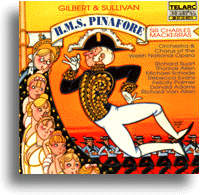
Soloists/Welsh National Opera/Sir Charles Mackerras. (1994) (TELARC)
* * * * (*) Five Stars. Complete on one CD this is everything you could want in a Pinafore and more. The singing is very polished with most of the cast very familiar to the repertoire. The orchestral playing is breathtaking - sample the Butterfly/Corcoran duet in Act two. The Overture cracks a very fast pace. Richard Suart is an excellent as Sir Joseph and Donald Adams is well cast (as usual) as Deadeye. It's great to have the women's chorus actually sounding 'out at sea' in Act One. The only minor complaint I have is there is a little lack of atmosphere.
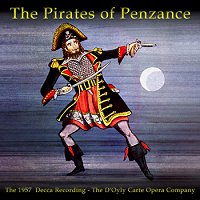
D'Oyly Carte/Isidore Godfrey (1957) (SOUNDS ON CD Licensed from DECCA/LONDON)
* * * (*) Four Stars. A classic recording and the one of the very first Gilbert and Sullivan recordings ever made in stereo. Unfortunately the production is marred by some dodgy tempi. The solo singing is all first-class with Thomas Round and Jean Hindmarsh (as Frederic and Mabel) being at their very best and the 'paradox trio' is absolutely superbly sung with some very hideous laughter from Ann Drummond-Grant as Ruth. Kenneth Sandford is excellent as the Sergeant of Police.
For my complete review of this recording check out the comments section on Chris Webster's website.
Glyndebourne Festival/Sir Malcolm Sargent (1961) (EMI)
* * * * (*) Five Stars. From the beginning of the Overture you sense a high spirited exceptional recording. George Baker is in his element as the Major-General and Monica Sinclair is a lovable Ruth. The slight disappointment is Richard Lewis as Frederic who sounds far more mature than his 21 years! The Pirates King's song, which needs to swagger along, is taken at an excruciating slow speed. Extra fill-ups on the CD feature four Overtures.
D'Oyly Carte/Isidore Godfrey (1968) (DECCA/LONDON)
* * * * * Five Stars. You can't get much better than this. Christine Palmer stands out as Ruth and you can understand every word of John Reed's Major-General. It is great to have Owen Brannigan as the Police Sergeant and Valerie Masterson is well cast as Mabel. Interesting is that if you don't mind missing the Act One finale, Ruth and Frederic's duet and the two Act Two trios you can pick up an almost complete recording at budget price.
D'Oyly Carte/John Pryce-Jones (1990) (JAY/SONY)
* * * Three Stars. This recording is worth having for the excellent orchestral playing and nicely positioned and sung chorus. The Chorus actually sound enthusiastic and involved in the action. The main problem are the soloists who just sing their parts and not much more. It would also help if they were a little closer to the microphone.

Soloists/Welsh National Opera/Sir Charles Mackerras. (1993) (TELARC)
* * * * (*) Five Stars. Complete on one CD (minus the overture). Sir Charles Mackerras directs a riveting performance with an exceptional cast. The numbers race along without any dragging tempos - witness the Pirate Kings song and 'How beautifully blue the sky'. A slight disappointment with Gillian Knight's Ruth - she sings well but lacks a bit in clear diction which everyone else seems to master OK.
D'Oyly Carte/Isidore Godfrey (1961) (DECCA/LONDON)
* * * Three Stars. Great diction. You get to hang onto every word. However the singing is not of the standard of the Glyndebourne version. Mary Sansom is disappointing in the title role. However Donald Adams as Colonel Calverley is dynamic and John Reed excels as Reginald.
Australian Opera/David Stanhope (1995) (EMI)
* * * Three Stars. Complete on one CD. This is a live recording made at the Sydney Opera House with an exceptionally strong cast lead by Dennis Olsen and Heather Begg. Christine Douglas as Patience has an exceptional voice but thinks she is singing opera instead of operetta. The chorus is a little ragged but does tend to adopt it's own personality in places.
Glyndebourne Festival/Sir Malcolm Sargent (1962) (EMI)
* * * * Four Stars. An excellent cast with the exception of John Shaw as Colonel Calverley who is very shaky and doesn't quite pull it off. George Baker is an exceptional Bunthorne. The orchestra is a delight with every detail of orchestration clearly recorded.

Glyndebourne Festival/Sir Malcolm Sargent (1959) (EMI)
* * * Three Stars. Exceptionally good singing especially in the Act One finale. George Baker is a strong Lord Chancellor but I prefer John Reed on the 1961 recording. John Cameron and Elsie Morison as Strephon and Phyllis are a little too strong in voice for their roles but they certainly seem to be enjoying themselves. Monica Sinclair is an excellent Fairy Queen - she certainly sends chills up the spine with her 'Take down our sentence as we speak it'.
D'Oyly Carte/Isidore Godfrey (1961) (DECCA/LONDON)
* * * * Four Stars.
Worth purchasing for John Reed's interpretation of the Nightmare Song. The whole production bounces along with an embarrassingly strong cast including Donald Adams, Alan Styler and Thomas Round. Mary Sansom is a little disappointing as Phyllis. Her voice not matching the others in the cast. Their is some exceptionally fine chorus work. One of the better D'Oyly Carte recordings.

D'Oyly Carte Opera Company/John Pryce-Jones (1991) (THAT'S ENTERTAINMENT)
* * * Three Stars. A recording where the orchestral playing almost upstages the singing. Certainly the best Peers chorus ever recorded. Philip Blake Jones as Strephon is fine in the faster numbers but disappoints in the slower. Richard Stuart is a fine Lord Chancellor but the singers really could have been recorded a little more forward.
D'Oyly Carte Opera Company/Sir Malcolm Sargent (1929) (ARABESQUE)
* * * * (*) Five Stars. This is quite the most exceptional recording of Iolanthe ever made. I mention it as it is almost a benchmark from which all others should be compared. George Baker is in his prime and Bertha Lewis is terrifying as the Queen of the Fairies. The only flaw in the casting is Winifred Lawson as Phyllis. Some might like her Munchkin like voice. This is strange as she possesses a lovely lyric soprano voice as her 1930 Patience proves. This recording is in the Public Domain and the Arabesque transfers are very good.
Sadler's Wells Opera/Alexander Faris (1962) (EMI/ANGEL)
* * * * (*) Five Stars. Note: Highlights only.
It is a shame that the complete performance of this opera was never recorded by the company as this would surely rate as one of the very best stereo recordings of the operetta. The cast are absolutely the cream of English singers of that period and the orchestral playing, chorus work and production are brilliant. Standout sections include Stanley Bevan's Spurn Not and a very melting Oh Foolish Fay from Heather Begg. This is coupled with the same companies complete recording of The Mikado. (see below)
D'Oyly Carte/Isidore Godfrey (1954) (SOUNDS ON CD Licensed from DECCA/LONDON)/ (NAXOS)
* * * (*) Four Stars. A classic recording from the fifties. Still holds up well even today. Some top soloists make this recording a joy to listen to. Thomas Round has an exceptional tenor voice and such simple pieces like "Ida was a twelve month old" are sung with much genuine conviction. Donald Adams is the most powerful Arac on record, Peter Pratt is a delight as King Gama, and Fisher Morgan, as King Hildebrand, has the most stunning voice I have heard for some time. Leonard Osborn, as Cyril, makes the most of his kissing song but is a bit too masculine in his solo in "Merrily rings". Of the women Muriel Harding as Lady Psyche is an authoritative teacher with perfect diction. Victoria Sladen has a few problems with the top notes in "Minerva" but has a very strong voice. The chorus are a fraction too recessed. There are a few cuts.
I did a comparison between the Sounds on CD and the Naxos transfer. I was
surprised at how good the Naxos transfer was. Much better than many of their
previous efforts. There was a nice ambiance around the voices of both issues
and a superbly clean sound on both discs. However the orchestral recording
was a trifle cleaner on the SOCD recording. For some unexplained reason I
noticed a little harshness on the Naxos - especially in the Act 1 finale. I
also noticed that Act 3 of the SOCD version was much cleaner than the
Naxos - I do not have an answer - maybe the Naxos remastering for this Act
was done at a different time. Try 'Whene'er I spoke' and you will notice the
difference.
The interesting fillup on the Naxos was the 1931 Columbia highlights which I had not heard before (I don't own a copy of the SOCD transfer of this). I found the transfer first-rate with the voices projecting well.

D'Oyly Carte/Sir Malcolm Sargent (1965) (DECCA/LONDON)
* * * Three Stars. A little bit more guts is needed to make this recording really succeed. Everything is nicely sung, except Kenneth Sandford, as King Hildebrand, who is very breathless. With the exception of Philip Potter (Hilarion) and John Reed (Gama) there seems to be a lack of emotion all round. Although the orchestra is well recorded the same cannot be said for the chorus. An excellent fill up with the Pineapple Poll ballet performed by the Philharmonia conducted by its creator, Sir Charles Mackerras.
Ohio Light Opera/J. Lynn Thompson (2000) (NEWPORT CLASSICS)
* * * (*) Four Stars. Although totted as a live recording this must have been recorded at rehearsals as there is no audience presence. This recording contains all the dialogue and also includes 'Come mighty must' which is not on the above recording. Generally a great all-round cast. Elaine Fox, as Lady Blanche, needs more power and Peter Castaldi, as Arac, struggles in his Act 3 song. Ted Christopher, as King Gama could be a bit more aggressive. Christopher Swanson, as Cyril, is a delight in his 'Kiss me' song. The dialogue does grow tiresome on repeated listenings.

D'Oyly Carte/Isidore Godfrey (1957) (SOUNDS ON CD Licensed from DECCA/LONDON)
* * * * * Five Stars. By far the best recording of the work ever made. Thomas Round is the greatest Nanki-Poo on record, likewise Donald Adams's Mikado and Kenneth Sandford's Pooh-Bah - the latter in far better voice than the 1973 version. The original recording had some bad orchestral passages and odd studio noises. These have now been cleaned up and lovingly re-mastered.
For my complete review of this recording check out the comments section on Chris Webster's website.

Glyndebourne Festival/Sir Malcolm Sargent (1957) (EMI)
* * * Three Stars. The first of the series of Glynebourne recordings conducted by Sargent. Like the Gondoliers the tempos are on the slightly slower side but the singing is first class, too much in fact. All treat the work as opera instead of operetta. Still Elsie Morison is a delightful Yum-Yum and it's good to have Owen Brannigan in the title role even though he is not very frightening. Sir Geraint Evans does not appeal as Ko-Ko. Others might disagree.
Sadler's Wells Opera Company/Alexander Faris (1962) (EMI)
* * * Three Stars. A nicely recorded version with a strong cast. All sound as if they are thoroughly enjoying themselves. Denis Dowling (Pooh-Bah) has one of strongest voices but lacks emotion. Clive Revill revels in the part of Ko-Ko and his scenes with Jean Allister as Katisha are a joy. The orchestra is nicely balanced but there is a little distortion at the arrival of the Mikado. Highlights from this recording are available on EMI's Classics for Pleasure.
D'Oyly Carte/Isidore Godfrey (1973) (DECCA/LONDON)
* * * (*) Four Stars. A standard performance from the Company. John Ayldon is a electrifying Mikado - almost an equal to the classic Donald Adams interpretation of 1957. John Reed is moving in the 'Tit Willow' song and Valerie Masterson is a sublime Yum-Yum. Disappointing is Kenneth Sandford (Pooh-Bah) who is unusually weak. Nice orchestral sound.
Soloists/Welsh National Opera/Sir Charles Mackerras. (1991) (TELARC)
* * * * (*) Five Stars. The first of the series of Mackerras recordings with the Welsh National Opera. Anthony Rolfe Johnson is ideal as Nanki-Poo and Marie Laughlin is a charming Yum-Yum. In fact it is good to have a trio of excellent singers in the roles of the three little maids. Anne Howells must be the best Pitti-Sing on disc. Richard Suart is, for me, not a Ko-Ko I would keep coming back to. With the exception of the Overture, and a couple of small bits, this fits onto one CD.
D'Oyly Carte/Isidore Godfrey (1936) (HMV/SOUNDS ON CD)
* * (*) Three Stars. A classic recording with both some stand out performances and some disappointing ones. A final chance to hear the wonderful tenor Derek Oldham and one of the first recordings with Martyn Green in the 'patter' role. Darrell Fancourt is admirable in the title role and Marjorie Eyre makes a wondefully devious Pitti-Sing. Josephine Curtis (Katisha) is in terrible voice and should not have been recorded. The Chris Webster/James Lockwood transfer is satisfactory with no hint of surface noise and a nice sound spread.
D'Oyly Carte/Isidore Godfrey (1962) (DECCA/LONDON)
* * * * Four Stars. From the opening of the Overture there is a sense of excitement with this recording. The men are in top form (Kenneth Sandford is particularly creepy as Sir Despard) and the little disappointments are with the women who sing well but without interest in what they are singing. They could have been placed a little more forward as well. There are some cuts but the original overture is included in between the Acts.
D'Oyly Carte/Isidore Godfrey (1950) (SOUNDS ON CD)
* * * * (*) Five Stars. One of the greatest D'Oyly Carte performances...ever! Underrated Ann Drummond-Grant (Mad Margaret)is excellent. Her Act One scene is certainly one of the best recordings I have ever heard her do. Martyn Green is in his element. Take for example the "As pure and blameless peasant" section in the Finale to Act One. You can actually hear the change in his voice as he takes on his new role as the bad Baronet. Not to be missed.
For my complete review of this recording check out the comments section on Chris Webster's website.

New Sadler's Wells Opera/Simon Philpps (1989) (THAT'S ENTERTAINMENT)
* * * * Four Stars. The most musically complete of all the recordings. Most of the cast are in top form. David Hillman as Richard gives just the right amount of accent and Linda Ormiston makes a nicely tamed Mad Margaret in Act 2 although she (and the others) lose it in the Matter Trio. There is a small chorus which suits the performance. The major disappointment is Thomas Lawlor as Sir Roderic...oh, only if Donald Adams had been available. The tempos are on the fast side which I normally wouldn't criticise but are not welcome in the madrigal scene at the beginning of the Act One finale. The recording is nicely balanced.
Glyndebourne Festival/Sir Malcolm Sargent (1963) (EMI)
* * * * (*) Five Stars. Loaded with atmosphere and possibly the best sung recording of Ruddigore. The finale to Act One is almost in demonstration class. Every word is clearly heard. Owen Brannigan is a terrifying Sir Despard and Elsie Morison is delightful as Rose. The disappointments are few. Pamela Bowden struggles with Mad Margaret and the Act Two 'Matter' trio really needs the old hands of the D'Oyly Carte to make it work. The CDs are filled out with music from The Tempest and The Merchant of Venice.
Soloists/Welsh National Opera/Sir Charles Mackerras. (1995) (TELARC)
* * * * (*) Five Stars. One of the best recordings of this operetta. 'I have a song to sing O' is sung very lightly and floats beautifully over the speakers. The most moving account of this duet on CD. Felicity Palmer and Donald Adams have great fun with their 'Rapture Rapture' duet. This would be the last recording Donald would make. He died in 1996. Every note of the orchestration is clearly heard. The only slight disappointment is Pamela Helen Stephens as Phoebe who doesn't quite seem to understand her 'Were I thy bride' solo.
Soloists/Academy St Martins in the Fields/Sir Neville Marriner (1993) (PHILIPS)
* * * Three Stars. Not my favourite recording of this operetta. Bryn Terfel as Wilfred has no idea of what his character is all about - he sings well but can't act and I dislike Thomas Allen as Jack Point. There are a few really poignant moments. I really loved 'When a wooer goes a-wooing' and Kurt Streit's 'Is life a boon'. The orchestral sound is very veiled. The complete work is available as a twofer (2 CDs for the price of one).
Glyndebourne Festival/Sir Malcolm Sargent (1958) (EMI)
* * * (*) Four Stars. This is a very operatic Yeomen which certainly suits the work and gives the soloists an opportunity to shine. Sir Geraint Evans makes a better Jack Point than a Ko-Ko (see above) and 'When a wooer goes a-wooing' is very moving. It's nice to feel Sargent's hand with the excellent orchestral detail.
D'Oyly Carte/Isidore Godfrey (1964) (DECCA/LONDON)
* * * (*) Four Stars. An above average recording with some nice solo work and excellent orchestral playing. John Reed is an emotional Jack Point but 'I have a song to sing O' is taken too fast. Gillian Knight as Dame Carruthers struggles with her diction especially in her first number. A nice performance by Ann Hood as Phoebe. Kenneth Sandford makes the most of his role as Shadbolt. There is a couple of distortion problems in some of the loud passages. Coupled with the 1964 Trial by Jury.
D'Oyly Carte/Isidore Godfrey (1979) (DECCA/SOUNDS ON CD)
* * * Three Stars. This was the final studio recording mde by the original D'Oyly Carte Company. It is an adequate performance of the operetta but suffers from some over-the-top multi miking which doesn't help with recording the ensemble numbers where it is difficult to make out any of the words at all...with fast tempos things turn quite horrid. Solo items work so much better. Barbara Lilley is exceptional as Phoebe and John Ayldon is a perfect Sergeant. His duet with Patricia Leonard (Dame Carruthers) is a delight. Also included is the often ommitted 'Laughing Boy'. John Reed certainly tries to draw the sympathy of the listener and I think successfully at that.
D'Oyly Carte/John Owen Edwards (1993) (THAT'S ENTERTAINMENT)
* * * * Four Stars. Musically the most complete recording of the operetta. This includes two numbers that were deleted after the first performances and an earlier version of 'Is Life a Boon'. Nicely recorded with with some pleasant singing. Terence Sharpe as Meryll and Gary Montaine as Wilfred stand out. Some might object to Fenton Gray's cockney Jack Point but I like it.

Glyndebourne Festival/Sir Malcolm Sargent (1957) (EMI)
* * * * Four Stars. A very successful recording of a very difficult operetta to cast. So many major roles requiring an excellent group of soloists. John Cameron and Richard Lewis stand out as the two brothers. This recording almost makes the grade except for a few sluggish tempos including a lack lustre Cachucha which needs a boot up the bum!
D'Oyly Carte/Isidore Godfrey (1961) (DECCA/LONDON)
* * Two stars. Possibly the worst recording of a G & S Opera that the D'Oyly Carte Company ever made. Even though The Gondoliers is a really difficult Operetta to cast there is really no excuse for the really bad singing that takes place on this recording. It sounds very much over rehearsed. Jennifer Toye and Jeffrey Skitch struggle through their Act One duet and Mary Sansom is intolerable as Gianetta. Thomas Round and Alan Styler as the two Gondolieri are excellent, as is Kenneth Sandford as the Don. Act Two comes together better. If you don't want the dialogue, the Overture or the long Act One opening you might just as well buy the budget release of highlights.
D'Oyly Carte/John Pryce-Jones (1991) (THAT'S ENTERTAINMENT)
* * * (*) Four Stars. A much preferable recording to the D'Oyly Carte listed above. The soloists are all excellent although I much prefer John Reed's Duke of Plaza-Toro to Richard Suart's very laid back characterisation. John Rath, as Don Alhambra, makes sure every word is clearly articulated. David Fieldsend struggles at the end of "Take a pair of sparkling eyes" (which sounds like it was recorded at the end of a heavy vocal session). The women are generally agreeable - Jill Pert makes a great Duchess, and Elizabeth Woolett is one of the best Casildas on record. The strength of this performance is the orchestral playing which is superb.
D'Oyly Carte/Harry Norris (1927) (EMI/SOUNDS ON CD)
* * * * (*) Five Stars. The most perfect Gilbert and Sullivan recording on record. The most difficult of their operas to pull off this is one marvellous exception and should be in every devottees collection. The dream cast are lead by Henry Lytton (Duke) and Bertha Lewis (Duchess). The words take a new meaning when these Savoyards perform these roles (as close to what you would have heard at the first performances). Aileen Davis is an excellent Tessa and Arthur Hosking makes the most of the small role of Luiz. Chris Webster has enhanced an original transfer by James Lockwood. Surface noise is at a minimum but I am not completely happy with the transfer work having been witness to some of the magnificent work Chris has done with recordings made even earlier.
D'Oyly Carte/Royston Nash (1975) (DECCA/LONDON)
* * * (*) Four Stars. Nicely recorded with some fairly outstanding singing. Meston Reid is excellent as Captain Fitzbattleaxe and is well supported by Pamela Field as Princess Zara. John Reed and John Ayldon clown their way through their roles as the Utopian Court Judges. Kenneth Sandford strains a bit in Act One but manages the Christy Minstrel number OK. David Porter as Mr Blushington should never have been allowed into the recording session. Two Overtures and a suite from Victoria and Merrie England make an attractive filler.

Ohio Light Opera/J. Lynn Thompson(2001) (NEWPORT)
* * * * Four Stars.
The first complete recording which includes all the dialogue. Nicely recorded with some excellent singing and orchestral playing. Tony Thomann and Lucas Meachem stand out as Scapio and Phantis. Tim Oliver, as Captain Fitzbattleaxe, also stands out and his 'tenors above' song is superb. A much better performance than Meston Reid in the D'Oyly Carte recording above. J Lynn Thompson should be credited for keeping the performance tight and moving it along at a cracking pace. Unfortunately the dialogue does tire with repeated hearings spoilt mainly by the cast declaiming it as if they are performing Shakespeare.
D'Oyly Carte/Royston Nash (1976) (DECCA/LONDON)
* * * * Four Stars. The Grand Duke has so many solo roles that it would be difficult to make a successful recording. The D'Oyly Carte team almost succeed. Kenneth Sandford, singing sotto voce, is excellent as Ludwig. The chorus sound really refreshed - obviously enjoying some new material instead of the standard fare. The recording is well balanced and every bit of orchestral detail can be heard.

The Prince Consort, Edinburgh/David Lyle (2000) (DIVINE ART)
* * * (*) Four Stars. The first complete (without dialogue) recording of this work. Recorded in Edinburgh in June 2000 with the finance and help of the Sir Arthur Sullivan Society. A totally committed recording with some excellent singing and orchestral playing. There are some rough spots (the results of trying to cram an entire opera recording into just one day) but this is made up for by the enthusiasm of the large cast.
The Prince Consort, Edinburgh/David Lyle (1985) (PEARL)
* * Two Stars. The first complete (without dialogue) recording of this work. Disappointing, not helped by a distinct tape rumble throughout. The voices are quite recessed which sound as if the microphones were placed towards the back of a hall. Sometimes the voices disappear completely as in the Act 1 Quartet "I'm the Sultan's vigilant Vizier." Christine Watson (Sunbeam), Mary Timmons (Rose-in-Bloom) and Richard Bourjo (Hassan) stand out from the soloists. The chorus are confident. The orchestra are generally very good. However there is some badly recorded percussion.
Soloists, Southwark Voices. Hanover Band/Tom Higgings (1999) (BBC)
* * * (*) Four Stars.
The highlight of this performance is the excellent orchestral playing bringing out every nuance of Sullivan's delicious score. All the soloists are very competent but lack enthusiasm which is a shame as this recording has everything going for it. I think the problem is a lack of rehearsal time. Try as I might I had great difficulty understanding the lyrics. Sally Harrison (Rose-in-Bloom) stands out vocally and Richard Suart tries to do something with his role. The fill-up on these CDs are an excellent collection of Overtures with an outstanding Mikado.
The Prince Consort, Edinburgh/David Lyle (1982) (PEARL)
* * (*) Three Stars. This is one work that really needs a professional recording. There is a vast improvement in the singing and recorded sound over the Prince Consort's Rose of Persia (above). The disappointment here is the orchestra which is just embarrassing in places. There is also an obvious audience so sections must have been recorded at performances as well as rehearsals. The singing is exceptionally first class. Mary Timmons and Jinty Smart stand out among the women. Alan Borthwick has an excellent tenor voice. Tempos seem to favour the slightly slow side and some numbers need to performed in more of an Irish jig style.
A Gilbert and Sullivan Gala (1994) (CBC RECORDS)
* * * * (*) Five Stars. An excellent compilation featuring some of the very best Canadian singers, plus the ever talented Richard Suart in the patter roles. The recording starts with one of the best recordings of the Iolanthe Overture that I have heard, wonderfully executed by the Winnipeg Symphony Orchestra conducted by Bramwell Tovey. All the performers sound as if they are thoroughly enjoying themselves. Tempos are very brisk and its great to hear clearly every word of the Nightmare Song as sung by Richard Suart. Maureen Forrester melts the soul in her two big arias (Iolanthe and The Mikado). This almost perfect recording is spoilt by a silly version of Three Little Maids (sung in falsetto by Stuart and Tovey) and some irrelevant snippets of dialogue.
Golden Moments From Gilbert & Sullivan (1993) (READER'S DIGEST)
* * * * (*) Five Stars. One of the very best collections available. Nine or so items from six of the popular operettas with a handful of Overtures thrown in. The chorus and orchestral playing is superb and James Walker keeps the tempos racing.
The standout collection must be The Pirates of Penzance with such an excellent group of soloists its a shame they didn't record the whole of the opera - even Kenneth Sanford performs a bright paced Pirate King. Donald Adams as the Sergeant is excellent.
The Iolanthe excerpts are equally appealing. Much is made of the chorus work and John Cartier is excellent as the Lord Chancellor. In Patience Donald Adams plays the part of Bunthorne which he would not do on stage.
The highlight of the whole set must be Anthony Raffell's cut-wrenching laugh in the Mikado's song.
The only disappointments are the omissions. No "Tit-Willow" or "Never mind the why and wherefore". No Gondoliers Gavotte and only two numbers from Act One of Iolanthe. Also why only a small part of the Patience overture is included I know not why.
A Gilbert and Sullivan Gala (1983 & 1985) (HMV CLASSICS)
* * * (*) Four Stars. Twenty seven tracks of the most popular songs, duets and trios from the operettas. All are performed with panache by four talented soloists: Valerie Masterson, Sheila Armstrong, Robert Tear and Benjamin Luxon. Those items recorded in 1985, conducted by Richard Hickox, are the better recorded with a more natural ambience. The earlier items have a slightly boxed in sound. The women seem to be in better voice in the slower numbers.
|
Check out the worst CD cover...ever!
|
Check these out!
A Gilbert & Sullivan Discography.
Check out Marc Shepherds excellent discography for a comprehensive list of all Gilbert & Sullivan recordings ever made.
The Gilbert & Sullivan Archive.
For a comprehensive list of everything Gilbert & Sullivan check out Jim Farron's excellent archive.
