KIDNEY HOME
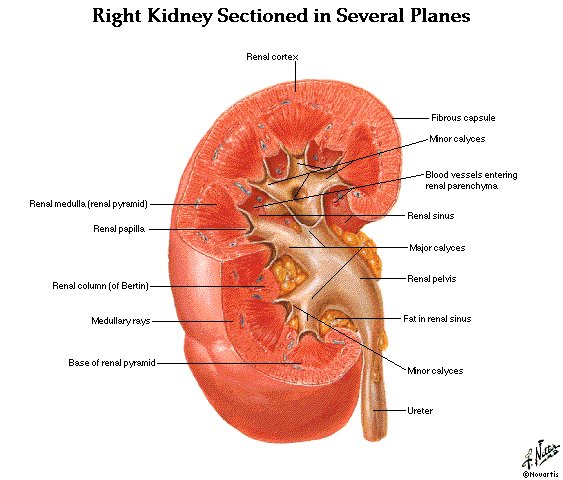
The outermost layer of the kidney is called the cortex. Beneath the cortex lies the medulla, an area that contains between 8 and 18 cone-shaped sections known as pyramids, which are formed almost entirely of bundles of microscopic tubules. The tips of these pyramids point toward the center of the kidney. The cortex extends into the spaces between the pyramids, forming structures called renal columns. At the center of the kidney is a cavity called the renal pelvis.
The task of cleaning, or filtering, the blood is performed by millions of NEPHRON, remarkable structures that extend between the cortex and the medulla. Under magnification, nephrons look like tangles of tiny vessels or tubules, but each nephron actually has an orderly arrangement that makes possible filtration of wastes from the blood. The primary structure in this filtering system is the glomerulus, a network of extremely thin blood vessels called capillaries. The glomerulus is contained in a cuplike structure called Bowman’s capsule, from which extends a narrow vessel, called the renal tubule. This tube twists and turns until it drains into a collecting tubule that carries urine toward the renal pelvis. Part of the renal tubule, called Henle’s loop, becomes extremely narrow, extending down away from Bowman’s capsule and then back up again in a U shape. Surrounding Henle’s loop and the other parts of the renal tubule is a network of capillaries, which are formed from a small blood vessel that branches out from the glomerulus.
TOP KIDNEY HOME