Who were "ordinary people?"
In truth, most of what we know regarding life in the 1830s evolved through the experiences and recollections of white, middle-class or upper middle-class Americans. It is mostly through their eyes that we begin to reconstruct American society of 170 years ago...1. In the 1820s-1830s, most working Americans lived on farms or in small towns.
2. The family, defined as a husband and wife, with or without children, was the basic building block of society.
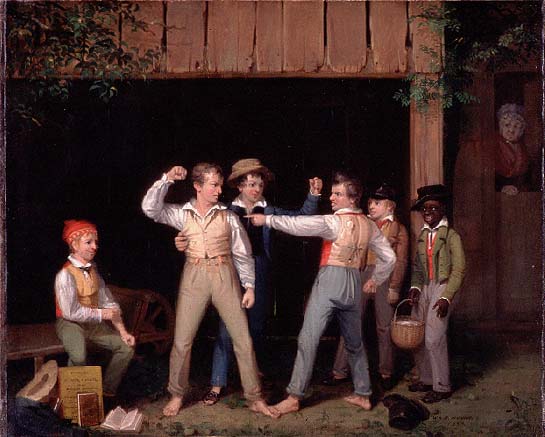
3. American society was heavily striated--far more so than today. Different elements of society had a formal or informal "pecking order," and once born into a particular class or social structure, only a few people moved up the social "ladder." Most Americans dwelled in only one or possibly two social classes for their entire lives.
4. The country also demonstrated deep devisions between sections, particuarly North and South. Southerners regarded New England "yankees" as narrow-minded, self-centered, tight-fisted, and snobbish. Northerners regarded their Southern bretheren as oafish, sloppy, dirty, and careless of speech, habits, and in matters of temperence. By the 1830s the Nation also experienced division between East--with its cities, roadways, infrastructure, and indoor "water closets"-- and the West, known for its rough, roguish, buckskin-clad ways and deep suspicion of new-comers.
5. The concept of so-called "civil rights" was essentially unknown in 1830s America. While the election of Andrew Jackson to the presidency ushered in the so-called "Age of the Common Man," the benefits of this "age" were almost exclusively restricted to white males. Although technically barred in the "Northwest Territory," slavery and the keeping of African slaves was practiced in nearly every state and territory. Indian people were regarded in nearly the same light. Women's right to vote would not become a reality until after the turn of the Twentieth Century.
6. Likewise absent from average 1830s life was virtually every convenience modern people take for granted: electricity, central heating and air-conditioning, running water, flush toilets, automobiles, radio, washers and dryers, plastics, processed foods, antibiotics, aspirin, formal education, and so forth. In the 1830s, the fastest thing most Americans knew was a race-horse; the most powerful thing many Americans knew were the huge grinding millstones at the local grist mill. A rough-and-ready man one might well have been described as "half-horse an' half-alligator"-- these being the best available comparisons of size, toughness, endurance, and striking power from their known natural world!
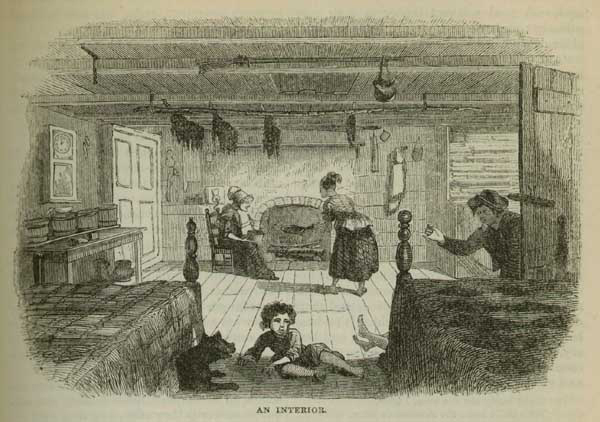
| "We had to make out with very little, as almost every article used about the house had to be brought from Virginia to Kentucky on pack-horses. Our tableware consisted of pewter plates, pewter dishes and spoons, and japanned tin tumblers. We made much use of gourds for drinking cups. Our cooking utensils were a small dinner pot, oven, skillet, and frying-pan. Our bread was always corn bread, mostly baked on a board and called johnny-cake, or in the ashes, when it was called ash-cake. Our meat, consisting of bear meat, turkey, venison, squirrel, quail and fish, was often roasted before the fire."
--- Elijah Isles, Early Life and Times in Kentucky, Missouri, and Illinois. |
| “To go to housekeeping in a clean new log cabin with a bright, young husband—healthy, cheerful, hopeful, with six plates, as many cups and saucers and spoons (not silver), a rocker, two chairs, a bedstead, a cooking stove, “with a bright hearth and a hearth swept clean” was by no means an unhappy lot… But, after all, it was a hard life, especially for the young wives and mothers. …Far from her early home, from mother father, sisters, friends, it needed a stout heart and a patient spirit to preserve her spirit from unlovely repining.”
--- Laura Chase Smith,
|
|
"I have thus been particular in my description that you may, in imagination, look at two handsome young gentlemen seated at table with 'Squire and lady, Peggy and Polly. Six was the number usually at log cabin tables, for the reason that six plates, one platter, six knives and forks, six tin cups--or, possibly among the more aristocratic, six cups and saucers-- constituted the table outfit. On a little bench in the corner of the cabin stood the water bucket, with a gourd, for drinking. It was the custom for each one, after being satisfied with the solids of the table, to walk to the bucket, and take their last course from the gourd. Then, while the younger scions were scrambling for what remained on the table, the older members of the family---both male and female-- would seat themselves comfortably around the fire with each a pipe, showing their own inventive genius. Several varieties might be seen on such occasions, but the most common was a piece of corn-cob dug out for the bowl of the pipe, with an alder quill inserted for the stem.
---Christiana Holmes Tillson, 1822.
|
|
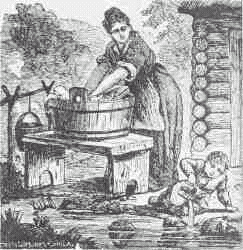
Friday was Mother’s washday, and then, when the duties of the field were not urgent, I left it for the house. A long trough dug out of the trunk of a tree stood under the back eaves to catch the rainwater for washing, and during the times of drought, when a shower came up all the wash tubs and buckets of the house were set out. …Mother’s rule was to begin early and finish by noon. My additional duties were to keep the fire going, take care of the children, and assist in hanging out the clothes which, for want of a line was often done on the fences. To bring them in at night, when they were generally froze in winter, was still more my business. ---Daniel Drake, Pioneer Life in Kentucky. |
|
Our most important manufacture, Mother’s and mine, was soap making. Father constructed the “ash hopper” which was composed of clapboards, arranged in an inverted pyramid. In the bottom were thrown some husks, or straw, or dry buffalo grass, to act as a strainer. It was filled with ashes, on the broad surface of which the water was, from time to time, poured by the bucketful. A trough beneath received the lye which, over a fire in the yard, was boiled down until it was strong enough to float an egg. The fat was then added, and the boiling continued until the soap “came.” By the aid of salt, we sometimes made an imperfect hand soap, to be used for special purposes.
---Daniel Drake, Pioneer Life in Kentucky. |
|
The first insight I had in the border society was the Fourth of July celebration... It was to occur at the old Harris place, below the portage, three miles from town. The crowd was the curious medley that could be imagined—only a fanciful pen could describe the scene. Several very polished persons were present; but it was the contrast that made it original… Of miners with uncut hair, red flannel shirts, and heavy boots drawn over their pants, there were a great number, all eager to dance and enjoy themselves to the worth of their money; but I must say to their praise, that they all behaved like gentlemen.
---Mrs. Adele de Perdreauville Gratiot,
|
|
Much trouble was apprehended from the Indian tribes generally, who were jealous at the encroachment of the emigrants, especially in the region of the Lead Diggings. The emigrant, settler, hunter, and trapper never parted with their trusty rifle either day or night. Weapons were an essential part of a man’s costume— his daily, yes his constant companions— they were in the hands of the traveler, the homes of the hardy squatter, and had there been any sanctuaries in the Territory then, I believe they would have been found in the pulpits. The rifle provided food for the hunter. It also executed the arbitrary law of the land—self defense, and its decrees were final.
--John Fonda, Michigan Territory. |
More Readings and Insights...
Baths, Brush Heads, Beards, and Two Pronged Forks by Jack Larkin, OSV
The American Woman of the Nineteenth Century.
1830s eating! Click here for a selection of period receipts.
Click here for more period receipts!