Realoving Orchids Shoppe









|
|
|
|
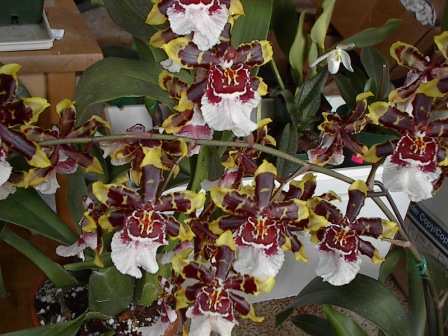
Cultural Information for the THE ONCIDIUM ALLIANCE From Greek onkos. tumor or swelling -refers to warty callus of the lip Among the most popular of all orchids, the oncidiums can be found in the wild from South Florida and the Bahamas through the Caribbean and the Lesser Antilles, as well as from Mexico throughout Central and South America, to Argentina and many points in between. With several hundred species in this interesting genus, there is usually some selection to satisfy the whim of every grower. Plants range in size from the small equitant (fan-like) species such as Onc. heneckenii (The Bumblebee Orchid) to huge specimens like Onc. altissimum (The Golden Shower Orchid), or from the terete-leaved Onc. cebolleta to the leathery, 'mule-ear' type, Onc. splendidum . Flowers are generally colored with combinations of yellow and brown, although there are some with highlights of red and or maroon. Generally, species and hybrids of the following genera may be grown following the cultural guide detailed below: Aspasia, Brassia, Gomesa, Maxillaria, Miltonia, Oncidium, Ornithocephalus, Rodriguezia, and Zygopetalum. Realize that this cultural information is provided as a guide only: adaptation must be made to suit your particular cultural environment. Specific cultural information may be obtained from the publications suggested under 'Recommended Reading'.
GENERAL CONDITIONS Oncidiums are tolerant of moderate conditions and will adapt well to an intermediate house even though they might be ideally suited to culture in a cool or warm house. A cultural program which is successful for cattleyas often proves very satisfactory for oncidiums with minor adjustments in watering or lighting practices.
TEMPERATURE Unless you can specifically accommodate the temperature requirements of individual plants, the intermediate house or moderate conditions should prove satisfactory. Maintain temperatures of 75°-85°F. (24°-3O° Celsius) during the day and 55°-6O°F. (13°-16° Celsius) at night. Higher or lower temperatures may be tolerated, but these could have an adverse effect on growth.
LIGHT Temperature and light are two closely related factors. In fact, these in turn are related to humidity and watering practices. To follow this relationship, realize that with more light one can normally expect higher temperatures and a requirement by the plant for more humidity to keep leaf surface temperatures at tolerable levels to avoid burning. The plants' physical characteristics provide some clues as to what light intensity may be required or tolerated. For example, Onc. jonesianum and cebolleta both have pencil-like leaves, suggesting a great tolerance for high light, while Onc. maculatum and flexuosum both have thin, ribbon-like leaves which obviously would burn in high light In addition,Onc. splendidum, cavendishianum, stramineum, and retemeyerianum all have thick, fleshy, 'mule ear' leaves, also indicating a tolerance for bright light. The equitant (variegata type) species and hybrids have tightly arranged clasping leaves which suggest a tolerance for high light, although experience has shown better cultural performance results when the light provided is only slightly brighter than that recommended for phalaenopsis culture. WATER, POTTING MEDIA, CONTAINERS As indicated above, watering practices must be adjusted according to light and temperature conditions, i.e. water less frequently or low light and cooler temperatures, and vice versa. In addition, attention must be given to the potting medium when deciding how to water. The oncidiums are intolerant of excessive water and simply will not do well if the medium is not well drained. Therefore, when using an organic medium for these epiphytes, pay close attention to be sure the osmunda, tree fern, or fir bark is not decomposed, resulting in poor drainage and or poor aeration in the root area. Charcoal or rock may also be used for potting media and generally will not present drainage or aeration problems; of these two, only the small, graded charcoal bits provide consistently successful results as desirable as the organic materials. During the growing season, oncidiums require abundant water. However, as growth is completed, a two or three week rest period should follow to allow the growths to mature. Generally speaking, the growing season extends from March to October. When repotting is necessary, do this just as the plant is beginning to make new growth. While most oncidiums will do well in pots. Some large-growing types such as altissimum, sphacelatum and wydleri should be transferred to a wire or wooden basket. Others, such as the equitant type species and hybrids, and maculatum, onustum, stramineum, jonesianum, cebolleta or stacyi, may be successfully grown on cork bark or tree fern plaques. FERTILIZER Plants which require abundant water usually need more fertilizer to offset the effects of leaching. Use 20-20-20 at the rate of one tablespoon/gallon every 10-14 days during the growing season (March-October) for plants in/on tree fern, osmunda, or cork bark. Use 30-10-10 at the same rate and frequency for plants in fir bark, charcoal, or stone. TlPS Many bulbous oncidiums prefer to be undisturbed for as long as possible, often becoming pot bound. However, do repot before the medium deteriorates to the point that drainage and air circulation are impaired with resulting root loss. The Butterfly Orchids, Onc. kramerianum and Onc. papilo, will bloom successively from the same inflorescence; do not remove the flowering stem after flowering is completed.
Pricing
|
|
Send mail to
realoving@rogers.com with
questions or comments about this web site.
|