Realoving Orchids Shoppe








|
|
|
|
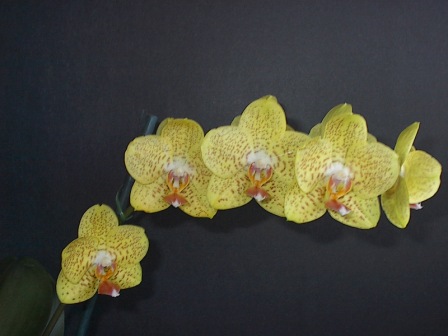
Phalaenopsis
PhalaenopsisPhalaenopsis are ideal houseplants under warm conditions. Well-grown plants can flower often, sometimes with a few flowers throughout the year. Average home temperatures and conditions are usually sufficient. Flower stems on certain hybrids can be forced to rebloom by cutting the tip off after the initial flowering. Only healthy plants should be induced to flower repeat-edly. Light-Bright light is important, but most windows are sufficient. GIVE: Bright light, very little direct sun. In the home, an east, shaded-south or west window. In a green-house, about 15% to 30% of full sun. Leaves should be a medium green. Temperature-Extreme cold is not tolerated, but fall nights to 55°F encourage flowering. GIVE: nights of 60° to 65°F; days of 70° to 95°F. Increase water, air movement and humidity when above 85°F. Seedlings need 5° to 10° higher. Greatly fluctuating temperatures cause buds to drop. Water GIVE: Don’t allow to dry completely; let just reach complete dryness in pot before watering. Seedlings need more constant mois-ture. Mist in home in the morning if air is dry. A humidity of 50% to 80% is desirable. Do not let water stand on leaves overnight or for any lengh of time. Fertilizer—Must be provided on a regualr basis since potting media have little. GIVE: In summer- 30- 10-10 at recommended rates. In fall, or when blooming - 10-30-20 may be alternated with standard fertilizers. PhalaenopsisPhalaenopsis the moth orchid, is one of the best orchids for growing in the home, and is also a favorite with green-house growers. Culture for Dorotis; a related genus, and Doritaenopsis, a hybrid between the two genera, is the same as for pure Phalaenopsis. LIGHT is easy to provide for pha-laenopsis. They grow easily in a bright window, with little or no sun. An east window is ideal in the home; shaded-south or west windows are acceptable. In dull, northern winter climates, a full south exposure may be needed. Artificial lighting is excellent. Usually four fluorescent tubes in one fixture are placed 6” to 1’ over the leaves, 12 to 16 hours a day, following the natural daylength. In a greenhouse, heavy shade must be given; 70% to 85% shade, or between 1,000 to 1,500 foot-candles, is optimum. No shadow should be seen if you hold your hand one foot above the plant’s leaves. TEMPERATURES for Phalaenopsis should usually be above 60°F at night, and range between 75° and 85°F or more during the day. Although higher temperatures force faster vegetative growth, higher humidity and air move-ment must accompany higher tempera-tures, the recommended maximum being 90° to 95°F. Night temperatures to 55°F are desirable for several weeks in the fall, in order to initiate flower spikes. Fluctuating temperatures can cause bud drop on plants with buds ready to open. WATER is especially critical for pha-laenopsis. Because they have no major water-storage organs other than their leaves they must never completely dry out. Plants should be thoroughly watered and not watered again until nearly dry through the pot. In the heat of summer in a dry climate this may be every other day; in the winter in a cool northern greenhouse, it may be every ten days. Water only in the morning, so that the leaves are dry by nightfall, to prevent rot from occurring on the leaves. HUMIDITY is important to phalaenopsis, the recommended humidity being between 50% and 80%. In the home, set the plants on trays of gravel, partially filled with water so that the pots never sit in water. Mist the plants in dry cli-mates, or during dry weather, in the mornings only. Grouping plants together raises the humidity by conserving the water that plants transpire. In humid climates, as in greenhouses, it is imperative that the humid air is moving to pre-vent fungal or bacterial diseases. Again, leaves should be dry as soon as possible, always by nightfall. FERTILIZER should be applied on a regular schedule, especially if the weather is warm, when the plants are most often growing. Twice-a-month applications of high-nitrogen fertilizer (30-10-10, or a similar formulation) are appropriate in warm, humid conditions. When flowering is desired a high-phosphorus fertilizer (10-30-20, or a similar formulation) may be applied to promote blooming. Some growers apply fertilizer at 1/4 strength with every watering; this is best for warm, humid conditions. When cooler, or under dull conditions, fertilizer should be applied once a month.
POTTING is best done in the spring, after blooming. Phalaenopsis plants must be potted in a well-draining mix, such as fir bark, tree fern, various types of stone, sphagnum moss, or combinations of these. Potting is usually done every 1 to 3 years. Mature plants can grow in the same pot until the potting medium starts to decompose usually in two years. Root rot occurs if plants are left in a soggy medium. Seedlings usu-ally grow fast enough to need repotting yearly, and should be repotted in a fine-grade medium. Mature plants are potted in medium-grade medium. When mature, a plant may stay in the same pot size for many years, but must have the medium changed. To repot, remove all the old medium from the roots, trim soft, rotted roots, and spread the remaining roots over a handful of medium in the bottom of a new pot. Fill the rest of the pot with medium, working it through the roots so that the junction on of the roots and the stem is at the top of the medium. Keep the plant shaded and humid, but drier in the pot, for several weeks to promote new root growth. A vitamin B1 solution may be helpful in establishing plants. Pricing
|
|
Send mail to
realoving@rogers.com with
questions or comments about this web site.
|