 |
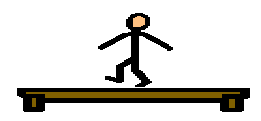
| individualized approaches updated in a regular basis, based on ongoing assessment. They also believe that regardless of one’s area of specialization, to acquire the ability to deal with a whole range of challenges faced by the population with ASDs, a team of professionals working with people with ASDs should be trained in a generalist model. This interdisciplinary model minimizes the likelihood of professionals developing a fragmented view of the child. The Theory of Mind was generated in the 1970’s, in London, by Beate Hermelin, Neil O'Connor, Lorna Wing, and others trained in cognitive psychology. They suggested that all autistic individuals exhibited three impairments: social interaction withothers; verbal and non-verbal communication; and play and imaginative activities. They felt that autism was caused by a developmental disturbance, characterized by the lack of a true concept of or feeling for, the other’s and their own mind. As stated, autistic people do not understand that individuals have their own thoughts about the world, which affects abstract skills acquisition such as pretend play. They called it a lack of "theory of mind". The Miller’s Method is a cognitive-developmental intervention developed over the last 30 years, (Miller, 1998) . It is based on the premise that autistic children often lack a sense of their own existence and their options. Miller believes that many of the strange behaviors or rituals are failed efforts to explore and make sense of the surroundings. The Miller method‘s main goal is to facilitate both awareness of self as an entity and the realization that there are available options and choices. To help develop self and body awareness, it focuses on physical activities such as introducing rough actions between the therapist and the child or placing the children on elevated structures which force an improved body organization and create a situation of better alertness regarding the surroundings. Depending on the child, the therapy will focus either on helping the child open up to understand how a series of activities lead to a desired outcome by performing the series of activities in different locations, with different people, presented figuring out what the activities are that would help him reach an objective by training the child to engage in more than one activity at a time. They repeatedly interrupt an activity the child is engaged in, to soon come back to it. The Miller method, however appealing, lacks empirical validation. As currently recognized, even among the highest functioning (or Asperger types), autism is a neuro-physiological syndrome with primary implications for the area of socialization. During the last few decades a new generation of relationship-based approaches has emerged. Creative interventionists seek to improve interpersonal skills such as affect and attachment, or bonding. To face the challenge of raising Raun, their autistic son, the Kaufman family developed an approach that was published in 1976 in the book Son- Rise. To develop rapport, the Kaufman’s decided to "celebrate any contact or connection he |
 |
| was able to make”. They selected the least distracting room of their home as the spot they spent most of the time with Raun. To understand Raun’s world, and demonstrate their unconditional love, they initially followed his lead and imitated his actions. Building on what motivated him, the parents, were then able to expand on Raun’s knowledge and helped him develop interpersonal relationships. As reported, after intensive work for a period of three and a half years, Raun’s “diagnosis” of autism did not exist any longer. The Kaufman’s have a training institute, but reports on positive outcomes by others are limited. Sally Rogers from the University of Colorado suggests that imitation and play skills need to be taught to many autistic individuals because they will not tend to learn these under more naturalistic circumstances. She has adopted a behavioral-cognitive system to help children play in simulated social situations. Another relationship-based approach is Gentle Teaching. It is based on the premise that adults need to unconditionally accept the individual with autism, and interact with warmth so that a bond will develop. In this approach, inappropriate behavior is redirected or ignored, and activities are modified for the individual with autism to be able to succeed. Attempts to cooperate are rewarded. McGee documented a study done by the Medical Center of the University of Nebraska in 1980-1985 in which Gentle Teaching was implemented with a group of 73 adults, 86% of whom exhibited self injurious behaviors. As reported, upon discharge none of the adults demonstrated these behaviors. This positive status persisted, according to McGee, over the five year follow-up of the study. The Greenspan Floor Time approach (acknowledging that children’s activities often occur on the floor, therapists are encouraged to establish reciprocal partnership there), has as initial goal to engage the child in spontaneous pleasurable activities. “Circles of communication” are built gradually. Assuring that it is essential for an interaction to be positive. As postulated by this approach, if an adult directed relationship fails to engage the child in meaningful interactions, there is a potential there for increased opportunities to fail in relating to others, intensifying the child’s difficulties in this area. Floor Time therapists often create obstructions to the child, such as moving a favorite toy to a place that the child can see but not reach, generating a need for the child to interact with the adult. Carol Gray’s Social Stories is a tool that provides children with autism spectrum disorder with an opportunity to understand social situations and to learn about appropriate behaviors. Summary: In recognition that there is no one approach that benefits all people with autism, the Birch Western Queens STEPS program has selected an eclectic and multi-disciplinary approach geared to assess the child’s strengths and motivations in an on-going basis. These are used to gradually increment the child’s skills. Parents are welcomed to become an active and influential member of the team. Our selected behavioral/cognitive interventions include the TEACCH model, ABA, PECS and other augmentative methods of communication, relationship based approaches, and sensory integration interventions. Parents receive training for them to apply similar interventions at home. |
| Some of the Icons used in this article were created with the Boardmaker program from Meyer-Johnson |