| The Picture Exchange Communication System (PECS) is a sophisticated augmentative method of communication, based on Applied Behavioral Analysis practices. It was developed in the 1980s by Lori Frost & Andrew Bondy at the Delaware Autistic Program to facilitate communication by children who are either nonverbal or have severe communication deficits. It is composed of six progressive phases of non-verbal communication, moving from teaching the child to initiate communication by requesting a desired object after discriminating its visual representation and exhanging it, to its last phase of spontaneous commenting in sentences. All this with the help of pictures or printed words. For PECS to be effective, staff and parents are trained to honor the child’s request with immediacy. While people who use PECS do not ignore the power of verbal communication, they prefer not to ‘waste student’s time’ by forcing it. Taking advantage of the strengths and child’s preferences they help to generate communication that is useful with immediacy, allowing exposure to success and fostering acquisition of new learning. Many clinicians use augmentative methods of communication in an eclectic approach, examples of people who have created their own respective systems are Barbara Bloomfield and Carol Goosins. It is important not to ignore the impact that affective, socioenvironmental and cognitive issues have on people with ASDs. In the USA legal standards require an individualized educational approach, based on a comprehensive evaluation of each person with a learning disability. The influence of different approaches (particularly those that use aversive responses) on the child’s emotional development and his/her self-esteem has not been explored by research. Donna Williams is an individual with autism who, in her biographical book “Nobody, Nowhere”, presents the reader with her naive interpretations of reality and her internal world of confusion. She is constantly exposed to danger, feelings of anxiety and irrational phobias. Williams’ book shows her psychological makeup, which, in her case is the result of a deplorable combination for anybody's emotional stability: confusion created by her own senses together with the |
 |
| Exclusive use of behavioral techniques might be limiting for most of our students with ASD, who are able to benefit from other approaches |
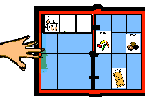 |
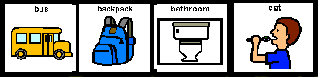
| lack of protection coming from an insensitive, unstable and neglectful environment. Cognitive theories claim that people are less as dependent on environmental forces than orthodox behaviorists believe, and less as dependent on their early history and unconscious drives than psychoanalysts believe. Our ability to think and to be creative makes us less dependent on mechanisms that are predetermined either by heredity or by the environment, allowing us a great deal of free will. Integrating views from cognitive psychology, social learning theory, and psychodynamic approaches, the cognitive-behavioral model explains human functioning as the product of interaction between personal and environmental variables. It provides a rationale for differentially altering cognition, behavior, affect, and interpersonal and social situations. It is believed that there is a reciprocal influence among behaviors, cognitions and emotions. A change in any one factor would, therefore, affect all the other factors. Before the Federal law IDEA was legislated, in 1972 the state of North Carolina passed legislation that enabled students to obtain accurate diagnostics and access to public schools using Individualized Educational Programs. The Treatment and Education of Autistic and related Communication handicapped CHildren (TEACCH) program was selected as the universal service to be provided throughout the state. The TEACCH’s approach was originally developed in the early 1970s by Eric Shopler as a clinic-based program at the school of medicine at the University of North Carolina. It is currently directed by Gary Mesimov. It started with a small number of children and their parents. Sensitive to the environment of hostility towards parents, and aware of its demoralizing effect on all the members of the family, one of the initial assignments of Division TEACCH demonstrated by research that parents could collaborate effectively in a co-therapy role. In recognition of the importance of maximizing the learning experience, TEACCH supports a structured teaching system, and adopted a behavioral-cognitive approach. They state that ASD manifests with unique characteristics that generate a culture of it’s own. This implies that programs for people with ASD require adaptations that sometimes need to be considered for a life time. As they explain it, it is universally recognized that a nearsighted person has the right to be prescribed glasses measured to correct his individual myopia. Similarly, an individual with autism should be allowed to participate in an environment that is personally adjusted to maximize her or his level of independence. One needs to focus not only on providing educational and clinical interventions to help the student improve skills, but also has the responsibility of engineering the environment to compensate for the deficits of autism, and specifically adjust it to the developmental level of each participant in the program. Division TEACCH mentions four components as helpful to reducing the need for guidance or redirection: 1) a clear organization of the room with distinct areas for different activities, 2) visual schedules that clarify the sequence of activities for the day, 3) work systems arranged with consistent and clear visual cues to help the children independently carry out their tasks, and 4)) individualized tasks, selected by the teacher/parent/clinician, using skills that are already mastered. Motivation to work should increase with the successful completion of the task. Once that system is clear, students learn to generalize from one task to another, and can perform new tasks adequately. Division TEACCH advocates the use of |
 |
 |