INTRODUCTION
Industry requires large amounts of water for their processes. Only a small fraction of it is incorporated in their products and some of it is lost by evaporation, while the rest of the water is released as wastewater. This wastewater contains organic pollutants as the major constituent and inorganic salts as dissolved solids. If this untreated wastewater is let into the water course, it severely effects the quality of the stream. This wastewater may contain toxic metals that directly effect the aquatic life or may contain nutrients that stimulate the growth of aquatic weeds or may have a high demand for dissolved oxygen resulting in anaerobic conditions. Under anaerobic conditions H2S gas is produced which produces offensive odors. Thus to protect the environment from the undesirable toxic materials the wastewater must be suitably treated before discharge to neutral streams.
Pharmaceutical industry produces various types of products ranging from vitamins synthetic drugs to antibiotics. The production process in a pharmaceutical industry involves manufacture of various constituents of drugs for bulk drug manufacture. The volume of waste generated in bulk drug manufacture is higher than in formulation. In formulation, extraction and fermentation the wastewater comes mainly from washing operations consisting of carbohydrates and formulating materials. Organic synthesis generates various types of effluents like acidic, alkaline, organic and inorganic effluents in a combined form. These effluents from a pharmaceutical industry or more precisely from a bulk drug manufacturing industry contain mainly organic components .
Advantages of biological treatment:--
Biological treatment has several advantages over physico-chemical options in treating such wastes apart from its ease of handling and economic feasibility. The reaction specificity of the microorganisms in a biological treatment permits selective enrichment of microorganisms for the degradation of target compounds. Also, as reported by Koziorowski and Kucharski clarification in settling tanks or chemical coagulation cannot be employed to remove BOD completely. In case of waste taken from synthetic drug units, chemical treatment may be necessary to neutralize the acidic waste or segregation of toxic elements like cyanide, phenol etc., but it is found to be ineffective in BOD and COD removal . Thus, a biological treatment and more preferably a suspended aerobic growth system is the desired treatment mechanism for an effluent from a pharmaceutical industry. The choice of an aerobic system over anaerobic system lies in the fact that a pharmaceutical industry produces a large volume of water coupled with a high concentration of BOD, COD and TDS.
Keeping in view the economy, time and efficiency, an aerobic treatment system is recommended for a pharmaceutical waste. This is due to the presence of aerobic organisms with a high respiration rate, which acclimatizes and treats the waste in a short period of time than in an anaerobic system (ref).
OBJECTIVE:
The objective of the present work is to treat the wastewater from pharmaceutical industries located in Hyderabad using an extended aeration system. By varying the F/M (food to microorganism) ratio and hydraulic retention time (HRT) the optimum conditions for obtaining an efficient system in terms of COD removal in treating the pharmaceutical waste is selected.
Experimental Setup:
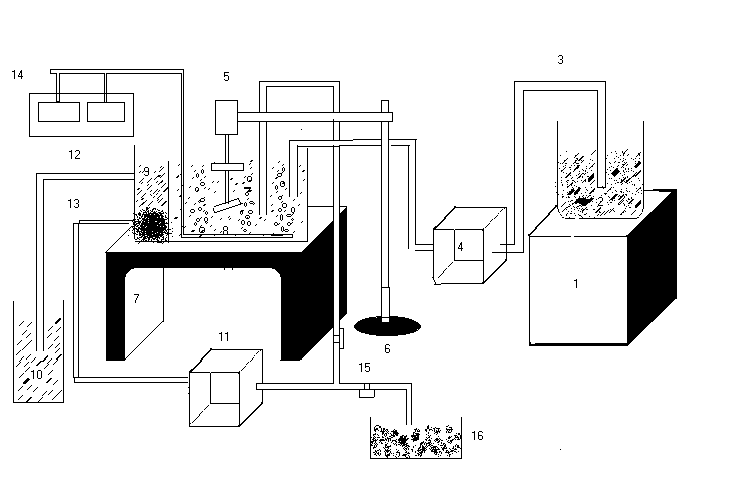
The experimental setup consists of an aeration tank of 9.2 liters and settling chamber of 1.8 litres. The settling chamber is attached to the aeration tank on width side making the unit a combined one. Using air pumps aeration is provided at the rate of 70lits/hr such that the dissolved oxygen content in the reactor is maintained between 1.5mg/l to 3mg/l. With PVC tubes submerged aeration is facilitated at the bottom of the reactor. Continuos mixing is provided using a stirrer consisting of two vanes and having a variable speed. The speed of the stirrer is fixed at 20rpm. Two peristaltic pumps are used in the process. Peristaltic pump 1 is used to feed the waste to the reactor and peristaltic pump-2 is used for activated sludge recirculation to maintain a constant MLSS concentration. Fig 1.0 shows the schematic diagram of the experimental setup.
1. influent tank stand
2. influent tank
3. influent line
4. peristalitic pump for inlet
5. stirrer
6. stirrer stand
7.reactor stand
8. aeration chamber
9. settling chamber
10. treated effluent
11. peristalitic pump for sludge recirculation
12. effluent line
13. recirculation line
14. air pumps
15. sludge wastage line
16.sludge collection chamber
Source Of Wastewater:
The source of wastewater is from the central collection unit of a common effluent treatment plant. The composition and characteristic of the waste is given in Table 1.
TABLE1: CHARECTERISTICS OF PHARMACEUTICAL WASTE:
|
PARAMETER |
CONCENTRATION |
|
pH |
8.14 |
|
COD (mg/l) |
7360 |
|
BOD (mg/l) |
1960 |
|
Total solids (mg/l) |
14950 |
|
Dissolved solids (mg/l) |
14000 |
|
Suspended solids (mg/l) |
950 |
|
Chlorides (mg/l) |
5955 |
|
Nitrates (mg/l) |
13 |
|
Ammonical Nitrogen(mg/l) |
600 |
|
Sulphates (mg/l) |
2118 |
|
Phosphates (mg/l) |
78 |
|
Alkalinity (mg/l) |
3700 |
The experiments are carried out with synthetic sample for developing the biomass in the reactor. Then the experiments are carried out with the industrial effluents. The composition of synthetic feed used for the reactor startup is given in Table 2.
TABLE 2: COMPOSITION OF SYNTHETIC FEED:
|
COMPONENTS |
CONCENTRATION (mg/l) |
|
pH |
7-7.4 |
|
GLUCOSE |
30,000 |
|
UREA |
125 |
|
KH2PO4 |
2500 |
|
NH4CL |
7500 |
|
K2HPO4 |
1000 |
|
NAHCO3 |
5500 |
Experimental Design:
The experiments are carried out by varying the parameters F/M ratio, MLSS and hydraulic retention time. The range of study is given in Table.3.
TABLE.3 STUDY PARAMETERS
|
PARAMETER |
RANGE |
|
COD concentration range |
1100-6500 (mg/l) |
|
F/M ratio |
0.05, 0.1, 0.15 |
|
MLSS |
2000, 3000, 4000 (mg/l) |
|
HRT |
3.5 & 5 days |
The biomass was acclimatized to the wastewater under laboratory conditions by increasing the concentration of COD from 500 mg/l to 1000 mg/l over a period of 10 days. The BOD: COD ratio of 0.4 – 0.6 (by diluting the pharmaceutical wastewater with sewage) and COD: N: P ratio of 100:5:1 was maintained in the influent through out the experimental studies. Micronutrients were also added through out the study.
The activated sludge process is monitored daily for the following parameters
RESULTS AND DISCUSSIONS:
Reactor Startup:
The startup of an activated sludge unit is considered to be one of the most significant operations. In order to start an activated sludge reactor an active seed is required. The seed required for the present study was procured from the sludge recirculation line of an existing unit. The seed was brought to the laboratory and allowed to stand for 24 hours. Around 1.5 litres of thick sludge was taken and introduced into the reactor. Three litres of synthetic feed with COD concentration of 500 mg/l was given and the reactor was left for about 48 hours. Subsequently, the reactor was filled to its total volume with synthetic feed of 1000 mg/l COD concentration. When a constant reduction of COD was obtained, the reactor was made continuous with the synthetic feed of 1000 mg/l of COD concentration. After 48 hrs of running the synthetic feed, pharmaceutical waste of 500 mg/l COD concentration was fed to the reactor followed with feed of 1000 mg/l of COD concentration. When a constant reduction in COD and increase in MLSS was observed the acclimatization of seed sludge to the waste under laboratory conditions was confirmed. The time taken for the operation is about 7 - 10 days.
Treatability Studies:
Chemical Oxygen Demand
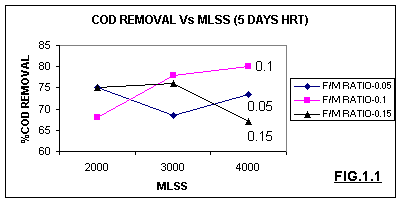
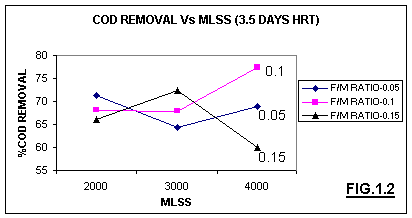
The performance of an extended activated sludge process can be best explained on the basis of COD and BOD removal efficiencies. In order to determine the treatability of pharmaceutical waste, effluent COD was monitored continuously. Fig. 1.1 & 1.2 shows the COD reduction at varying F/M ratios and MLSS concentration for 5.0 days & 3.5 days HRT. It can be observed from the fig 1.1 that for a 5.0 day HRT, COD removal efficiencies followed a particular trend. At an F/M ratio of 0.05, COD removal varied between 68-75%. It was observed that COD removal was over 70% for MLSS concentration of 2000 mg/l & 4000 mg/l while 68% reduction was observed at 3000 mg/l.
Further at F/M ratio of 0.1, COD removal increased with increase in MLSS concentration. It can be inferred from the fig 1.1 that 68%, 78% & 80% reduction was observed for 2000 mg/l, 3000 mg/l & 4000 mg/l. However at an F/M ratio of 0.15, COD removal efficiency decreased with increase in MLSS. About 75% removal was observed at 2000 mg/l & 3000 mg/l and COD removal reduced to 67 at 4000 mg/l. Thus at HRT of 5 days high COD concentration were found to be inhibitory for microbial activity, however between 0.05 and 0.10 treatability was found to be effective indicating optimum range for effective biological treatment.
The COD removal efficiency at 3.5 days HRT for all the F/M ratios ranged between 60-70%. At lower F/M ratios i.e., 0.05 and 0.1 to maximum treatability was achieved indicating effective microbial activity. However at 0.15 F/M ratio, the removal efficiency was effective upto 3000 mg/l MLSS concentration but drastically reduced to 60% at 4000 mg/l MLSS concentration (4500 mg/l of COD) indicative of reduced microbial activity due to formation of intermediate secondary metabolites.
Biochemical Oxygen Demand:
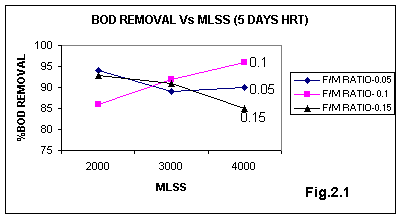
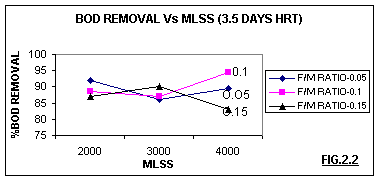
The BOD of the outlet and inlet was monitored for all the concentrations considered for the study. From fig. 2.1 & 2.2 it is evident that BOD removal for all the concentrations both for 3.5 days and 5 days HRT was above 90% except in few cases indicating high BOD removal efficiency of the acclimatized bacteria. The observations are in good agreement with COD and SVI values.
Sludge Volume Index
The SVI is used as an indication of the settling characteristics of the sludge. However the index value that is characteristic of a good settling sludge varies with the characteristics and the concentration of mixed liquor solids.
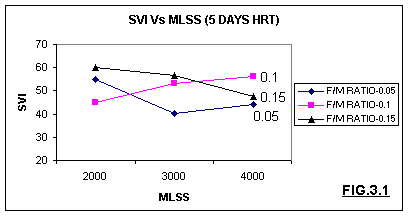
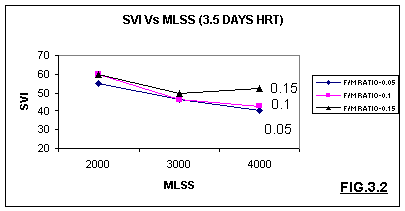
The sludge volume index was determined continuously for each F/M ratio considered for the study. Fig. 3.1 and 3.2 shows the SVI at each F/M ratio with varying MLSS concentration. It is evident from the graph that SVI values were in good agreement with the reduction efficiency. At F/M ratio of 0.05 (5 DAY HRT) the SVI values decreased with increase in MLSS and COD concentration. A maximum SVI value of 55 was reported at 2000 mg/l and further validated by good COD reduction. At 0.1 F/M ratio the SVI value were greater than 45 for all the MLSS concentration and a maximum of 56 was reported at 4000 mg/l indicating good sludge characteristics.
Further at an F/M ratio 0.15, the SVI values ranged between 48-60 with 4000 mg/l MLSS reporting the lowest SVI. This sudden decrease in SVI from 57 at 3000 mg/l to 48 at 4000 mg/l can be attributed to the inhibitory effect caused due to high COD loading. Thus SVI values at 0.10 and 0.15 F/M ratios except for 4000 mg/l MLSS concentration at 0.15 F/M were in good agreement with reduction efficiency of the system. The SVI represented a similar trend for 3.5 days HRT also. The SVI values ranged between 40-60 indicating good to moderate sludge characteristics. At an F/M of 0.05 SVI values range between 40-55 with maximum SVI value comprehending maximum removal (2000 mg/l MLSS). At an F/M of 0.1 the SVI values for all the 3 concentrations ranged between 43-60. Further at 0.15 F/M ratio SVI values were found to be uniform for all the three concentrations indicating good sludge characteristics. However 0.05 and 0.1 F/M ratios showed good COD reduction with moderate SVI values and thus considered to be the optimum F/M range at 3.5 days HRT.
Oxidation Reduction Potential (ORP):
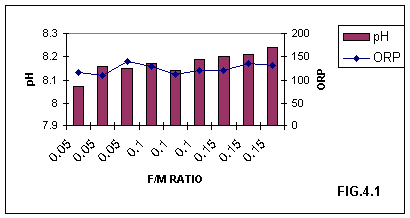
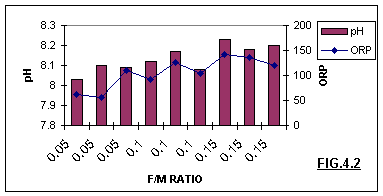
Many of the chemical and the biochemical processes encountered in industrial waste treatment can be described fundamentally as oxidation reduction system which depends on the activity of the microbial consortia Although the measurement of the redox potential does not explain the nature of the system, it is useful in the evaluation of magnitude, characteristics and process change. ORP is determined electrometrically with instrument resembling, that of measuring pH, that is expressed as millivolts. ORP is quickly observable and invaluable index in the control and diagnosis of problem or malfunction of wastewater treatment process. When the ORP is between +400mv and –20mv aerobic system prevails (14). In the present study ORP was continuously monitored and was observed to be between 50mv – 150mv throughout the study confirming the optimum aerobic conditions prevailing in the reactor.
pH:
All water solutions of acid and base owe their chemical activity to their relative hydrogen and hydroxyl ion concentrations in water (6). Biological systems are dependent on the pH change, which are brought about by the oxidation and reduction of various substrates in the process. Activities of microorganisms are more in a specific pH value. Aerobic systems work in a pH range of 6.5 - 8.5.
The pH of the effluent from the process was continuously monitored through out the study. It is observed to be between 8.0 - 8.25.
CONCLUSIONS:
The present study revealed the biotreatability of the pharmaceutical wastewater after initial acclimatization of the waste under laboratory conditions. It can be concluded from the results of the present study that treatability efficiency of pharmaceutical wastewater was found to be optimum between 0.05 and 0.10 at 2000 MLSS for 3.5 days HRT and between 0.10 and 0.15 at 3000 MLSS for 5 days HRT. BOD reduction of 90% and above in almost all the concentrations studied reveals high biodegradability of the pharmaceutical waste. SVI Values between 40-65 was observed for all the F/M ratios studied at 5.0 days & 3.5 days HRT validated by good reduction efficiency.
Thus it can be concluded that 0.1 F/M ratio at 3000mg/l MLSS for both the HRT’s studied is optimum for the waste studied under laboratory conditions.
REFERENCES:
part 3 manufacturing processes in pharma industry-
contact email--saugath@yahoo.com