Treat of the experience of Unionists in County Donegal during the period 1919-22 | ||||||||
"IRELAND IS NOT A NATION, Introduction Unionism in County Donegal has a long and proud tradition and heritage, which dates back to the very foundations of the Unionist cause on this island. Yet it was during the period 1919-22 that the Unionist people of County Donegal were put to their utmost test. Ultimately, it is arguable that they lost – Ulster was partitioned and the pro-union community decimated. But in the final analysis it cannot be denied that Unionism in the county survived the period, and continued in one form or another up until the present day. In this essay I hope to begin by giving a brief account of the events which led to the split with the UUC in early 1920, and the ramifications which this had on the political consciousness of loyalists in Donegal. I then propose to examine the decline in Protestantism, as well as the geographical concentrations of Unionists in the county, with special reference to the report of the Irish Boundary Commission in 1925. I will then attempt to trace the polarisation of the communities in the county, before moving on to accounts of sectarian violence during the "war of independence" period. In particular I hope to examine the unionist response to such violence, as well as the response to the attempted imposition of Dublin institutions on the county, and the effects both had on the most popular unionist institution, the Orange Order. As an example of inter-community conflict in the county I hope to examine in detail the tale of the border village of Pettigo from 1921-22. This is the fascinating story of one community’s fight for survival during the War of Independence period. "Ulster shall fight, and ulster shall be right" Donegal was to the fore in the original campaign of resistance to the proposed imposition of Home Rule upon the people of Ulster. Stewart recalls that "from Belfast to the shores of Donegal, recruiting was going on at a rate which exceeded the most sanguine expectations". A British intelligence report comments that "there is a very bitter feeling against Home Rule amongst the great majority of the Protestants in this county". The loyalist people of Donegal even organised a plan to ship in their own arms – from the beginning of 1913 Lord Leitrim of Carrigart, the OC of Donegal UVF, organised a scheme whereby arms would be purchased in Birmingham before being shipped to Donegal in his steamer the SS Ganiamore. By 1914 it was estimated that there were 128 rifles and 12,800 rounds of ammunition in the hands of the UVF in the county. Indeed Donegal’s UVF grew to be bigger than that of either Monaghan’s or Cavan’s, with 10 Unionist clubs holding regular drilling exercises. The Ulster Women’s Union met in Lifford to organise housing for the wounded out of any campaign of resistance. On the declaration of war in 1914, Donegal’s UVF was amalgamated into the 36th (Ulster) Division as the 109th brigade, sharing this honour with UVF regiments from Tyrone, Londonderry and Fermanagh – indicative of the close links Donegal had always enjoyed with her three neighbouring Ulster counties. In the light of these links, it is hardly surprising that the underlying theme of Donegal Unionism from 1919/22 is one of betrayal. The major political question at the time was that of Partition. Owing largely to the success of Unionism and the UVF in gaining publicity for Ulster’s cause, it was generally accepted that Partition was inevitable. The crucial question became that of the boundary – options ranged from a 4 county to a 9 county Northern Ireland state. It was eventually settled that Londonderry, Tyrone, Fermanagh, Antrim, Down and Armagh would constitute the new Northern Ireland. This, of course, meant the abandonment of the loyalist communities in Donegal, Cavan and Monaghan. "Men not prone to emotion shed tears" Thus it was that a crucial political drama was acted out within the Ulster Unionist Council during the months of April and May of 1920; a drama which split the Unionist cause in two, and which resulted in the breaking of Ulster’s Solemn League and Covenant of 1912. Recognising that they were about to be "sold down the river" the combined Ulster Unionist Council for the Three Counties organised themselves to face their brethren. They prepared a pamphlet opining that "the facts about the Three Counties were as clear as when the Covenant was first signed, and they have not altered" This pamphlet went on to point out that, even within a 9 county Ulster Protestants would have a solid majority of 200,064 and concluded optimistically that they were "Thankful to see such a large number of the delegates from the Six Counties respect the Covenant they had signed, and are confident that they represent a large majority of the Unionists of Ulster". Unfortunately for the Donegal Unionists, their arguments held little sway with a 6 county community concerned that "Protestants in the three counties are willing to swamp 820,370 Protestants merely for the satisfaction of knowing they are all going down to disaster in the same boat" Thus, despite two meetings, and the resignations of many six-county members, such as Brig-Gen Ricardo of Sion Mills, in sympathy with the 3 county unionists, the Combined UCC of Cavan, Monaghan and Donegal was forced effectively to resign from the UCC after being decisively outvoted by 301 votes to 80. This prompted the response from the popular Cavan leader Lord Farnham that "our members look upon themselves as betrayed and deserted", leading the later unionist commentator, MacManaway to comment that "the Ulster people gave a bitter consent" to Partition. Even following the Great Betrayal 6 county unionists continued however to support at a grassroots level their 3 county brethren. The Rector of Newtownbutler, speaking at the Fermanagh County Twelfth celebrations in 1920 asserted that "there was an element of cowardice and want of backbone in the action of the UUC in sacrificing the loyal men of Cavan, Monaghan and Donegal … for which there was no argument whatsoever except the numerical argument" "Cast aside without one single sign of recollection or recognition" Needless to say this whole episode gave rise to very grave feelings of betrayal amongst the loyalist community in Donegal. John M. Barkley, a Presbyterian minister recalls visiting a friend’s house: "There on the mantelpiece in the study was a framed copy of the Ulster Covenant. It had been torn in two and written across it were the words "The Broken Covenant"… It had been written in the minister’s own blood… the betrayal was never forgotten and I saw with my own eyes the anguish of one of those who had been betrayed"
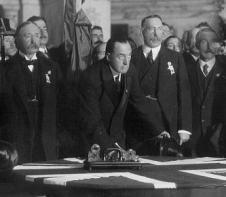
Edward Carson MP signing the Solemn Covenant in 1912 This feeling of betrayal resonated throughout the community, and in one form or another exists to the present day. Relations between Unionists in Donegal and Londonderry were somewhat soured, although unionists in the latter county were horrified by the persecution of their Donegal brethren in early 1922, with many angry Londonderry Sentinel editorials and news reports demanding action. That said, Donegal Unionists still continued to look, albeit with a tinge of bitterness, to Belfast rather than Dublin – a fact which manifested itself perhaps most openly in the banner depicting Sir Edward Carson which was carried by Newtowncunningham LOL to the Donegal CL celebrations on July 12th 1921. "They have stood by the Empire – will the Empire desert them now?" Thus it was that the Unionist community in Donegal was left to face the war of independence without the direct help of the apparatus of the soon-to-be established Northern Ireland state. There can be little doubt that the Protestant community suffered numerically as a result of the conflict as can be seen from the following table:
Across the rest of what was to become Southern Ireland Protestant figures were decimated, largely due to the war of independence. Barkley claims that, by 1922, Presbyterian congregations were reduced by:
In general, of the Protestant congregations, Presbyterians suffered badly. In 1913 their Assembly voted democratically against Home Rule, by 921 votes to 43., and therefore, in nationalist eyes, they were seen quite definitely as being in the "enemy camp". Class envy was also a factor, although in Donegal there was no major class difference between Protestant and Catholic farmers, with the exception of the Protestant gentry. Geographically, Donegal Unionists were concentrated towards the east of the county. A 1913 British Intelligence report drew an "imaginary line" between Dunkineely in the South West to Moville in the North East – east of this line was where Unionists were strongest, although they did have other strongholds; most notably around Hom Head, Carrigart and Kilmacrennan. Thus we can see that the Unionist community was largely split in two – between East and South Donegal. However there were differences between the two communities; Joan Vincent identifies the Eastern community as having the three characteristic indices of Scottish settlement: Scottish surnames, Presbyterianism and the Ulster-Scots dialect. Indeed she identifies the area immediately west of Londonderry, "the Laggan", as being a "core" Ulster-Scots area. In contrast the South Donegal Protestants didn’t have these characteristics. The strength of Unionism in certain areas of Donegal can best be seen in the recommendations of the Boundary Commission in 1925, which urged the transfer of the "Laggan" area west of Londonderry (an area exclusive of the unionist enclave of Raphoe) to Northern Ireland. The Donegal Protestant Registration Association claimed that "the Unionist inhabitants of [Donegal] desired that it should be included in Northern Ireland, and that the economic difficulties occasioned by the boundary would thereby be removed" The DPRA had a point, as the following table shows:
The Boundary commission also recommended the inclusion of the tiny Unionist enclaves of West Urney, Grousehall and large portions of Pettigo and Templecairn. However other Unionist areas around Ballyshannon and Letterkenny were left in the Free State. The report of the Boundary Commission is useful in examining the geographical placement of Donegal Unionists during the war of independence, even though it’s findings were never implemented. "This county cannot now be regarded as adequately policed…" Throughout the period 1919-21 the underlying theme with regard to County Donegal is one of decline. Slowly but surely the RIC, although backed by the military, failed to contain the growing wave of SFIRA terrorism. By October of 1920 the police were forced to withdraw from the nationalist stronghold of West Donegal, prompting the gloomy comment in the monthly police report that "the county cannot now be regarded as adequately policed or protected and is in a distinctly unsatisfactory state" Towards the East of the county things were in a slightly better situation, due both to the high level of support amongst the community for the police, and also to the increasingly stable situation in the county and city of Londonderry, where, by the end of 1920 the police commented: "the UVF is now thoroughly organised for the protection of life and property… and willing to assist the police in case of necessity" Despite the fact that, at this time, the revived Donegal UVF still maintained a strength of 1993 volunteers, there are no records of similar UVF assistance for the police, although known UVF sympathisers were likely to get off lightly for possession of rifles or ammunition. The polarisation of the two communities can be traced perhaps most accurately through the pages of the local nationalist newspaper, the Donegal Democrat. By early 1920 the nationalist community found any outward display of Britishness or British culture to be distasteful. Referring to popular British dances the Democrat asserted that: "Our criticism went a considerable distance in banishing from the town and neighbourhood those demoralising dances more adapted for the slums of [the] English…" Even harmless Ultonian institutions came in for attack; by March 1920 an editorial condemned the Ulster Farmers Union, and by August Irish Farmers Union advertisements replaced those of the UFU in the Democrat. "Foreign" games were also looked on with distrust and the paper was scathing in it’s criticism of the Gaelic-Irish speaking village of Townawilly for playing "soccer football". From such harmless expressions of sectarianism more sinister actions developed. By November of 1920 the monthly internal police summary reported that: "The outrages consisted chiefly of intimidation by threatening letters, raids on mails, raids for arms, cutting telegraph wires and raids for the purposes of theft" Roads were blocked, railways destroyed. The post was regularly suspended. All this led to the Londonderry Sentinel expressing the hope that the wave of terror instigated by the IRA would "revive amongst the thinking section of the Donegal people consideration of the question whether the county has lost or gained by having thrown itself head and heels into the arms of Sinn Fein" In June of 1921 the Democrat records an IRA raid on a farmer William Thompson and is wife in the predominantly Unionist area of Raphoe. In May of that year the Presbyterian Lecture Hall at Quigley’s Point was burned down, whilst on April 25th a pamphlet produced by pro-union activists on the mainland recorded that: "Meenglas Protestant Church, County Donegal, desecrated by Sinn Feiners. Communion Table used for meals. Wine drunk. Prayer books, Bibles and surplices torn up and font defiled" On the same day the house of the postmaster in the same village was attacked, all his money stolen and his life threatened. On the 15th of September Unionists in Raphoe were warned to withdraw their custom from the Ulster Bank in the town. Donegal Unionists were therefore despised for their culture, attacked for their religion and deprived of their democratic rights. Despite these attacks however, the community proved resilient; the Orange Order in particular continued to host well-attended loyal events, particularly the Twelfth celebrations each year. "…But few of our brave men were lost, so stoutly we defended…" There is some evidence that the Unionist community participated in these incidents of sectarianism. A police report for October 1920 records that an AOH hall was burnt down in the village of Pettigo. Shots were also fired at two local Sinn Fein / IRA activists by unionists rumoured to be playing a "drunken prank". In October of 1920 letters were posted up right across Donegal urging people to inform on IRA terrorists. These letters provided detailed instructions on how to inform anonymously, and were roundly condemned by the nationalist Democrat as evidence of grassroots unionist activity in the county. Particularly in the east of the county the RIC were able to continue with near normal governance, with the Democrat recording numerous occasions on which petty sessions were held, although this was usually with heavy military backing. For instance, on July 12th 1920 the Irish Times records that: "For the opening of the Donegal Assizes the military have erected sandbags and machine guns at Lifford courthouse" Perhaps nowhere however can the grassroots sectarian conflict be seen better than in the saga of the little unionist border village of Pettigo, half of which lay in County Donegal, and half in County Fermanagh. This situation was remarked upon by a correspondent of the Irish Independent who opined humourously that the situation would provide a good basis for an Irish comedy. Unfortunately a far more serious drama was to be played out in the village during the period from 1921 to 1922. Neville McElderry, a local historian, recalls that "The Pettigo area of County Donegal had been predominantly Protestant and Unionist, but as tension mounted and a considerable amount of harassment occurred on both sides, many Protestants moved into Fermanagh" In the face of growing IRA activity over the rest of County Donegal, the loyalists of the village soon asked the British government for help. Firstly B-Specials were sent, and then A-Specials to protect the Fermanagh half of the village. The IRA responded and "caused much consternation by setting up a barracks in Mill Street" They also forced loyalists to paint out a mural upon which were inscribed the words "Fear God, Honour the King", whilst other IRA men "looted extensively". By May of 1922 such persecution provoked the Londonderry Sentinel to devote an entire editorial to the situation. Asserting that "the whole district has been put in a reign of terror" the paper pointed out that the persecution of Donegal unionists had increased to the point where many were being forced to seek refuge across the border in Londonderry. By June 3rd of 1922 the Sentinel was reporting that "a considerable number of refugees have arrived at Castlederg". Also on this day however British forces moved down a nearby lake and landed in the IRA occupied Belleek-Pettigo triangle, followed by another column which advanced on Pettigo from the east. The troops proceeded, despite heavy IRA fire, to liberate the village, capturing terrorist weapons and men, as well as a stolen police car. By June 8th the Sentinel trumpeted in a headline "Pettigo Loyalists Rejoicing!" as the townspeople welcomed their liberators. The owner of the house where the mural was obliterated paraded around the town wrapped in the Union flag, whilst children played at wearing stolen IRA caps – "binding them round with red, white and blue ribbons" After two years of relative subjection, and several months of downright oppression, the unionist community in the area eagerly grasped the excuse for celebration. As the Sentinel reports: "Over every farmhouse a Union Jack was stretched in the breeze"
The contemporary historian Walter Alison Phillips concluded that "the affair had a wholesome effect, if only as showing that the British Government was not indefinitely malleable" The Pettigo incident did indeed have a wider significance, as it discouraged other border IRA units to make similar forays into what was now Northern Ireland territory. "The partition of Ireland is an accomplished fact" However, perhaps the most interesting aspect of the experience of Donegal Unionism is the often stormy relationship which existed between the emerging illegal government of Dail Eireann and the minority community, which tended of course to favour the existing British institutions. Perhaps the most interesting episode of this relationship was that of the rates crisis. Upon falling into Sinn Fein hands, Donegal County Council broke off official links with the Local Government Board, and instead pledged allegiance to Dail Eireann. Because of this, many people, and particularly unionists, grew reluctant to pay their rates. A Democrat editorial summed the problem up: "…with the consent of the people, the County Council pledged allegiance to Dail Eireann. The loss of grants [£105,200] was the result…" A typical example, both of the reluctance of unionists to pay the new (increased) rate and of the political and military wings of republicanism working together, can be found in the case of a Unionist by the name of Wilkinson. In late 1921 Wilkinson received a request to pay the "Tirchonaill County Council" the sum total of £5 17/4. Wilkinson refused to pay, and the result was a more sinister follow-up note from the O.C. of the "South Tyrconnill Brigade IRA" warning that "any person found disobeying these orders will be severely dealt with" By August 16th the problem had reached crisis point and the County Council met to discuss the general rates situation. Much angst was targeted at prominent unionists: "… some of the railway companies and Lord Leitrim and a few others had garnished their rates against malicious claims…" A Unionist councillor, by the name of Clarke, defended himself against the charge; pointing out that he had called publicly for the payment of rates. However he went on to criticise Sinn Fein over the high level of rates. A particular point of contention was the fact that this high level of rates was partly the result of a SF refusal to take a printing tender from County Londonderry – opting instead for one from a nationalist area. Clarke also expressed doubt as to whether the SF rate collector was "properly appointed" and refused to pay his own rates until such time as this doubt was assuaged. He opined that this course of action would have the approval of the Local Government Board, which drew the weary retort that "they had bade adieu to that body long ago"
The imposition of the Belfast boycott on the county was also resisted by many unionists – one must always bear in mind of course the close economic links the county enjoyed with the rest of Ulster. On November 11th 1920 the police recorded a threat sent to Patrick Duffy, a draper in Clonmany, warning him against purchasing goods from Belfast firms. During September of 1921 a "black list" was published of merchants with the temerity to continue trading in "prohibited British goods".
The imposition of Sinn Fein courts was also a difficult episode, with both the Donegal Democrat and the Londonderry Sentinel routinely reporting proceedings from both Sinn Fein and official courts in the same issue. The RIC and military were often forced to heavily protect their own courtrooms, and there are numerous cases of RIC raids on Sinn Fein courts. There are also cases of sectarian harassment; in November of 1921 John Elkin, a Unionist from Moville needed police protection after refusing to stop working with the official courts. Many prominent Unionists were prominent in working with the official courts, with many serving as Justices of the Peace – Major Myles is a prime example.
However, it is probably fair to say that, whilst sectarian incidents grew in frequency throughout the period, complete polarisation of the communities did not occur, at least until the Civil War period when unionists were openly persecuted. A willingness to give credit where due can be seen in the comment by the Democrat in late 1921 that a military inquiry into the death of one of its staff was "most impartial". The Democrat also strenuously condemned "cowardly and blackguardly" attacks on Protestant families in Tanawilly.
"The protestant boys are loyal and true though fashions are changed and the loyal are few" Throughout this difficult period, the Orange Order held a particularly crucial position. By 1919 the Orange had laid deep roots within the Protestant population of East and South Donegal and there was much truth in the 1919 claim that "the Institution has more active adherents than ever". Many 6 county Orangemen had supported their Donegal brethren in the UCC split in early 1920, with the result that cross-border Orange relations were never tinged with the same sense of betrayal under which cross-border Unionist co-operation laboured. In 1921 Major Moore, who was then County Grand Master of the Donegal County Lodge, chaired the main Twelfth celebrations in Londonderry. He recalled "glancing at the Orange lilies blooming at the door" when leaving for the parade, and concluded by congratulating "The Loyalists of Ulster for the magnificent result of the Northern elections". Across the border in Raphoe similar celebrations were held at Carrigane by the brethren of the Raphoe district lodge with what the Sentinel describes as "great enthusiasm and success". Union flags and Orange lilies were everywhere to be seen, and the individual lodge banners depicted stirring scenes from recent Ulster history; such as the charge of the 36th (Ulster) Division at the Somme. The Chair of these celebrations would have been speaking for many Donegal Orangeman in expressing his disappointment at Donegal’s exclusion from Northern Ireland as "he knew there were no more staunch and loyal Orangemen than those in that district of [East] Donegal" The meeting concluded with motions passed declaring loyalty to the King and with the singing of the National Anthem. All in all, I believe it is possible to claim that the spirit of Orangeism in County Donegal survived the 1919-22 period remarkably well, especially given the decline in the Protestant population. "…Our orange banners floating outshine the rebels all…" Thus we can see that, despite the grave feelings of betrayal following the split with their fellow Unionists in Northern Ireland, Donegal Unionism, whilst suffering physically and numerically, largely managed to keep up it’s sense of self-identity through the "war of independence" period. It is undeniably true that IRA actions in Donegal, especially in 1922, contributed greatly to the startling decline in Protestantism in the County. However, because Unionists tended to be geographically concentrated in the East of the County, near the largely unionist agricultural hinterland in county Londonderry, they held together better than most.
Community relations did suffer during the war of independence, but not on a scale comparable with Northern Ireland. Open sectarian clashes were rare, with both communities seeming to prefer largely to retreat within their own culture, only emerging on occasion to snipe at "the other lot". Tensions did exist, and were undeniable; with the incidents at Pettigo being a prime example of this.
Unionists did resist the republican take-over as best they could. However, at the end of the day, they were too few in number, and too weak organisationally to win through. They did succeed however in largely holding onto the areas in which they were strongest; as is evidenced by the fact that the 1925 Boundary Commission recommended the transfer of hardcore unionist areas in the far East and South of the county to Northern Ireland. "then work and don't surrender but come when duty calls" Perhaps the greatest tribute however, to the efforts of Unionists in Donegal in the period 1919-22, can be seen in the fact that to this very day there exists a thriving, largely unionist, Protestant community in the County. Each summer the Orange Order in the county continues to march 15,000 strong with Union flags flying "as in days of yore". At a political level, the aspirations of the community are reflected through the activities of the Donegal Progressive Party, which draws its support largely from the Protestant section of the community. During the 1987 general election the Unionist candidate, an independent from Belfast, outpolled the Labour Party. During the war of independence two distinct, relatively ethnically homogenous, nations clashed against each other. It was in Ulster that the clash was most keenly felt, and Donegal was potentially a key flashpoint; representing as it did the farthest outposts of Unionist strength in the west of the Province. Ultimately, Donegal Unionists succeeded in holding the fort during this period, and therefore suffered proportionately less than the far more scattered loyalist communities throughout the South and West. Therefore, in conclusion, Donegal Unionists ensured that their identity was protected, retained and indeed cherished to this day. Bibliography
|