Bahasa Assembler :
Aritmatika
|
Arithmetic and
Logic Instructions
Most Arithmetic and Logic
Instructions affect the processor status register (or Flags)
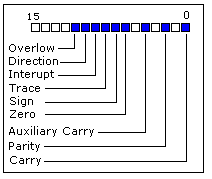
As you may see
there are 16 bits in this register, each bit is called a flag and
can take a value of 1 or 0.
- Carry Flag (CF) - this flag is set to 1 when there is
an unsigned overflow. For example when you add bytes 255 +
1 (result is not in range 0...255). When there is no overflow this
flag is set to 0.
- Zero Flag (ZF) - set to 1 when result is zero.
For none zero result this flag is set to 0.
- Sign Flag (SF) - set to 1 when result is
negative. When result is positive it is set to 0.
Actually this flag take the value of the most significant bit.
- Overflow Flag (OF) - set to 1 when there is a
signed overflow. For example, when you add bytes 100 + 50
(result is not in range -128...127).
- Parity Flag (PF) - this flag is set to 1 when there is
even number of one bits in result, and to 0 when there is odd
number of one bits. Even if result is a word only 8 low bits are
analyzed!
- Auxiliary Flag (AF) - set to 1 when there is an
unsigned overflow for low nibble (4 bits).
- Interrupt enable Flag (IF) - when this flag is set to
1 CPU reacts to interrupts from external devices.
- Direction Flag (DF) - this flag is used by some instructions
to process data chains, when this flag is set to 0 - the
processing is done forward, when this flag is set to 1 the
processing is done backward.
There are 3 groups of instructions.
First group: ADD, SUB,CMP, AND,
TEST, OR, XOR
These types of operands are
supported:
REG, memory
memory, REG
REG,
REG
memory, immediate
REG, immediate
REG: AX, BX, CX, DX, AH, AL, BL,
BH, CH, CL, DH, DL, DI, SI, BP, SP.
memory: [BX],
[BX+SI+7], variable, etc...
immediate: 5, -24, 3Fh,
10001101b, etc...
After operation between operands, result is
always stored in first operand. CMP and TEST instructions
affect flags only and do not store a result (these instruction are used to
make decisions during program execution).
These instructions
affect these flags only:
CF,
ZF, SF, OF, PF, AF.
- ADD - add second operand to first.
- SUB - Subtract second operand to first.
- CMP - Subtract second operand from first for flags
only.
- AND - Logical AND between all bits of two operands. These
rules apply:
1 AND 1 = 1
1 AND 0 = 0
0 AND 1
= 0
0 AND 0 = 0
As you see we get 1
only when both bits are 1.
- TEST - The same as AND but for flags only.
- OR - Logical OR between all bits of two operands. These rules
apply:
1 OR 1 = 1
1 OR 0 = 1
0 OR 1 =
1
0 OR 0 = 0
As you see we get 1 every
time when at least one of the bits is 1.
- XOR - Logical XOR (exclusive OR) between all bits of two
operands. These rules apply:
1 XOR 1 = 0
1 XOR 0 = 1
0 XOR 1
= 1
0 XOR 0 = 0
As you see we get 1
every time when bits are different from each other.
Second group: MUL, IMUL, DIV,
IDIV
These types of operands are supported:
REG
memory
REG: AX, BX, CX, DX, AH, AL, BL, BH, CH, CL, DH, DL, DI, SI, BP,
SP.
memory: [BX], [BX+SI+7], variable,
etc...
MUL and IMUL instructions affect these flags
only:
CF, OF
When result is
over operand size these flags are set to 1, when result fits in
operand size these flags are set to 0.
For DIV and
IDIV flags are undefined.
- MUL - Unsigned multiply:
when operand is a byte:
AX =
AL * operand.
when operand is a word:
(DX
AX) = AX * operand.
- IMUL - Signed multiply:
when operand is a byte:
AX =
AL * operand.
when operand is a word:
(DX
AX) = AX * operand.
- DIV - Unsigned divide:
when operand is a byte:
AL =
AX / operand
AH = remainder (modulus). .
when operand is a word:
AX =
(DX AX) / operand
DX = remainder (modulus). .
- IDIV - Signed divide:
when operand is a byte:
AL =
AX / operand
AH = remainder (modulus). .
when operand is a word:
AX =
(DX AX) / operand
DX = remainder (modulus). .
Third group: INC, DEC, NOT,
NEG
These types of operands are supported:
REG
memory
REG: AX, BX, CX, DX, AH, AL, BL, BH, CH, CL, DH, DL, DI, SI, BP,
SP.
memory: [BX], [BX+SI+7], variable,
etc...
INC, DEC instructions affect these flags
only:
ZF, SF, OF,
PF, AF.
NOT instruction does not affect any
flags!
NEG instruction affects these flags only:
CF, ZF, SF, OF, PF,
AF.
- NOT - Reverse each bit of operand.
- NEG - Make operand negative (two's complement). Actually it
reverses each bit of operand and then adds 1 to it. For example 5 will
become -5, and -2 will become 2.
|