Whole School
Activities
Morning Messages | Gatherings
| Power Hour | School
Improvement Files | School
Survey | Reporting to
Parents | Quilting Project
| Social Responsibility Cards
| Behaviour Support
| Facilitating Socially
Responsible Behaviour
Morning
Messages
As part of the daily, “Morning Message,”
(each class, in turn, is responsible for reading the message to the
school), the specific focus for social responsibility is identified.
The following sample is from a recent message:
“One of our school goals is tro create a
socially responsible learning community. This week we will focus on
appreciating the diversity of our Blakeburn community. We will do
this by honouring and respecting the differences between ourselves
and others.”
Throughout the week, the focus area is developed
and reinforced through classroom activities designed by individual
teachers, as well as school-wide modeling and discussion at the
Wednesday gatherings, the Power Hour activities, and classroom visits
by the principal.
Other topics for weekly goals include:
- appreciating diversity - honouring and
respecting the similarities and differences between
people
- consideration - having regard for other people
and their feelings
- courtesy - being courteous by treating others
as if we value and care for them
- patience - sticking to something for as long
as it takes to finish it; not complaining or criticizing others;
calmly waiting your turn, trusting that the results will
come
- respect
- kindness
More ideas for weekly goals can be found in the
Virtues
Project, Resource Materials.

TOP
Gatherings
The whole school meets bi-weekly for a
“Wednesday Gathering.” At each gathering, the administrator
focuses on some aspect of social responsibility, teaching specific
behaviours, engaging students and staff in role-playing, and
reinforcing the language of the performance standards. At a recent
gathering, the topic was including others in rainy day
activities:
- The principal introduced the topic and
explained that, at Blakeburn, no-one has the right to exclude
others. Everyone has the right to be included. No other behaviour
will be accepted.
- With the help of some staff members, she
role-played a situation where students playing a game excluded
someone who wanted to join them. As part of the activity, she
invited the students to rate the behaviour they observed—did
it meet expectations?
- Students correctly concluded that the
behaviour they observed was “not yet within
expectations;” then several students joined some staff
members to role-play how the situation could be changed to
“fully meet expectations.”
- Other students were invited to role-play
various levels including “exceeding
expectations.”
- The principal lead a discussion of what
appropriately including others looks and sounds like, while one of
the staff members recorded ideas on an overhead.
- The principal then reiterated the school
expectations: “This is what including others looks and sounds
like. This is socially responsible behaviour. This is the
expectation at Blakeburn. No other behaviour will be tolerated.
Students whose behaviour does not meet expectations will be
receive behaviour support to help them learn to make wiser
decisions.”
TOP
Power Hour
Each week, the principal works with
half of the students (approximately 120 from grades 1-5) so that
their teachers can attend their action research “power
hour.” During this hour, the whole group works on a topic
related to social responsibility. Over the last few months, topics
have included: specific safety concerns that have arisen on the
playground; writing pen pal letters and sending gifts to children in
Cuba; solving problems; using the social responsibility standards.
The following activities occurred at a recent
session:
- Students were asked to think
about a problem situation that had arisen in class or on the
playground. They offered various suggestions; of those, the
principal chose to deal with one where students had teased another
student who screwed up a skipping demonstration in
P.E.
- They then defined the problem
in problem in general terms: Not being supportive when someone
has a problem. Making fun of people’s mistakes. They
talked about why it is important to support each other, and how it
feels to be the person who makes a mistake.
- Students were organized into
groups of 4. Each group was given two laminated, colour-coded
performance standards
cards—Not Yet
Within Expectations and Fully Meets Expectations (although
there are four levels on the scale, in large group activities and
those involving younger children, the staff often work with just
two levels.)
- The principal invited
volunteers to help her role-play the problem. After the role-play,
each group had a few minutes to decide what level of performance
they had observed, and to identify one or two pieces of evidence
to support their rating.
- At a signal, each group help
up the card they felt best described the role-played behaviour;
several groups were then asked to give their
evidence.
- Groups were invited to
role-play other situations that illustrated one of the levels (not
yet within or meeting); other groups tried to decide what level of
behaviour was being illustrated, held up their rating cards to
show their decision, and offered evidence.
- Before leaving, each student
was asked to think about one situation where he or she could
immediately work on being more supportive to
others.
- The principal provided staff
members with a brief description of the session.
TOP
School Improvement
Files
To monitor school improvement, the principal and
administrative staff are developing school improvement files
which include evidence of student performance in reading,
writing, numeracy, and social responsibility, collected and evaluated
by classroom teachers twice each year. The data in these files is
intended to provide a systematic “big picture” of how the
whole school community is doing in key areas of student learning.
Each file includes a summary sheet that shows the level of the
performance standards that the student reached on samples collected
in October and in April for:
Writing: Personal writing, stories and
poems, and/or information writing. (Minimum of one writing same from
each period.)
Reading: Literature and/or information.
(Minimum of one sample for each period)
Numeracy: performance sample from any area
(Minimum of one for each period)
Social responsibility: ratings for each of
the following aspects of the performance
standards scale from each period; where
possible, teachers include relevant evidence (often self-evaluation
or reflective writing), but this is not a
requirement:
- Contributing to classroom and school
community
- Solving problems in peaceful ways
- Valuing diversity and respecting human
rights
- Exercising democratic rights and
responsibilities
Note: These files are not
intended for evaluation or reporting on individual students –
classroom teachers continue to use a variety of ongoing methods for
assessing and evaluating individual student growth. In most cases,
the student samples and performance evaluations contained in the
school improvement files are copies of material from teacher’s
files and student portfolio—however, teachers are in no way
required to rely on the material in the school improvement files.

TOP
School
Survey
Students, parents, and staff were surveyed, using the performance
standards, to find our their perceptions of the level of social
responsibility in the school. The survey helped to raise awareness
and understanding of social responsibility, reinforce the performance
descriptions and levels, and emphasize its importance. Responses were
used to raise awareness of issues, plan activities, and provide
feedback to staff students. Preliminary
Results Students (grades 2-5) were guided
through the survey, with teachers reading the descriptions aloud;
parents completed the survey at a parent’s night. Participants
rated the school community on the aspects described in the Quick
Scale K-3,
4-5,
circling the description in each section that best described their
view of the school community, including students, teachers, and other
staff members:
One of our school goals is to create a safe,
caring, socially responsible learning community at Blakeburn. The
purpose of this Social Repsonsibiltiy Rating Scale is to gather
parent, student, and staff perceptions of the
school.
Please highlight or circle on box in each section
that best describes “typical” behaviour at Blakeburn
Elementary. We will use this intial data to compare perceptions,
identify strengths, set goals, and create an actions plan. We will
compare this initial baseline data with similar data we collect
later.
TOP
Reporting to
Parents
Individual student
report cards, in keeping with provincial
policy, include a structured written report identifying areas of
strength, accomplishment, as well as goals, and support plans. (At
grades 4 and 5, students also receive letter grades for each
subject.) At Blakeburn, teachers have agreed that each structured
written report will begin with a short section describing the
student’s social responsibility, often using phrases and
descriptions directly from the performance standards, and identifying
the level at which expectations have/have not been met. Some
reports also include the student’s goals which often mention
improvements in social responsibility:
- “My first goal is put capitals at the
beaging and piridat the end of a sentens. My second goal is speak
nice to others.”
- “My first goal is to raes my hand more
ofen. My second goal is captals at the beginning peurits at the
end.”
TOP
Quilting
Project
During the first five months of the school year,
an artist-in-residence worked with each class in the school, teaching
students to express themselves through art. During this time, each
student created a self-portrait in acrylic on fabric; these were
stitched together to create a community quilt that hangs in the
school, representing every member of the school community. As part of
their contribution, each student sewed a button on the quilt, working
one-on-one with the artist. During one of the power
hours, students brainstormed words that
represented their community; these words (most of them reflecting the
emphasis on social responsibility) form the border of the
quilt.

TOP
Social Responsibility Cards
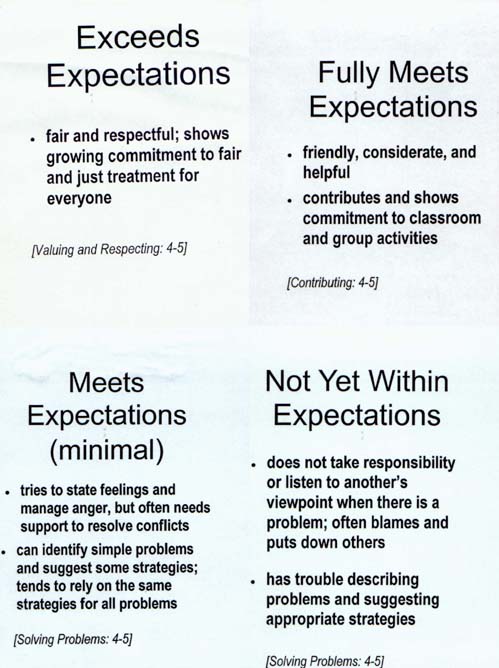
The teacher assistant reproduced the social
responsibility scale as a series of laminated, colour-coded cards and
provided sets for each classroom that students can use them to rate
characters in books, or classroom role-plays.
- Several sets of four colour-coded 8.5 x 5.5
cards. These contain the performance standards labels in large
print (green=not yet within expectations; blue=meets expectations
(minimal); red=fully meets expectations; yellow=exceeds
expectations.)
- Several sets of 16 cards (4.25 x 5.5) with the
same colour-coding as above. Each card in this set contains the
actual performance description for combination of aspect/level;
(e.g., Fully Meets Expectations for Contributing; Exceeds
Expectations for Solving Problems Peacefully.)
Students like using the cards; even the youngest
students are able to work with and remember two levels (see
Classroom
Activities for a description of a
kindergarten activity)—when asked to list all of green things he
could think of, one 5-year-old announced, “green is the not yet
within expectations card!”
TOP
Behaviour Support
Students whose behaviour is judged to be “not yet within
expectations” are provided with behaviour support. They lose
recess and or lunch “free time” and “give back to the
community for their unwise decisions,” generally in the form of
helping the principal beautify the community (i.e., pick up
garbage.)
TOP
Facilitating Socially Responsible Behaviour
Decisions about how the school will operate always consider
implications for social responsibility.
Playground problems result in a personal
visit from the principal and/or leadership team members to every
class to talk about what happened.
Rainy day activities are intended to
provide students with productive, engaging ways to spend their time.
They have carts of board games available, along with mats for playing
them in the hallways; lego in the lobby and office area; dancing
groups in the library; open gym; and technology in the lab. Students
are expected to make wise decisions about how they spend their time,
to be inclusive, to solve any problems they encounter in a peaceful
way, and to exercise their responsibility to report serious problems
to an adult. All activities are open to whoever wants to participate,
except the technology lab which is restricted to three students from
each classroom each day (classroom teacher distribute passes before
lunchtime.) Responsibility for setting up the rainy day stations is
rotated among classes.
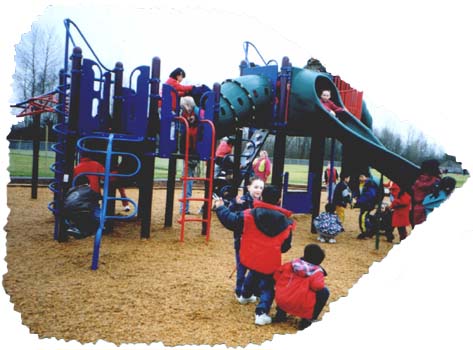
Outside activities are also designed to
provide students with productive, engaging ways to spend their
lunchtime. These activities include supervised hockey (every class
has one day every two weeksto play hockey) soccer, basketball,
tetherball, playground games (e.g., Chinese skip), chalk drawing on
the blacktop, dancing to a variety of popular CD's (screened by the
principal), and playing on the playground equipment.
Displays reflect the importance of
community and of the individual people in it. There are several photo
collages that include every student in the school; the quilts
described above; student work on various themes related to social
responsibility. The staff frequently talk about the importance that
all displays reflect what is valued in their school community (and
that all displays be the real work of
students.)
No electronic bells ring in the school.
Each week, one class is assigned to ring hand bells that signal when
school is in session. Students are able to come into school building
from 8 am on, but they are expected to engage in some
activity—reading, playing games, using the technology
center.
All staff members consistently use the language
of the social responsibility performance standards. This constant
reinforcement (e.g., “Excuse me, did that fully meet
expectations?) has resulted in the students now using the language
independently (e.g., “Ms. D., I’m sorry, I know what I did
was not yet within expectations. I made an unwise decision. I should
have gotten support.”) There is a growing shared understanding
of what it means to be socially responsible.
Celebrations reflect diverse cultural
backgrounds and have included Christmas, Chinese New Year, and Noruz
(Iranian New Year.) In each case, the school collaborates closely
with families and other community members to strengthen ties not only
within the school, but between the school and its larger
community
TOP