 |
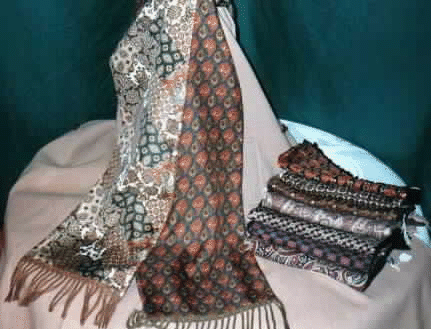
| Men's/Women's Mufflers 61" 12-3/4" with 4-1/2 Fringe $25.00 |
|
| 119 |
| 120 |
| 121 |
| 122 |
| 123 |
| 124 |
| 125 |
| 126 |
| 126A |
| The Muffler |
| THE MUFFLER - 100% Polyester (Once side has a fleece finish, and the other side has a silk scarf finish Color 119 Olive green fleece backing and fringe. Scarf side has hunting horns and saddlebag pattern in olive green and beige. Outlined with a royal blue strap pattern. Colors: gold, olive, tan and royal blue Color 120 Dark beige fleece backing and fringe. Scarf side has an overlapped square and rectangular design filled with paisleys and circles. Colors: tans, beiges, olive, off-white and black Color 121 Black fleece backing and fringe. Scarf side has black and white saddlebag and hunting horn pattern. Outlined with a medium=tan strap pattern. Colors: light and dark tans, dark green, and black and white Color 122 Medium-brown fleece backing and fringe. Scarf side pattern consists of diamond an doval shaped designs. COlors: Black background with light gray, sienna brown and beige Color 123 Medium-brown fleece backing and fringe. Scarf side has paisley design. Colors: cream, beige, and grayu Color 124 Olive green backing and fringe. Scarf side has small paisleys in colors of green, multiple-tans, black and off-white Color 125 Beige fleece backing and fringe. Scarf side has a square and oval pattern. Colors: off-white background with rust brown, forest green, gold and black Color 126 Army green backing and fringe. Scarf side has a multiple square-like pattern. Colors: Army green background with off-white, sienna brown, tan and black Color 126A Black fleece backing and fringe. Paisley design. Colors: Black background with Army green, red, white and gol |
 |
| Como's Silk Industry Como's silk industry has been world-famous for many years, and its beginnings, as is so often the case, are shrouded in legend based on a tale told by Procopio of Cesarea in 551 BC: "Having learnt that Emperor Justinian was trying to stop the latins from buying silk from the Persians, a group of monks newly arrived from Serinda (the Land of Silk for the Greeks and Romans) went to him and explained that silk was produced by a certain kind of worm wich had been endowed with this art by Nature. The Emperor promised the monks great rewards if they could provide proof of what they said, so they returned to Serinda and brought silkworm eggs and mulberry buds back to Byzantium. Ever since then silk has been produced by the Latin". Although there is no way or proving this tale is true, we know for a fact that it was thanks to the Byzantine that silk was produced in the western world from the 6th century onwards. Today, Italy produces 91% of all the silk produced in Europe. The city of Como |
| covers 85% of this amount itself. Como's silk industry is by far the most important in the area. Starting in the middle of the 1600's, the spinning and production of silks moved north of Milan into the area surrounding Como. At that time there were already 124 silk mills operating in teh Como area. Thanks to this long history, the manufacturers are able to call on not only the most skilled artisans to finish these delicate fabrics, but also they have the most efficient machinery. They have the perfect balance of traditional crafts and modern production methods. The industry has survived attacks of punishing diseases of both the worms and the mulberry trees, as well as challenges from strong European and Asian competition. In support of the production process, the designers followed. The Italian genius for fashion design is well known and has truly flourished in and around Como. Among famous fashion houses who sommission silk materials are Versace, Valentino, Gianfranco Ferre, Christian Dior, Karl Lagerfeld, Gucci, Paloma Picasso, Yves Saint Laurent and others. ********************************* |
 |
| Next Pg. |