







 |
 
First on the scene: First responders add to ambulance
services in rural communities
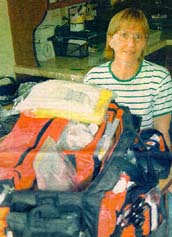
It’s the ambulance dispatch in Prince Albert. There’s an emergency, and the Melfort ambulance is on its way, but Nemeth has been called as well. They know she can get there first. Within minutes, she’s out the door, medical bag in hand, and cruising down gravel roads toward the site of the emergency. That’s a typical routine for Nemeth, who volunteers as a first responder along with four other people in the Yellow Creek area. By having people with extensive training in CPR and first aid in the district, medical help can reach people involved in an emergency much faster than waiting for an ambulance to arrive. “We’re so darn far from any emergency help that we have to be able to look after our own,” Nemeth said, explaining that the nearest hospitals to Yellow Creek are in Melfort and Wakaw. Once arriving at the scene of an emergency, first responders assess the situation and do preliminary work to save the ambulance time once it arrives. “We assess the emergency, we come in there and find out exactly what’s happened, and we start treatment,” Nemeth said. “And then we manage it. You find out what happened, what this person needs, and then you do it.” She said first responders have to fill out a patient care form – the same type as ambulance staff use. “The assessment has been done, so basically when the ambulance gets there, all they do is put them on their stretcher or board, and out they go. They don’t have to do any on-scene stuff. It’s really slick. It cuts down their work.” Wayne Therres, owner and operator of Melfort Ambulance Service, agrees that the first responders program is beneficial. “They’re probably the best thing that’s come along in a long time as far as ambulance service is concerned,” he said. “That may be overstating the fact a bit, but it really is a benefit to us to have someone there before we can get there. I think it makes the family feel a lot safer because there’s somebody there that can help.” Therres said there’s 12 first responders in the North Central Health District in the communities of St. Brieux, Meskanaw and Yellow Creek. It takes an ambulance 20 minutes to arrive at a typical call to Yellow Creek, but Nemeth said she can be to an emergency in the village within two minutes. For emergencies in outlying areas, she said it will often take the ambulance more than 45 minutes to get there. A faster response time isn’t, however, the only benefit of the first responder program. Nemeth said people in emergencies are more comfortable interacting with someone they know. “It’s very scary being sick and then these strangers come in your home and ask you a few questions, stick a mask on you and out the door, and you don’t know where you’re going, you don’t know who can come with you. “As first responders we can assure them where they’re going and what’s going to happen and who can go with them.” Nemeth said people in Yellow Creek are so comfortable with the first responders that in emergencies people will often phone Nemeth and the other first responders rather than the ambulance. “It’s not really the way it’s supposed to be, but if that’s what works, I have no problem with it,” she said. “That’s the nice thing about having a first responder or a group of them in a community. People are familiar with them, they know them, and their phone numbers are quite often on the top of their head.” Another advantage of having first responders in a district, according to Nemeth, is they are also often familiar with the people whose emergencies they attend. “Another little perk about being in the community is quite often we know someone’s medical condition,” she said. Therres agrees this is useful. “They can tell us what’s going on, and they know a little bit of history about the person that you maybe don’t get from the family because they’re excited,” he said. Nemeth became a first responder five years ago after hearing about the program in news items from the area surrounding Saskatoon. She and another woman in the village investigated it, and eventually brought in a training program. The training is offered by the Saskatchewan Association of Prehospital Emergency Care and involves 40 hours of intense first aid, taken over two weekends. Although first responders have been active in the province since the mid-1980s, up until 1994 there was no standardized model for education of these responders. In 1994, the Saskatchewan First Responders program was developed. First responders keep up their training with monthly in-services as well as a yearly conference in Saskatoon. Nemeth said she would like to see more people get involved in the program, and can’t understand why people wouldn’t want the training. She thinks people don’t understand what being a first responder involves. “There’s people that would never do this because they’re scared of the responsibility or being accountable for something,” she said. “Maybe they don’t quite understand that if you have good training, you should be able to handle a situation. Maybe they don’t really understand that you don’t go diagnosing and you certainly don’t operate.” Nemeth admitted, though, that being a first responder can be hard on the nerves. “I’m terrible. I cut myself to pieces after a call. ‘I should’ve done this. I forgot to do that. Why didn’t I think of this?’” However, she said Melfort Ambulance Service provides an excellent debriefing session after every emergency to help volunteers work through their emotions. And the fulfillment Nemeth gets from the experiences far outweighs her fears. “The fulfillment is being able to help, and for whatever positive difference it makes, that’s good enough for me.” Therres is grateful to have the complimentary services of the first responders for his ambulance service as well. “In a nutshell, basically what they are is our eyes, ears and hands before we get there,” he said. |
 It’s
4 a.m., the phone rings, waking Kathy Nemeth from her sleep at her farmhouse
near Yellow Creek.
It’s
4 a.m., the phone rings, waking Kathy Nemeth from her sleep at her farmhouse
near Yellow Creek.