













Ernie and the Marxkado
Written
January 7, 2008
My mother and I were reluctant to admit it, but on Thursday nights, while my father was still at his dealership selling Chevrolets, we liked to watch The Ford Show on television.
Henry Ford's car company was our competition. If my father traded for a used Ford, he jokingly refused to say the dirty word. He'd spell it out, F-O-R-D.
But in this case The Ford Show referred not only to the sponsor, the Ford Motor Company, but also to the star, Tennessee Ernie Ford. The baritone from Bristol got his start on gospel radio. From 1956 to 1961 he hosted a half-hour variety show on NBC. It was in color, though Mother and I watched in black and white.
|
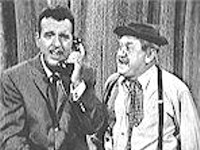
As "the old pea-picker," Ernie played up his southern accent and clowned around with guests such as Charley Weaver, portrayed by Cliff Arquette.
|
|
|
But he was also a talented vocalist who had had a big hit in 1955 with "Sixteen Tons." (Click the picture for a YouTube clip.) When my mother first heard the impassioned climax of this song, she remarked that she hadn't realized ol' Ern could sing so well. |
|

The final line of the song — I owe my soul to the company sto’ — made no sense to me until my mother explained. She grew up near the southeastern Ohio coal mines. The workers lived in a "company town" and bought their groceries on credit from a "company store" operated by their employer. Their wages were applied to their accumulated debt at the store. If they owed more than they earned, they might never see a paycheck, and they had no choice but to keep working.
|
She admired the fact that in the final five minutes of the show, after the Hollywood tomfoolery was over, Ernie always finished with a hymn. Other than Perry Como during the holidays, no other variety show dared to do that. (Click the picture for another clip.) |
|

Then he'd promise to see us the next week, "if the Good Lord's willin' and the creek don't rise. Good night, and bless your little pea-pickin' hearts!"
Ford had attended the Cincinnati Conservatory of Music. While there, he performed in a production of Gilbert and Sullivan's comic operetta The Mikado, which is set in Japan. So when his TV show planned to do a Mikado skit as a medley of three songs, and the sketch continued to grow, Ernie suggested that they expand it to the full half-hour. They could do a condensed version of the whole operetta, with sets and costumes and everything.
|
The show aired at 9:30 on Thursday, April 16, 1959. In his down-home voice Ernie narrated the improbable story, and he also played the comic lead, the hapless executioner Ko-Ko. I watched, enthralled. The New York Times wrote, "The result was a delightful sampling of G&S, presented with professional taste and style worthy of a major production. . . . Mr. Ford certainly fooled those who might tend to think of him only as a Peapicker."
|
|
|
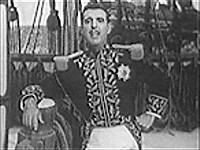
The production was such a success that another Gilbert and Sullivan classic, H.M.S. Pinafore, was presented on January 14, 1960. Ernie played naval officer Sir Joseph Porter. |
|


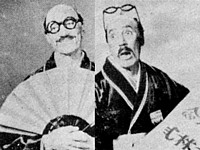
And fifteen weeks later, on Friday, April 29, 1960, The Mikado returned in a bigger production on NBC's prestigious Bell Telephone Hour, with Donald Voorhees conducting the Bell Telephone Orchestra. G&S veteran Martyn Green adapted the operetta for a one-hour time slot. The cast featured Wagnerian operatic soprano Helen Traubel in the role of Katisha, and Ko-Ko was played by the one, the only — Groucho!
|
At the time, we knew Groucho Marx mostly as the host of You Bet Your Life. (Say the secret woid and win a hundred dollars.) Coincidentally, this game show aired immediately after The Ford Show at 10:00 pm on Thursdays. At the time, I had never seen a Marx Brothers movie. Now, in hindsight, I realize that Groucho as the Lord High Executioner was not that far removed from his movie persona. In the movies, he had to woo elderly Margaret Dumont while delivering quips written in the 1920s by George S. Kaufman. In The Mikado, he had to woo elderly Helen Traubel while delivering quips written 40 years earlier by William S. Gilbert. |
|

"The flowers that bloom in the spring (tra-la)
Have nothing to do with the case.
I've got to take under my wing (tra-la)
A most unattractive old thing (tra-la)
With a caricature of a face."
|
Some complained when Groucho's daughter Melinda was cast as Peep-Bo, one of the Japanese "three little girls from school." Melinda was not trained in opera like the other two "little girls." Actually, to me, her unaffected singing voice sounds the way a naïve schoolgirl should sound. I later found that I was able to purchase the music from this telecast on an LP record. The recording is still available. Click the picture at the right for a link to amazon.com, where you can listen to excerpts. |
|

Having been exposed to Gilbert & Sullivan through these television productions, I bought a book of 14 songs to play on my new Baldwin organ. When I got to college five years later, I found that Oberlin had regular productions of the operettas, and I attended Patience and The Mikado and Ruddigore and The Gondoliers and Iolanthe.
Even today, I sometimes listen to recordings of these classics from the Victorian era. Thanks, Tennessee Ernie, for introducing me to G&S!
|
|
|


