


Juan Vicente Gomez was President of Venezuela from 1909-1935. A classic caudillo, (strong leader
bolstered by a
sort of cult of strong personality traits and inscrutable benevolence), he
was a tyrant and a despot that feared foreign influences and all threats real or perceived, to his power. He would not let
refineries or a decent school system be built as they would bring too much western influence and ideas.
American oil workers were segregated in exclusive compounds and education was
not high on the Gomez list of priorities (Un pueblo manso es un pueblo feliz-"an uneducated, unquestioning people are a happy people"}. He won the approval of foreign
governments by always meeting international obligations and an aggressive campaign
to influence foreign public opinion through the cultivation of journalists and
various deceptions. What follows is a briefing of his life and times prepared for individuals who already had
a rough knowledge of Latin American History and I apologize if it assumes too much or leaps too far.
This fascinating man who ruled for so long with an iron hand had a great effect
on Venezuela and its eventual adoption of democratic government that has survived over 40 years(an impressive record in
Latin America ), partly in reaction to dictators like Gomez and Jimenez whose politics of national isolation, ignorance,
terror and intimidation ruled for much of this century. Many would question if the power sharing system agreed to at Punto Fijo resulted in a truly representative democracy but it was certainly not a despotic or militaristic dictatorship of the left or right either. My thesis here is that by avoiding
the international debts that resulted in U.S. Occupations of the Dominican Republic, Cuba, and Haiti
, Gomez was able to keep the autonomy of Venezuela intact and helped foster
a strong sense of national pride and unity despite his despotic, and at times horrifying
proclivities.
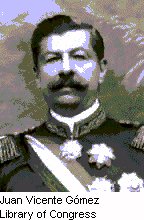
The Britannica article begins like this...."Gómez, Juan Vicente
| b.
1857/64, San Antonio de Táchira, Venezuela d. Dec. 17, 1935, Maracay |
"Yes We are very proud of our country. For one
          thing , we have no internal or external debts....
          Venezuela is in debt to no one. As a matter of
          fact" , and he would emphasize each word with a nod
          of his head, "our treasury is filled to
          overflowing." And he would sit back to let the
          weight of the words sink in .
               Invariably the visitor might ask, "I am told
          Venezuela has to import her foodstuffs. Is that
          so?"
               "Import foodstuffs", he would snort, glancing
          in feigned surprise, "Haven't you seen our farms?"
          ... ..."And revolutions, aren't there ever any
          revolutions in Venezuela?"
               "There has been, he  would say , adroitly
          evading the question, "peace in Venezuela for
          thirty-two years." He would discretely omit to
          mention the many embryonic revolutions and the
          snuffing out of thousands of lives to preserve the
          status quo of the Gomez clan.


          "Liberty is the most foolish of all hopes"

                                       El Benemerito,
                                           Juan Vicente Gomez


                                   - John Lavin, A Halo for
                                     Gomez
  The strategic and economic importance of Venezuela to

the U.S. were demonstrated at the dawn of this century.

Intervention in support of Venezuelan territorial claims and

U.S. security under the Monroe Doctrine and the Roosevelt

Corollary was directed at stemming European influence and

imposing fiscal responsibility on the corrupt and bankrupt

regime of General Cipriano Castro. Frustrated by the chaotic

feuding of ungovernable regional caudillos and the wily

evasiveness of Castro in settling debt obligations Theodore

Roosevelt broke relations in 1907 and exclaimed, "Someday I

fear we shall have to spank Venezuela!".1 Stability was an

objective that seemed remote until the ascendancy of Juan

Vicente Gomez, "El Brujo de la Mulera" known as "El

Benemerito" by his loyal cronies.2  Secretary of State Elihu

Root's counsel of a more benevolent approach to Venezuela

became a possibility.3

     Gomez demonstrated an exceptional military prowess. As

Castro's general he effectively crushed opposing caudillos,

consolidating power first in his native state of Tachira in

the Andes. The relatively prosperous coffee and cattle region

was to produce every president for decades. Gomez, a mestizo

rancher and farmer, ultimately assumed the presidency from

his former friend and mentor Castro whose regime was

crumbling under the weight of foreign pressure to satisfy the

debt and poor health in December, 1907. The controversial 27

year dictatorship brought national consolidation and organ-

ized terror and repression of dissent on a scale hitherto un-

known. Torture  and intimidation were supplemented by the

effective use of the newly available telegraph to crush the

merest whisper of infidelity to the virtual fiefdom of "El

Benemerito".

     Years later, Juan Bosch, reformist President of the

Dominican Republic would make an important distinction.

Previous heads of state had political purposes and were

interested in control over military forces. Self enrichment

through abuse of power had ample precedent and was a by-

product of politics. Gomez's purpose was nothing less than

economic control, latifundism taken to what he deemed a

logical end.4

     To the U. S. Gomez offered a stability and openness to

investment that was infinitely preferable to his predecessors

intransigence. By avoiding interventions more serious than

the occasional gunboat off La Guaira or Puerto Cabello, the

U.S. divorced itself from the contradictions inherent

elsewhere in the Caribbean. Occupations of neighboring Haiti

and the Dominican Republic fostered a paternalistic concern

and involvement difficult to reconcile with the principle of

self determination and unsuccessful in imparting the

democratic values the U.S. deemed necessary for successful

 self government. "Liberty is the most foolish of all hopes",

declared Gomez, perhaps chillingly astute for his time.5

     Remarks such as this prompted President Woodrow Wilson

to declare "This scoundrel ought to be put out" while the

State Department insisted relations under Gomez were an

improvement.6 A germanophile with Prussian trained Chilean

officers aiding his consolidation of unruly provincial

generals, Gomez's flirtation with Germany caused a wary U.S.

to send secret agents to Caracas during World War 1.7  A

realist, Gomez was always cautious, avoiding conduct that was

certain to invite the wrath of what he realized was

preponderant power and influence. This did not preclude him

from seeking to counter this power through European

investment.

     An important distinction should be made . Gomez regarded

financial obligations as sacred if the integrity and prestige

of his regime were to be established and maintained. This

prescience on his part served him well in the court of

international opinion, the only arena outside his family

where he deemed it expedient to cater to another's

perceptions. Thus the dichotomy between internal and external

norms of political behavior. To the world at large Gomez

promoted his slogan of "Union, Paz, y Trabajo" which his

people joked meant unity in jail, peace in the grave, and

work on his infamous road gangs. Roads were "built primarily

with a military objective" by "peones camineros" who were

"marvelously faithful" according to a visiting Georgetown

School of Foreign Service delegation.8

     They probably were unaware of the extent of Gomez's

repression such were his skills at giving "potemkin village"

tours of the countryside. These roads were known as "caminos

de los muertos" to Venezuelans. Gomez promoted himself as a

boon unto his people and a "restorer of peace to the

hemisphere".9 His Foreign Ministry was "staffed by people who

believed the only salvation was to be in the strongman, that

Venezuela was in no position to even approximate some type of

democracy".10

     Perhaps it was not. Nevertheless, his people suffered

fearful degradation or death on whimsy (in violation of the

then present and virtually all previous Constitutions) and

were  purposefully kept ignorant and apolitical. Not only was

no political tradition allowed to develop, the fragile

existent tradition was ruthlessly suppressed to the point of

extinction domestically, while a fragile exile community that

had survived the excesses at home searched for an applicable

political theory abroad. This is "not to suggest any simple

minded notion of external coercion by North American

capitalists busy dictating behavior to Venezuelan dependents.

Quite the contrary, it was Venezuelans who, in acquiring the

benefits of North Atlantic trade and capital investment, also

acquired new values".11

     An indication of the extent of internal control over

external influence in the twilight of the regime was the

Gomez habit of privately screening and censoring all motion

pictures he deemed detrimental or subversive. Indeed upon

Gomez's death on December 17th, 1935 (coincidentally on the

anniversary of Simon Bolivars death), the Venezuelan people

were surprised to find that with the exception of Mexico

Venezuela was held in high esteem by the international

community.12  A public relations blitz included the bribery

of writers and newspaperman and extravagant hospitality

towards foreign guests and diplomats. Many, if not most, were

fooled. U.S. Minister Preston MacGoodwin (1914-1919) was

accused of being a willing fool who made a fortune with a

crooked import company.13 Gomez did his best to suppress any

nascent revolution of rising expectations. He achieved this

by isolating his people from the world and keeping them

ignorant.

     The wealth of Venezuela's predominantly agrarian economy

was to be dramatically altered by the states exploitation of

its enormous subsoil wealth. Petroleum reserves are among the

largest in the world but their development lagged behind

areas such as the Middle East and Persia. Eventually swarms

of foreigners, American refugees from the closeout in the

Tampico oil fields in Mexico and a host of other adventurers,

invaded the state of Zulia. The most famous discoveries were

in the little town of Cabimas. Maracaibo grew explosively.

     By 1928 Venezuela was the leading exporter of oil in

world. In the late 19th Century pits of asphalt were mined

and some of this flowing tar eventually paved the streets of

New York City and Washington. Foreigners and natives alike

were generally unaware of its significance. Not until Gomez

was the mammoth job of exploration, drilling, and the

construction of roads and infrastructure undertaken.

     This process slowly brought forth the geysers. The

remote and dangerous concession sites were invested with such

hazards as flak jacket piercing poison arrows catapulted by

unconquered Motilone Indian warriors.14 Geronimo had long

since surrendered.

     These conditions may explain an incident described by

Jose Rafael Pocaterra, a Minister of Development assigned to

Zulia who went on to revolt against Gomez. In "an episode of

the origins of the Yankee incursion in Venezuela", Pocoterra

describes an encounter with a Mr.Nash of the Rowlan Bartlett

Company and his band of hired guns who disavowed his

authority, threatened him with firearms and finally set fire

to the field they stood on by authority of "the company" .

For Pocaterra this is an example of "that infamy of some

fools that negotiate for sums that are ridiculous in relation

to there real worth."15

    Venezuelans have historically been cautious in their

negotiations on oil concessions and Gomez was no

exception. The petroleum laws of 1918 continued a trend of

securing better terms as oils importance grew. Venezuela

drove a harder bargain than  many of its contemporaries. A

two stage concession process, one for exploration, one for

exploitation, guaranteed Venezuelan ownership of half the

land exploration proved to be endowed with reserves. Ever

present opportunities for corruption were not  ignored and

many of these concessions were illegally transferred to

foreign ownership enriching favored gomecistas.16

     The construction of refineries on Curacao and Aruba

instead of the Venezuelan mainland was a rallying point for

those who viewed U.S.  economic intervention in the

development of petroleum as inimical to the interests of the

people in benefiting from their subsoil wealth. Geography

was a factor (Lake Maracaibo was not deep enough for ship

transit) but  evidently domestic political reasons were

largely to blame . The "Well Deserving" feared a

concentration of workers laboring alongside U.S. technicians

would provide fertile ground for "agitators" who were

"infiltrating the oil camps"17. Lavin notes that "wealth was

flaunted in the very face of abject poverty. It is a wonder

that life proceeded so smoothly without undue mishap Into

what had been an unfertile backwater by Venezuelan standards

came "el baile de los millones".18 Mule paths became

machinery laden highways.  A new era had begun . With the

rush of foreigners came modernizing influences that seeped

out of segregated foreign compounds and added fuel to fires

already burning in cosmopolitan Caracas and abroad.


      Before examining the origins of dissent and the birth of

modern reformist political movements the financial effect of

petroleum should be examined. It is generally conceded that

without oil revenues Gomez would never have succeeded in

paying of the tremendous debt he inherited. His stability

rested on this ability. By freeing himself from outside

intervention for debt obligations he gained non interference

in internal affairs by foreign powers. With this free hand he

forged a strong central government and developed national

institutions. Uniting a nation near anarchy necessitated

harsh measures. Oil wealth bought allies and permitted

limited development and the type of monuments of which

dictators are so fond. A people largely ignorant of the

marvels of the 20th Century would be satisfied with meager

forms of progress.

     Dissenters were either killed, silenced, or exiled.

Such a policy could not help but contribute to a latent

unrest. Disaffected hacendados forged alliances with

caraqueno oligarchs. Students "examined the current

revolutionary doctrines and decided that the attacks upon

feudalism and imperialism were particularly applicable to

                 conditions in Venezuela".19

     A young firebrand named Romulo Betancourt used his

considerable oratorical skills to antagonize the Gomecistas.
A preliminary survey of the prevailing political theories of

the day initially convinced Betancourt that Marxist analysis

was applicable to the Venezuelan situation and he became a

Communist. He had no direct links with Moscow, as did Gustavo

Machado, founder of the Partido Communista Venezolano, and

those who formed the first Marxist study cells in 1929.20

Betancourt, who with such figures as the literary giant of

Venezuela, Romulo Gallegos, went on to found Accion

Demoratica, which survived the Jimenez dictatorship of the

fifties and in institutionalized form holds power today. In

1949,  after the realities of Venezuela's unique situation

and time fostered a political maturation,  Betancourt

renounced communism. 21

     Students of Caracas Central University shared a common

revulsion for the militarist regimes excesses which

transcended their various reasons for ending the Gomez

tyranny.  They were supported by disaffected oligarchic

elements and down on their luck caudillos, among then Andean

caciques who had road with Gomez to power. These

"Veintiochistas" so named for the riotous revolt of 1928 went

on to pursue their goals in exile and sponsor the Plan of

Barranquilla in 1931. This document, authored chiefly by

Betancourt, laid the basis for the reformist agenda of the

Agrupacion Revolutionaria de Izquierda (ARDI), forerunner of

Accion Democratica. The plan concluded that "the imperialist

international has maintained and sustained Gomez in Venezuela

as they have sustained and maintained governments of force in

any of these countries, with brutal repression to throttle

all aspirations for improvements by he working class".22

     The 23 year old was to temper this rhetoric as events

progressed and political maturation occurred.23 "Betancourt's

communism stemmed from desperation over Gomez and ignorance

of the socio-economic realities of the American people which

provided a fertile ground for the messianic hope for

revolution - a la rusa." 23  Upon the death of Gomez from

failed health a political tradition infused with democratic

ideals incorporating a wider range of views than those of

Betancourt had been established. The significance of this

development was not lost on a Gomez general, Eleazar Lopez

Contreras, who rode the storm of public unrest following the

dictators death and wisely instituted reforms that allowed

steam to escape from the boiling cauldron of resentment and

democratic aspiration Gomez's regime engendered.

    "Although Juan Vicente Gomez was the archetypal caudillo,

his administration set in motion forces which were to end the

caudillo system, organize a real national army, and develop

the oil industry."24  A relationship of mutual accommodation

with the United States allowed for autonomy and the avoidance

of the type of direct intervention the U.S. imposed on other

Central American and Caribbean states of the period . This

relative independence of internal direction of affairs was in

part due to external international compliance with financial

obligations and a foreign policy designed to placate and

forestall the chiefly congressional critics of his repressive

regime in the U.S. The position of the U.S. avoided a

potential political and administrative quagmire while gaining

a strong foothold in a country whose strategic importance was

greatly enhanced by the discovery and exploitation of

petroleum. By allowing political exiles safe haven indirect

aid was given to revolutionary movements which eventually

led to the development of a democratic political

tradition in Venezuela. The seeds of change were sown.


                             NOTES


     1.As quoted in Sheldon B. Liss, Diplomacy and Dependency

Venezuela, The United States, and the Americas (Salisbury,

N.C.,1978),p.47

     2. "El Brujo de la Mulera" translates as "The Sorcerer

of the Muleyard". Gomez was renowned for his divinatory gifts

and circumspect nature. "El Benemerito" means "The

Welldeserving".

     3.Ibid.,p.44

     4."El interes primordial de Castro era el poder sobre

fuerzas militares y humanes, no el central de la economia

nacional" and "el tirano no era un politico sino un

negociante y un latifundista", Juan Bosch and Luis Cordero

Velasquez, Juan Vicente Gomez: Camino del Poder, (Caracas,

1982 ).p.35

     5. John Lavin, A Halo for Gomez, (New York,1954).p.412

     6. Liss,p.68

     7. Ibid.p.80

     8. Georgetown School of Foreign Service, Venezuela,

     An Economic Report. (Georgetown,1921).p.67

     9. Liss,.p.83

     10 Ibid.p.99

     11. John V.Lombardi, Venezuela; The Search for Order,

     the Dream of Progress. (Oxford,1982).p.227

     12- Lavin, p.98 The Vasconcelos Affair caused a

diplomatic break. Vasconcelos, a Mexican journalist, called

for Gomez's assassination.

     13. Ibid., p.172

     14. Ibid., p.295

     15. Jose Rafael Pocaterra, Memorias de un Venezolano

         de la Decadencia. (Caracas, 1979) p.320 "Un episodio

de los origenes de la incursion de los yanquis en

Venezuela",... "Quien le ha dado a usted tal orden?"

"'La compania', repuso con los manos puestas en las culatas

de sus dos pistolas de caballeria" ..."en el propio teatro de

los acontecimientos aquella infamia de unos insensatos que

negociaban en Caracas por sumas ridiculas en relacion a lo

que significaba el vendido".

     16. Robert J. Alexander, Romulo Betancourt and the

         Transformation of Venezuela (New Brunswick, 1982).

         p.13

     17. Lavin, p.306. Lavin continues " So strong was the

dictators stranglehold upon these wretched and oppressed

people that they dared not beg for the crumbs from his

overflowing table".

     18. trans."dance of the millions"

     19. Charles D, Ameringer, Democratic Left in Exile: The

         Anti-Dictatorial Struggle in the Caribbean 1945-1949

         (Miami,1974).p.23


     21.  "Venezuela is engaged in a profound renovating

transformation in its political, economic, and social

organization, which requires, in order to have historical

validity and guarantee of permanence, a great democratic

party, in which are joined, around a concrete party and

within a single party discipline, the advanced sectors of all

the creative, productive social classes, and not of only one,

the working class.  I consider a Communist party unnecessary

in the country. I reject the Communist Party ...because its

dependence on Moscow converts it into a simple bureaucracy

appendage of the Soviet state." Alexander, p.162


     22. Ibid.p.57

     23. Ameringer, p.26

     24. Alexander, p.12

...........................................................................................................

Bibliography


Alexander, Robert,. Romulo Betancourt and the Transformation
     of Venezuela. New Brunswick, 1982.

Ameringer, Charles D., The Democratic Left in Exile: The
     Anti-Dictatorial Struggle in the Caribbean 1945-1959.
     Miami, 1974.

Betancourt, Romulo, Venezuela: Petroleo y Politica. Caracas,
     1967.

Bosch, Juan; Cordero Velasquez, Luis, Juan Vicente Gomez -
     Camino del Poder. Caracas, 1982.

David Leon, Ramon, El Brujo de la Mulera. Caracas, 1976.

Gallegos, Romulo, 1948-1958 Cuba: Patria del Exilio Venez-
     olano, Caracas, 1982.

Georgetown School of Foreign Service, Venezuela; An Economic
     Report Presented as an Aid to the Foreign Trade of the
     United States. Georgetown, 1921.

Lavin,John, A Halo for Gomez. New York, 1954.

Levine, David H., Conflict and Political Change in Venezuela.
     Princeton, 1973.

Liss, Sheldon, Diplomacy and Dependency: Venezuela, the
     United States, and the Americas. Salisbury, N.C. 1978.

Lombardi, John V., Venezuela; The Search for Order, the Dream
     of Progress. Oxford, 1982.

Pocaterra, Jose Rafael, Memorias de un Venezolano de la
Decadencia. Caracas, 1979.
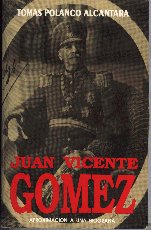
In time The Rant Pages will include essays by guest authors and ranters. All submissions to jtisdall@CapAccess.Org that concern Venezuela will be considered. Short winded comments can be submitted to The Your Thoughts Page and will be added to the list of comments at the bottom of the page as they are received. I will endeavor to add comments in timely fashion but since I am not able to use a CGI script to modify the page automatically, expect delays.

