Tulum
We arrived in Tulum in the evening, on a Saturday. It took us some time to find the right accommodation. It had to have an air conditioner, the humidity was really high and after all it was our first night in Yucatan. We found a hotel that had color TV with cable and "clima", as they call the air conditioner in that region. A bottle of aqua purificada added more value to the room.
The next morning I woke up tired, partly due to the role of thermostat that I had during the entire night. The AC was either too powerful or too old but it was unable to stop itself before making the room's temperature lower that we could bare.
After a desayuno we went straight to the ruins. We stopped in the parking lot leaving the AC equipped car there and ventured on foot for the rest of the 500 m that separated us from the archeological site.
The ruins are surrounded by a stone wall, the entrance being made through a low stone gate. We found out that on Sunday the admission is free in all archeological sites in Mexico, more money left to spend on other admissions.
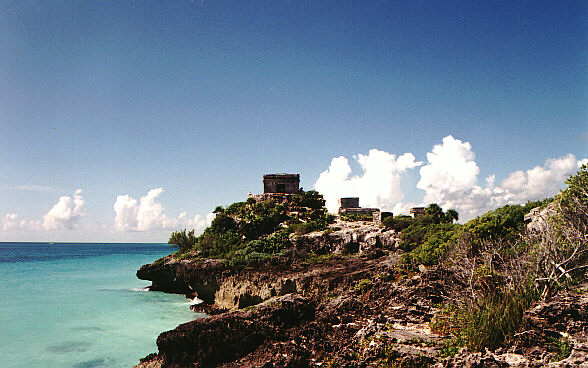
Entering Tulum we discovered that the city is situated on a plateau over looking the sea. Its location suggests that it was built as a fortress.
Right at the entrance there was a map indicating the main buildings. We stopped in the shade of a temple and looked in our guidebook for the historical background of the city.
Tulum, meaning "City of the Dawn", was settled in the Early Post Classic Period (900-1200).
The city continued to be inhabited even after the arrival of the Spaniards.
The sun was really coming down on us even at that hour of the morning, 8:30. The bottle of water that we thought was to much to carry and we left it in the car now would have been more than welcomed.
As we were seeking the protective shade, a huge iguana was stretched on a rock, obviously enjoying the morning sun. I took some pictures as a souvenir, later after I printed them I discovered that nobody can tell how huge that iguana really was; there is nothing to compare it against in the picture.
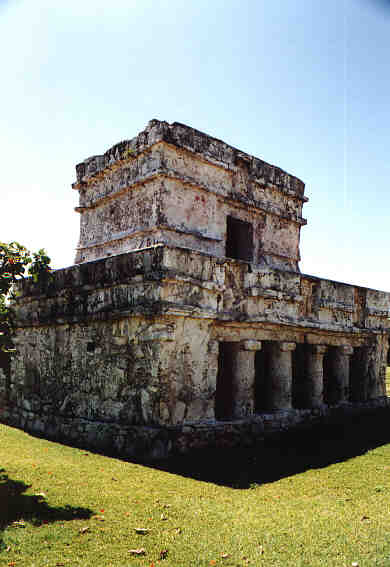
There are 16 ruins in Tulum. One of the most interesting is the Temple of the Frescoes, a smallish temple where you can still see the frescoes on its interior walls. The corners of the temple looks slightly like the contour of Mayan face.
El Castillo, with its back turned to the sea, is the tallest building in Tulum. It has the Temple of the Initial Series onto the right and the Temple of the Descending God to the left. The Temple of the Descending God is so named after the stucco relief of a diving god above the door.
Visiting the ruins in the sight of the torrid sun makes the temptation of the beach and sea something impossible to resist. A friendly advice, do not forget your swimsuit when visiting Tulum. The water is magnificent and as a bonus you get to see El Castillo from the sea.
On Sunday, there were many Mayans visiting the site, showing their children the remains of a flourishing civilization. It gave me the impression that once again, after so many centuries Tulum is alive.
 Get your own Free Home Page