
Flora


|
|
Nature Flora |
|
|

Broadleaved and mixed forests include mostly the European beech, sycamore, whitebarked fir, ash, and grey alder. However, parts of these primary forests were cut down in the past and replaced by secondary spruce stands.
The rests of the original forests have been saved in the valley localties along the Upa, Labe, Jizera, and Jizerka rivers.
In the herb layer you can find following plants: Wood Anemone and Yellow Wood Anemone, Common Lungwort, Mezereon, Nine-leaved Toothwort and Coralwort, Toothwort, Herb Paris, Martagon Lily along with dozens of other species.

The spruce (unfortunately often of a completely unsuitable genetic provenance) prevails in the structure of mountain forests. The European beech, sycamore, mountain ash, and the whitebarked fir rarely occurs. The occurence of deciduous trees decreases at higher altitudes.
The natural and planted spruce forests are strongly affected by air pollution now and they have far worse existential conditions for the development of the herb layer. Strong shadow and acid soil are congenial especially for pteridophytes (ferns) - like Holly Fern, and Lady Fern Broad Buckler Fern, and for large grassy stands, especially Hairy Small-reed (Villous Smallreed) and Wavy Hair-Grass.
Flora is richer and more spectacular in the surroundings of mountain brooks. Such species in evidence are, Monkshood (Aconitum napellus) Hedge-garlic Adenostyle, Rattlesnake Root, White Butterbur, Blue Sow-Thistle, Hairy Chervil, Large Bitter-cress, and also rarely Opiz's cress.
The origin of forestless enclaves in this altitudinal zone goes back especially to the 18th century when during the so called "farming" the mountaineers cut, burned down and cleared the mountain forests and began to keep cattle and tend grass in the enclaves. Successively flower rich mountain meadows have arisen here with a big variety of species and a lot of rare plants which are protected by law today.
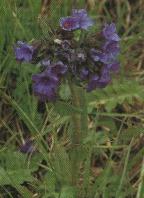
For instance there are Mountain Pansy, endemic Czech Bluebell, Giant Cat's ear, Hawk's beard, Grim the Collier, some endemic hawkweeds Arnica and many terrestric orchids. Yet the botanical composition of the flower rich mountain meadows depends on their careful care and that is one of the serious contemporary problems of the Krkonose Mts.
The subalpine zone forms the most valuable of the Krkonose ecosystems - dwarf pine stands, primary and secondary matt-grass meadows, and subarctic peatbogs concentrated mostly around the both plateaus. It is a region situated above the alpine timberline where instead of trees only shrubs, little shrubs, grasses and herbs dominate.
Especially striking are the dwarf pine stands consisting of the original Krkonose wood species - Swiss Mountain Pine. Its shrubs are over 200 years old. Other species grow strugglingly here - Carpathian Birch and Silesian Willow, in the herb layer, underneath the dwarf pine shrubs can be found small shrubs of bilberry, cowberry or bog whortleberry, Chickweed Wintergreen, Purple Coltsfoot, and rarely the minute Alpine Clubmoss.
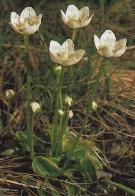
The matt-grass meadows are species poor, and they are also called "the hercynic desert" now and then. In spite of this, it is possible to find beautiful flowery mountain plants here - e.g. the Scherfel Anemone, Avens, Alpine Goldenrod or Golden Cinquefoil. The dwarf pine stands of both plateaus hide peatbogs which are a true copy of Nordic ecosystems including the occurence of many Nordic species reminiscent of the ice age, so called glacial relics. Cloudberry, Sudetic Lousewort, Lindberg bog moss, and Marsch Andromeda belong to them, among other plants like Small Cranberry, Crowberry (Empetrum hermaphroditum), Hare's-tail Cottongrass and Common Cottongrass or Deergrass.
This zone is situated on the highest peaks of the Krkonose Mts (Snezka, Studnicní and Lucní hora, Vysoké Kolo and Kotel) where there are, besides the stony debris, the grassland and lichen communities with Fescue (Festuca supina), Bent-grass, Three-leaved Rush, stiff Sedge and especially the whole palette of endemic hawkweeds among which you can make the rare find of Daisy-leaved Speedwell, Spiked Woodrush, Least Primrose or Dwarf Willow.
The special yellow-green color of the stony debris, well seen already from a greater distance, is caused by the lichen (Rhizocarpon geographicus) the thallus of which really reminds us of geographic maps.
The enumeration of the remarkable phenomena of the Krkonose Mts. would not be complete if we did not mention the places where the above described altitudinal zones are not displayed in such delineated fashion. On the contrary, flora and vegetation of all zones of the Krkonose Mts. occurr in remarkable combinations in some areas.
Glacial cirques, one of the most outstanding features of the Krkonose Mts. belong to such zones. Some topographic names used for those phenomena - as for instance Krakonosova, Certova (Devil's), Schustlerova or Kotelská (Basin) zahrádka (garden) truly express the spectacular variety of places which total 15 in the Krkonose Mts.
The vegetative abundance in the glacial cirque is no work of a mere chance but a result of long-term activity of the already mentioned anemo-orographic systems; putting up huge layers of snow, the presence of snow and debris avalanches, stowing up the seeds, small organisms and fine particles of soil spread by wind from the nearer and distant places, of the more convenient climatic conditions.
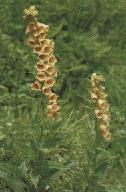
Rich communities of alpine tall herb meadows with Monkshood, Candle Larkspur, Hedge-Garlic Adenostyle grow here, wet rock walls and springs play host to Chives, Alpine Bartsia, Marsh Felwort, Yellow Wood Violet. In tall herb communities you can see Daffodil Anemone, Globe Flower, Yellow Foxglove and a lot of other remarkable plants.
The same variety of glacial cirque flora is valid for fauna as well, especially in the insect empire. By right, the glacial cirques are strictly protected against human interference and they serve as unique example of the natural development of middle European mountain wildlife.
