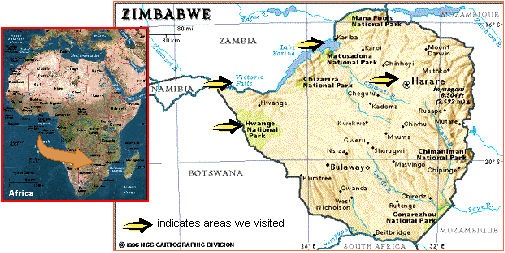
Zimbabwe is a land about the same size in area as
California with a population (1995) of 11.2 million. Land-locked and bordered
by South Africa, Botswana, Mozambique and Zambia, Zimbabwe at time of writing
is a safe place to travel; English is commonly spoken and prices still
reasonable. It is a beautiful, lush and unspoiled country with an abundance
of life of almost every kind, and an almost perfect climate.
But there is trouble in paradise.
The majority of Zimbabweans are black, of the Shona
or Ndebele tribes, though the white minority still enjoys, in general,
a much higher standard of living. Since the War in 1980, which brought
Zimbabwe its first general election and installed President Mugabe as head
of a socialist state, the native population has started to participate
in all levels of Zim life, though many citizens still live in what we would
consider great poverty, in the rural Zimbabwean villages.
Though Zimbabwe continues to struggle through economic
crises, political turmoil, residual bitterness as a result of the civil
war, and the very difficult growing pains of any new nation, there
remains a sense of optimism and enthusiasm. This country is rich in resources
and populated by spirited, devoted and determined men and women. Such potential
underlines the great irony of Zimbabwe's present difficulties.
What are the difficulties?
Many people, particularly the urban and the white
population, are distressed with the corruption of Mugabe's 18 year
old government. There were high expectations for this new regime, but few
reforms succeed while government officials amass great fortunes and have
no fear of accountability. As the Zim dollar plummets, President Mugabe
takes no responsibility for the economic failures and the lack of any real
improvement in the standard of living for the majority of Zimbabweans,
despite the country's great wealth.
"Mugabe's private war" is what some call the
Zimbabwean involvement in the civil war taking place in the Democratic
Republic of the Congo. Rumours --lots of rumours --abound regarding President
Mugabe's interest in sending Zim troops to fight DRC rebels. In any case,
troop morale is low at all levels, and inaccurate casualty reports cause
suspicion about the reasons for continued Zim participation.
The List which appeared in the fall of 1998
targeted close to 800 white commercial farmers with threats of appropriation
without compensation of their farms and homes. President Mugabe has often
stated that it is a priority to restore Zimbabwean lands to native (black)
Zimbabweans. This is problematic on several counts: first, that the listed
properties were successfully employing thousands of people in a country
with close to 40% unemployment; secondly, these businesses bring much needed
foreign currencies into the country; and thirdly, most of the white farmers
are second and third generation farmers and consider themselves no less
Zimbabwean than any other citizen. Those whites who could not tolerate
the ideas of a black president and votes for all black citizens left the
country during or after the 1980 war. Those that remained made complete
financial and emotional commitments to their farms and to the new Zimbabwe,
and trusted the President to honour his promise that they would be permitted
to remain on their farms. To further President Mugabe's aim of more land
ownership for native Zimbabweans, the farmers pointed out to me that there
are many farms abandoned or for sale which could be purchased by the government
and returned to black farmers. At time of writing the government has decided
not to appropriate the listed farms, but those who were under threat wonder
when it may next be politically expedient to make such public threats again.
...But there are many things to be proud of
Zimbabwe at the moment enjoys a free press,
and I was always interested in the lively debates which appeared in the
many newspapers the country supports. Recently there have been some attempts
by President Mugabe to control the press. If he succeeded it would be disastrous
for the country. What good are free elections if there is no free press?
Natural resources...people always say what
great potential Zimbabwe has, and it is true that the country is
blessed with an abundance of natural resources and a population committed
to making the country work.
Zimbabwe is a relatively safe country, with
only common sense measures necessary when traveling.
There is a good transportation infrastructure
in place, with mostly well-maintained roads and a usually reliable airline.
The people of Zimbabwe are justifiably proud
of their country, and are happy to show it off to tourists.
|