
Tanya's | Travels
Home >
Europe >> Battlefields of the First World War page 1
|
Tanya's | Travels
|
|
Home >
Europe >> Battlefields of the First World War page 1
|
Africa | Asia | Australasia
Battlefields of the First World WarCopyright © Tanya Piejus, 1999 My Mum and I had both studied the poetry of the First World War and been very moved by the experiences of the men in the trenches who lived and died as part of the Allied forces in 1914 to 1918. We'd often talked about visiting the battlefields and the memorials to the soldiers and finally decided to fulfill our intentions over a long weekend in April 1999. We spent Friday 9th to Sunday 11th driving though the Somme and Ypres Salient, stopping off at the many cemeteries, memorials and preserved areas of war-torn ground to try to gain some impression of the numbers of men involved and an idea of what they suffered before so many of them needlessly died. Here follows my account of the sites we visited and how they struck me in our journey of remembrance through modern-day France and Belgium. Friday 9th April Armed with maps, print-outs from the internet and a couple of reference books, we crossed under the Channel from Folkestone on Le Shuttle on a bright, fresh spring morning, much like thousands of young men would have experienced eighty or so years ago when they set out from Dover, not knowing the hell that awaited them. The excitement and anticipation of being in a foreign country again filled me as we emerged from the Sangatte terminus and headed for the road inland. From Calais we cut straight down the autoroute towards Lens in order to make our first call. An immaculately-kept cemetery sits next to the arrow-straight N43 between Bethune and Lens on the brow of a small hill and was a fitting place to start our journey into the past. Dud Corner, just outside Loos (Loos-en-Gohelle) was the scene of bitter fighting in the summer of 1915 and the memorial commemorates over 20 000 British men whose bodies were never found in order to give them a proper burial alongside their hundreds of luckier colleagues whose graves are marked. We stood at the far end of the cemetery and peered into the haze across what had been the battlefield where these young lives were lost. The bleached cross of the Advanced Dressing Station cemetery across the flat farming plain shimmered in the distance. Lone Tree Ridge skulked beyond. A single tractor made its careful way across ploughed fields just starting to green with new shoots and I tried to imagine the mud, trenches, barbed wire and screaming shells that would have obliterated these pastures back in 1915. It's such a gentle, peaceful scene of enduring rural life now that I struggled to picture the bloodshed and gave up trying in order to wander amongst the simple white headstones and read the names. So many simply say 'A soldier of the Great War'. Author Rudyard Kipling's only son, John, is one of those remembered on the memorial to the missing and it was Kipling himself who suggested the 'Known unto God' that graces the bottom of all the unidentified soldier's graves. As we were leaving, an old lady and her family from England arrived in the cemetery looking for the grave of her uncle. Otherwise, we were alone with the ghosts and the memories of the ploughed-in fields. Moving on, we skirted Lens and followed the N17 south through Mericourt, scene of more bloody fighting, up over Vimy Ridge and on into the pretty town of Arras. After finding ourselves a comfortable hotel and having lunch, we headed back up the steep face of the Ridge which had been held by the Germans until 1917. It was here that the four Canadian divisions, fighting as a single unit for the first time, attacked and sustained heavy losses before finally taking the ridge and securing their greatest success of the war. We weaved along the narrow roads, through trees and pock-marked ground still bearing the eighty-year-old scars of battle, to the Candian memorial that crowns one of the highest points of the ridge. It is a monumental piece of modernist sculpture, all in white stone, encircled with the names of 11 000 'missing, presumed dead'. The mourning figure of Canada herself commands a panoramic view of the battle area beneath and the memorial stands, stark and solid, against the skyline when seen from the sloping land below. We walked back down the way we had driven up, through the cratered former battlefield, much of which is screened off with red danger signs to warn the unwary of still-unexploded mines and shells that litter the woods even now. An area of the front line has been preserved and the trenches fortified with concrete 'sand-bags' in order to show where many of the Canadian soldiers fell. The trench lines of Ally and German are achingly close together; so close in fact that the opposing troops could easily have lobbed rocks at each other over the wire and doubtless did, along with anything else conveniently to hand. A vast network of tunnels lies under the battlefield which were used to explode mines under the enemy lines. One of them is open to the public but none of the young Canadian guides were around to show us inside. The last unexploded mine to be found was detonated safely as recently as 1988 and many more are still to be found. The memorial site also has a small but excellent museum about the decisive 1917 battle that secured the ridge for the Allies at the cost of many Canadian lives. While reading the information boards, I realised that the battle, upsettingly and strangely coincident, had commenced exactly 82 years earlier to the day. That 9th April had been Easter Monday and the troops had waited to attack in sleety rain and waded through inches of snow to take their objective. Decades on, I watched their silent battle on gritty black and white film with a group of British schoolgirls and emerged into cold wind and a chill grey sky. Mum sent a postcard to her Canadian friend to tell her about our visit and we drove past the memorial, stopping to absorb its grim remembrance before driving on down the road to the two nearby cemeteries. There were many English and Scottish names amongst the Canadian ones, including several Royal West Kents, soldiers of our local regiment. I'd chosen a route that would bring us out onto the D937 by a German cemetery as I had read that they were quite different from those maintained by the Commonwealth War Graves Commission. A simple low bank marked the boundary rather than a neatly-built stone wall and, apart from mown grass, there was no attempt to keep the memory of the soldiers alive with carefully-groomed vegetation as we'd noticed at Dud Corner. The cemetary consisted of sombre lines of plain black crosses, inscribed with up to four names on the cross-piece. Every so often there would be a a tall squared-off headstone with a Star of David and Hebrew inscriptions to mark the graves of Jewish soldiers. I doubt they had little awareness or forethought of the attrocities the descendants of their brothers-in-arms would be committing against their own sons and daughters just twenty years later. This cemetery was a poignant reminder of how fickle the course of history can be and that there was, of course, another side in the battle that suffered just the same. We drove north up the D937 and turned off to wiggle our way along more tiny, steep roads to reach the vast national French war cemetery at Notre-Dame-de-Lorette. Here are buried some 70 000 French troops, their graves marked with pale stone crosses bearing small plaques. An imposing church and tower stand in the middle and in the tower burns an eternal light to mark the national sacrifice. Although we were there too late to go inside, apparently there is a seemingly bottomless pit inside, chillingly piled high and five-deep with coffins. There is also a small museum which we decided not to go in as it was near closing, but we did go in the refreshment room which was lined with dioramas containing pictures from the Front. One gruesome collection was entitled 'The Horror of War' and was filled with grisly sepias of an amputated leg with its boot still on, a body strung over barbed wire and raddled with gun-fire, a skeleton still wearing its kit and pack, and a trench full of rotting German dead. In another there were pictures of gaily-marching Tommies, sepoys from the Indian regiments with bicycles and big moustaches, and stiff generals riding their cavalry horses, all shiny brass and polished Sam Brownes. We sat and pondered the hell of it all as we drank lemon tea from a vending machine that tasted like Lemsip. As we drove back to Arras in the fading light, we passed more Commonwealth cemeteries, large and small. One little one sat forlorn, but tenderly cared for, in the middle of a field, its uniform white cross casting a soft evening shadow over the headstones. Next page...
|
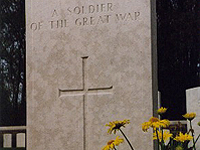
The grave of an unknown soldier in France Amazon.co.uk picks:
|

