
Tanya's | Travels
Home >
Europe >> Battlefields of the First World War >>> page 2
|
Tanya's | Travels
|
|
Home >
Europe >> Battlefields of the First World War >>> page 2
|
Africa | Asia | Australasia
Battlefields of the First World War continuedCopyright © Tanya Piejus, 1999 Saturday 10th April After an excellent night's sleep at the smart three-star Hotel L'Univers, we took the D939 out of Arras towards Cambrai. Our first objective for the day was to find war poet Wilfred Owen's grave in the small village of Ors near Le Cateau, which was taken by the Allies on the final push back into Belgium in the autumn of 1918. Owen was killed exactly a week before the Armistice whilst preparing to cross the Sambre-Oise canal with his troops. His parents received the telegram they'd been dreading for two years as the town bells of Shrewsbury were ringing to announce the end of the Great War. Their son's grave, and those of about 50 others, lies in the far corner of the village cemetery amongst the gaudy granite scrolls and mausoleums of local families. As ever, the small British cemetery is beautifully kept, the three rows of headstones clean and blemish-free, surrounded by a tightly-pruned low hedge and overlooked by the ubiquitous white cross. I soon found the grave of Lt W. E. S. Owen of the Manchester Regiment, aged 25, in the back row, third from the left, with two of his young Privates buried on either side. Fittingly, among the last words Owen ever wrote were: 'Of this I am certain you could not be visited by a band of friends half so fine as surround me here.' A bunch of blood-red flowers had been placed to one side along with two small wooden British Legion crosses and another cross, home-made. A poppy wreath with a photo of Owen and a message of remembrance had also been left beneath the headstone, as had a rather tacky plastic thing which appeared to have been lifted from one of the nearby Frenchman's graves. It said 'Amon Grand Pere' and had a bronze-effect rose stuck on it. It was a sweet, if somewhat odd, gesture. I think Owen, the poet and aesthete, would have been pleased with the simplicity of his own memorial and touched that people like us would take the time to visit his grave and remember him in their own way some eighty years later. On the way out of the quiet little village, we stopped on the bridge over the canal where Owen was shot and killed. It is an unremarkable stretch of straight, flat water, now verdant, peaceful and forgotten. Ors is a fair way from the Somme and we had a long drive back towards Albert to start our look at the scene of some of the bloodiest and most wasteful fighting in the whole war. We drove through Bapaume which was all but obliterated during the fighting and is now a small, modern town. Turning off the D929, we continued through Martinpuich to High Wood. A large number of men from the various London regiments are amongst the 1500 buried there after a failed attack on 15 September 1916 in which they fought with 'reckless bravery' according to the history books. The cemetery is a relatively small one and seemed oddly so until I recalled accounts of the fighting at High Wood and that very many of those who died were never recovered, their remains being cruelly scattered and obliterated by two months of continuous fighting. This was the fate of some 300 000 men, collectively 'the missing', whose names are recorded on six huge memorials in France and Belgium. High Wood itself, on the edge of which the cemetery stands, is now a tangled, pretty, bluebell-filled mass of green. At the time it was described as 'Ghastly by day, ghostly by night, the rottenest place on the Somme.' The wood was eventually captured from the Bavarian troops holding it at the end of that hard-fought day in 1916 which also saw the New Zealanders attack just up the road towards Flers. A memorial to them marks their furthest point of advance and stands on the top of a low hill surrounded by farmed fields. We went up the narrow strip of tarmac that ran straight through the fallow soil and stopped in front of the neatly trimmed lawn and chain-link fence encircling the plain stone obelisk that says 'To the ends of the Earth' under the inscription to the Kiwi troops. A chill wind was blowing across the featureless agricultural land and I felt deeply sorry for those young men who had come half way round the world to be mown down on a damp autumn day in the mud and grime of an alien country. What must the war have seemed to them? On through Longueval and we came to Delville Wood which was partly captured during a highly costly battle on 14th July the same year. Many of those who fought there were South Africans some of whom are buried alongside their other Commonwealth comrades, many of them Scots, in a huge cemetery. A massive monument on the fringe of the regenerated woodland commemorates the colonials and an avenue of Cape oaks lines the way up to it. These oaks were originally grown from French acorns so are a particularly fitting gesture. Again, the Commonwealth War Graves Commision must be praised for their thoughtfulness. We didn't have time to go in and see the memorial or the museum it has been expanded to contain. It's possible to walk in the wood, itself a mass grave for thousands of Allied and German dead, and see the rides that mark the trenches that were named after streets in Cape Town and Edinburgh by the troops that dug them. Apparently, there is also a solitary tree near the museum that survived the war. The scars of battle are visible but it grows strongly still. From Longueval, we followed the D20 through Contalmaison to La Boiselle where heavy fighting occurred on the First Day of the Battle of the Somme, 1 July 1916. One of the main strategic plans that day was to explode huge mines underneath the German lines and the crater of the Lochnagar mine remains today as a memorial. A hole 30 yards wide and many deep was made by 20 000 lbs of explosive and certainly gave the Germans a surprise when it blew up under their feet. A large wooden cross stands on its rim and a small ring of Royal British Legion crosses has been placed in the bottom of the pit, by whom I don't know but they are a poignant remembrance of the many thousands of men who were cut down that first day on the Somme. After a late lunch in Albert opposite the impressive basilica, we headed back up the D929 which bisects the Somme area and turned off for Thiepval. The Thiepval Memorial to the Missing can be seen for many miles in any direction across the former battlefield and records the names of 73 412 soldiers whose bodies were engulfed by the mud in 1916-17. It is a strangely alien-looking brick and stone thing designed by Edwin Lutyens that has two thick legs divided into wide pillars on which are carved the massed ranks of names, regiment by regiment. A knife-like and bitter wind whistled through it and the misty battlefields beyond looked especially bleak in the leaden afternoon we visited. The taking of Thiepval Ridge was a joint British and French achievement and this fact is marked in the cemetary below the memorial. Three hundred British and three hundred French soldiers were reburied from smaller battlefield cemeteries and now lie side-by-side to mark their combined efforts in battle. The headstones peer up in awe at the colossal monument, its great twin feet astride the hilltop, like so many supplicants kneeling in prayer. Between Thiepval and the Ancre Canal is the Ulster memorial which was being refurbished when we went past. It commemorates the Irishmen who died on the first day of the Somme, partly through being misinformed that British troops had captured Thiepval village. It is like a little castle made of thick grey stone. We didn't have time to stop but headed on over the canal to the Beaumont-Hamel battlefield where the Newfoundland Regiment fought and sustained heavy losses. A large section of the battlefield has been preserved and marked with signs that chart the progress of the Canadian soldiers of 1st July. An impressive, and quite different memorial, commemorates the 715 officers and men who died in No Man's Land that day. It is in the shape of a roaring caribou cast in bronze and is surrounded by plants from Newfoundland growing on the mound that raises it above the trenches and shell craters. Standing at its feet, it is much easier than elsewhere to imagine the scenes that went on at 9 am when the Newfoundlanders advanced through the dead and dying of the Scottish, Irish and Welsh soldiers who formed the first and second waves which had gone over the top before them. The British front line and support trenches are clearly visible, now grazed by a happily cud-chewing flock of sheep, and the few hundred yards of crater-scarred No Man's Land stretch out beyond. In the distance is a small memorial and line of trees that mark the German front line and Y Ravine, the troops' objective. I closed my eyes and imagined the sudden sound of birdsong as the screaming metallic bombardment ceased, then the thin shrill of the whistles ordering the men over the top. I then opened them and saw the ragged grey figures of men emerge from the zig-zagging slits below and walk uncertainly towards their destinies in the wire and shell-holes beyond, laden with redundant ammunition and sodden packs. A few made it past the 'danger tree', a battered stump that sits at the halfway point to the German lines, then disappeared into the fading distance, ghosts lost forever in rolling green. I walked alone across No Man's Land to the three cemeteries where those men fell and looked at the steep little valley that cost them their lives. Like so much of the fortified points that wave after wave of men were sent to capture, it looked so insignificant. Strategically, it meant everything but now it looks nothing; a crack in the ground that any land-owner would consider an unfarmable nuisance. We took a narrow, winding road north from the Canadian memorial to join the D919 where I was hoping to find the Sheffield Memorial Park and Railway Hollow Cemetery. A bumpy drive up the wrong farm track took us to another cemetery but eventually we found the little bottle green sign and followed a winding track to a dark, dense evergreen wood. The battalions of Kitchener's New Army suffered the greatest casualties at the onset of the Somme Offensive, none more so than the Pals' Battalions: groups of young men from the same factory, working town or school who were encouraged to join up en masse before anyone realised that an entire male generation from a town or village would suddenly cease to exist. The majority of the Pals came from the northern industrial cities and the Accrington Pals (officially the 11th East Lancashires) lined up alongside the The Sheffield City Battalion, or the 12th York and Lancasters, on 1st July 1916 to attack the German-held village of Serre. The 'Official History' of the war states that: 'The extended lines started in excellent order, but gradually melted away. There was no wavering or attempting to come back, the men fell in their ranks, mostly before the first hundred yards of No Man's Land had been crossed. The magnificent gallantry, discipline and determination displayed by all ranks of the North Country division was of no avail against the concentrated fire of the enemy's unshaken infantry and artillery, whose barrage has been described as so consistent that the cones of the explosions gave the impression of a thick belt of poplar trees.' Over one thousand men from these two battalions alone fell during the failed advance and their lost lives are marked in the tinder dry understory of the modern woodland by small, individual memorials. A black marble stone, poppy wreaths laid along its base, remembers the Barnsley Pals, and a sturdy wall of Accrington brick marks the pointless sacrifice of the East Lancashires who also served in Egypt. The whole woodland is the memorial to the Steel City men who fought along with them. Having spent three years studying in Sheffield, I wanted to remember the ancestors of the proud and always-friendly Yorkshire people I lived alongside. I was particularly touched that the body of one soldier had been recovered in 1926 and his grave is now marked by a simple, tall wooden cross bearing his name and the date of his official burial, rightfully attended by his family. It was starting to get cold and late in the day and we still had a long drive north across the Belgian border to Ypres. After about two hours on the autoroutes, we came into the pretty, grey-stone town in heavy rain. Not knowing where anything was, we headed for what seemed to be the middle and stopped in a large square. A huge Gothic building with an impressive clocktower faced us and a sign for a hotel beckoned us inside. Having settled in the strangely basic, apparently bathroomless, hotel, we set off to find the Menin Gate. I'd struggled with the Flemish town map and worked out that it was, usefully enough, just round the corner from the hotel on Meenenstraat. At 8 pm every evening since 11 November 1929, except during World War II, there has been a short remembrance ceremony to honour the 54 896 British and Commonwealth missing from the Ypres Salient whose names are carved into the white stone of the Menin Gate. They, and many more troops of 1914-17, marched through the gate on their way into battle at Passchendaele, the Menin Road and the two Battles of Ypres and never marched back. We stood with what must have been all the tourists in Ypres that night behind the chain fences as the local police stopped the traffic through the arch. The town's five fire brigade buglers marched neatly out into the middle of the road under the eastern end of the gate, their backs to the Menin Road, and a hush fell amongst the spectators. Into the silence the buglers poured out the crisp notes of the Last Post. Then a British Army captain marched out across the road and stood under the centre of the arch. With ringing military gusto, he read A. E. Housman's 'For the Fallen' and those watching, heads bowed, quietly echoed the last few words of the poem: 'We will remember them.' The captain marched briskly back and held a firm salute through a minute's silence. The buglers finally sounded reveille. The chains were let down, the traffic came through again and the spectators wandered away, quieter than when they'd arrived. It was a fitting end to a truly humbling day and over dinner I suddenly felt profoundly sad, even depressed. Visiting Auschwitz in 1996 had been a short, sharp shock. I'd gone there with little idea of what to expect, had been stunned and appalled, but had gone away with the sense that it was very much a part of the past and without really grasping the huge scale of death that had occurred in the camp. There was nothing to give perspective to the vast numbers of lives involved, no benchmark for understanding. But the last two days in France have had a far more penetrating effect on my emotions. It's impossible to travel more than a mile or two through a massive area of rural France without seeing a simple white cross standing above ranks of headstones, or to pass a distinctive green and white sign pointing the way up a narrow B road to a quaintly-named cemetery tucked away in a copse. It's this constant and unrelenting reminder of the many, many men whose ghosts haunt the battlefields, and the many more whose final whereabouts aren't even known, that sink into the soul and impress the mind with the huge and brutal scale of the war that was supposed to end all wars. We go through the motions of keeping a generation's memory alive but the Second World War claimed the blood of their sons and younger brothers, then Korea, Vietnam, the Falklands, the Gulf... Will the human race ever learn from the lessons of 1916? Next page... |
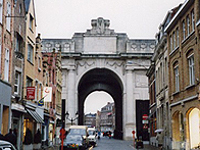
The Menin Gate, Ypres Amazon.co.uk picks:
|


