
Tanya's | Travels
Home >
Europe >> Battlefields of the First World War >>> page 3
|
Tanya's | Travels
|
|
Home >
Europe >> Battlefields of the First World War >>> page 3
|
Africa | Asia | Australasia
Battlefields of the First World War continuedCopyright © Tanya Piejus, 1999 Sunday 11th April Our bizarre hotel was comfortable enough although room 6, which supposedly held the bathroom, was occupied by a slumbering body when I went in with the intention of having a shower. After breakfasting in the hotel dining-room, we checked out into a bright, sunny morning and walked back round the corner to see the Menin Gate in daylight. The sun cast hard-edged shadows down the stairways and through the arches of the gate as we explored its ranks of names. The light made it less sombre but no less powerful in its reminder of the vast number of men who died in the Ypres battles. The inscription on each side of the arch reads 'Here are recorded names of officers and men who fell in Ypres Salient but to whom the fortune of war denied the known and honoured burial given to their comrades in death'. It suits the cold magnificence of the memorial. Taking the N69 out of Ypres, we headed towards the village of Messines that gave its name to one of the most important strategic features of the war, Messines Ridge. Our first stop was at what has become known as the Pool of Peace along the road to Kemmel from Wijtschate. Spanbroekmolen Crater was the result of the largest of a chain of mines that was ignited under the ridge in early 1916. It contained 91 000 lbs of explosive and the crater is 96 m wide and 12 m deep. It is now next to a small farm and filled with water, hence its acquired name. The sun glittered on the wavelets caused by a cold breeze rumpling its surface and it seemed like any other farm pond. Its perfectly spherical shape, though, gives away the secret of its earth-shattering origin. Continuing on down the N69, we arrived in the pretty little village of Messines (a.k.a. Mesen) itself. We looked for the so-called 'Four Huns' bunker on the way in but, not knowing what it looked like or exactly where it was, failed to locate it. We went on down the N304 towards Wulvergem to the Messines Ridge British Cemetery which houses the graves of soldiers of many nationalities other than British. It is also home to the New Zealand Memorial to the Missing. This is a Cross of Sacrifice mounted on a circular plinth onto which are inscribed many names, some with obscurely quaint ranks not seen elsewhere like Army Cyclist. The cemetery contains approximately 2000 graves and, as we wandered among the rows, dogs barked and music blared from the windows of the farm next door, as if we needed a reminder that life goes on despite the casual atrocities of occasional war. On our way to the New Zealand Memorial Park south of Messines, we saw a sign to something that we did not even know existed - the Island of Ireland Peace Park. It was opened as recently as 11th November 1998 by the Queen and King Albert of Belgium so was not included in my Flanders book. It is a memorial to the Irish Regiment who fought on the ridge and to the sappers who dug out and laid the mines. In the middle of the garden is a tall, pointed tower made in stolid granite which is a replica of one in Ulster. Surrounding the tower are rows of straggly small trees which apparently represent the regiments of Ulstermen marching home. The park looks new with its bleached paths unsullied by weeds and its clean-cut borders round beds of spindly bushes, but when it has had a year or two to settle down and flesh out its foliage, I am sure it will be a lovely, peaceful place with its commanding view across the Belgian countryside and over the border into France. The New Zealand Memorial is an impressive white stone obelisk on a wide, terraced platform. This is surrounded by well tended, sloping landscaped gardens which take in two concrete German pill-boxes, half sunk into the ground. These were part of the rear defences of the German front line. One of the pill-boxes is blocked up with earth but the other has enough room to peek inside. The dank interior is knotted with wire and lumps of rubble. I felt sympathy for the young men that must have shivered and cursed their fate as allied shells crashed around them and run for their lives from the poky, dark shell as the waves of khaki finally overcame them. Carrying on down along the N69 another 3 km brought us to Ploegsteert and the infamous Plugstreet Wood. Most of the wood was held by the British for the majority of the war but the Germans captured it in April 1918. We stopped at the Hyde Park Corner cemetery, official graveyard of the Royal Berkshires which straddles the narrow road. This cemetery is obviously at the wrong end of the six-year Commonwealth War Graves Commission cleaning cycle as many of the stones were green with rain-washed algae and some of the foliage was looking tired. It is the only cemetery we have seen that looks a little unkempt. However, the cemetery also contains the Ploegsteert Memorial to the Missing, an imposing circular classical monument guarded by two stone lions with a central colonnade around which are inscribed 11 447 names of men lost in that sector. It is a very impressive and fitting memorial, surrounded as it is by neat rows of headstones and the thick foliage of the wood which stretches away in all visible directions. Our last stop, on the way back into Ypres, was a very pretty cemetery just south of the town on the N365 on the west side of the road just north of St Eloois. Here, as in France, we constantly pass the bottle green signs that pointed the way to small cemeteries in fields and wooded areas just off the road. There is no let-up in the march of the dead. We knew of an excellent museum housed in the Cloth Hall in Ypres but, not knowing where the Cloth Hall was and being unable to read Flemish, we knew that finding it would be a challenge. We went back to the map in the main square and found the word 'Lakenhallen' which seemed the most likely candidate for what we were looking for, but the map unhelpfully made no mention of a museum. We realised that what we sought was close by and wandered round the back of the large Gothic building that we'd admired yesterday. We found a sign next to the door of a house which said 'In Flanders Fields Museum' and rang the bell. No response. Disappointed, we at first thought that maybe the museum was closed but this didn't seem likely. On closer inspection, we realised that this was just the head office and library of the museum and that the museum itself was elsewhere. We soon decided that the Cloth Hall was, in fact, the magnificent building with the clock tower that we had been praising minutes before! Back in the main square we walked around what was evidently the rebuilt Cloth Hall and found the door to the museum. The In Flanders Fields Museum was well worth the searching as it is truly excellent. I don't think I've been to a better museum before or since. It is an imaginative study of the war in general interspersed with the involvement of the town of Ypres itself. It has many features the like of which many other museums would be well to emulate. There is a display about the poetry of the war consisting of recorded readings of two poems, one of which is Wilfred Owen's 'Dulce et decorum est', the other John McRae's 'In Flanders Fields', appropriately enough. These are accompanied by changing coloured lights which drench a large wall display of blow-ups of the hand-written poems. The lights are red for the poppies of 'In Flanders Fields' and green for the mustard gas of 'Dulce at decorum est'. Meanwhile, perspex tubes containing gas masks fill with dry ice and the sickly green light shining through it gives a gruesome effect. Along with a particularly sinister reading of the poem, the effect is simple but stunning. When you first arrive at the museum, you are asked your nationality and are given a plastic card with a bar code on it. As you progress through the museum, you swipe the bar code to get details on a touch-screen computer of a soldier of your nationality who fought in the war. Ours was an 18-year-old Regular called Willy McNally who fought in several battles and eventually met his end at Passchendaele in 1917. His is one of the many names on the memorial to the missing at Tyne Cot cemetery and I made a mental note to look for his name when we visited in the afternoon. The museum is an interactive, creative and fascinating experience and I would like to have had more than the one and a quarter hours we spent rushing through it before we had to move on. I would thoroughly recommend it to any visitor to Ypres, whether they are interested in the war or not. We didn't have time to climb the clock tower, visit the cathedral or St George's church which houses many British memorials but I have read that they are all worth a visit. We took the main N9 route east out of Ypres to Hooge and Sanctuary Wood. The wood and what was Hill 62 are now commemorated with an eccentric museum and some preserved trenches behind it. It is run by an elderly Belgian and is chockfull of all kinds of mad detritus dug up from the surrounding battlefield and other rusted bric-a-brac from the war collected by the owner. There are some chilling dioramas of what the area looked like during the war years, denuded of trees smashed apart by constant shelling, stinking craters full of rain and decomposing bodies, and rank trenches filled with exhausted and shell-shocked wraiths of men. The remains of these trenches zigzag through the regrown Sanctuary Wood and we walked along them and peered under the corrugated tin roofs and barbed wire into the sticky, wet dug-outs that would have been the soldiers' only shelter. On a sodden, leaden day it must be grim even now but the pleasant spring day was devoid of horrors. Two children in red wellies splashed along the trench floors and ran through the trees skipping over shell holes, oblivious of the ghosts. Heading towards Zonnebeke, we passed Polygon Wood, so named because of the 'polygone' at its heart which was a Belgian training ground. It contains an obelisk memorial reached via a long flight of steps to the 5th Australian Division, plus two British cemeteries in a peaceful, breezy woodland. Families strolled in the sunshine on the long ride between the trees that leads away from the memorial which commemorates the bravery of the colonials who broke through the German lines and finally took the wood on 21st September 1917. The wastage of the battles surrounding Passchendaele in 1917 can best be seen at our final stop of the trip, Tyne Cot British Cemetery and Memorial. The 50th Northumbrians named the area because they thought that the German bunkers, a few of which are still there, looked like Tyneside cottages. The cemetery and gardens rise up a hillside off the west side of the N303 before the village of Passchendaele. It's the largest Commonwealth cemetery in the world with 12 000 graves and a further 35 000 names on the huge curving wall of the missing at the top of the cemetery. The central cross sits on top of a bunker and is surrounded by the dead from a dressing station buried in randomly scattered graves. I sat on the base of the cross and surveyed the row upon row of neat graves filled by soldiers carried here from other parts of the battlefield, drinking in the sunshine that flooded across the fields that hide the British lines spreading away through the small villages below. I kept my promise to Willy McNally and found his name among the thousands of others on the wall of the missing; the thousands of men and boys who, unlike my Mum and me, will never be going home. Looking across the field of silent headstones, I felt a profound sense of loss although I have no relatives to my knowledge who died in the war. My great grandfather was one of the lucky ones who came back unscathed save for the nightmare memories of the four bitter, bloody years of the First World War. Words fail. Back to Europe page...
|
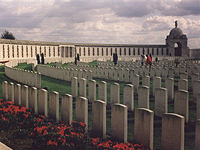
Tyne Cot cemetery, Belgium Amazon.co.uk picks:
|

