We break camp at 9:15 and hit the road towards the town of Paryang, 255 km to the west. As we are on a main route, the road condition is better than yesterday's.
A number of our party are ill, generally of a digestive nature. Before leaving Kathmandu, Dick warned me that soon the main topic of conversation among us would be the state of our bowels; his prediction proves true. One of the women seems to be afflicted with altitude sickness, especially headaches. We make frequent stops for bathroom breaks.
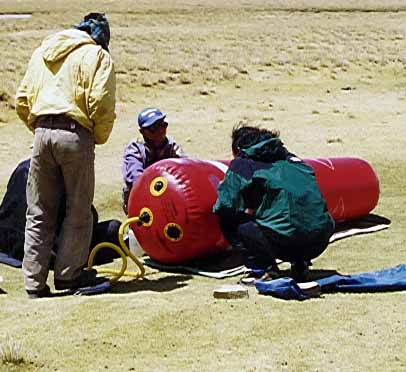
At 1:00pm we stop for lunch just after a Chinese road checkpoint. The woman with the headache is no better, and the guides decide to put her in the Gamow Bag. This bag is an airtight rubber container connected to a foot-operated air pump. Pumping the chamber full of air at about 2 PSI reduces the effective altitude by several thousand feet. This treatment is often very effective in releaving altitude-related symptoms. She remains in the bag for 45 minutes, and seems to feel better. While in the bag, the person being treated can be subject to claustrophobia. Therefore there is a clear window in the top of the bag, and people take turns talking to her. I find a VOA station on my shortwave which plays Garth Brooks for her. The bag attracts the interest of a number of Tibetan herders as well. They gather around to watch as one of the guides slowly pumps air while we chat with our patient.
We make camp early, and the woman goes back in the bag for over an hour. Once again I find VOA and BBC on the shortwave, to which she listens while inside. I also find Radio France International, and the French news tells us that Frank Sinatra has died. When she emerges from the bag, she feels much better, and will have no further problems the rest of the trip. That is the last time the Gamow Bag is needed as well.
This night it gets quite cold. On awakening the next morning, there is ice in our water bottles, and the thermometer reads 28F.
This day is a long drive starting at 9:15am and camping at 7:00 in the evening. The road is quite bad, and everybody is sore from the jouncing. We ford several streams, and in one of the wider ones the lead land cruiser gets stuck. 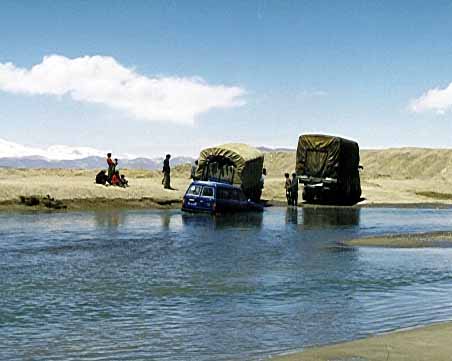 The driver had neglected to engage the front wheel hubs. When our truck arrives, the crew attaches a cable and pulls the land cruiser free. In the photo you can see that a Chinese truck has broken down blocking the ford; this is the primary reason that our vehicle became bogged down.
Later in the afternoon, our land cruiser runs out of fuel, and we must wait to be refueled from the truck. While on the subject of breakdowns: several times per day our driver, Mr. Yu, is forced to stop the engine, remove the fuel filter and tap it to dislodge dust and dirt to unclog the passage. Apparently the gasoline supplied by the Chinese is contaminated with dirt that clogs the filters. Initially this repair is disconcerting, but after several days we become accustomed to the filter being tapped against the front fender during bathroom breaks.
Despite the desolate nature of the landscape, there is a large amount of animal life to be seen. This includes yaks, sheep, ducks, marmots, ravens, vultures, and a type of small bird which resembles a sandpiper. It hunts for insects by scurrying about probing the sand with its long pointed bill. Once we see a small herd of wild donkeys in the distance. There are a large number of dead animals (yaks and cattle), the picked carcasses lying beside the road. The guide tells us that there were severe blizzards in February, and that many animals perished.
We are scheduled to arrive in Darchen the next day. Camp is at 15,500 feet, below the Mayum La pass.
Page 7