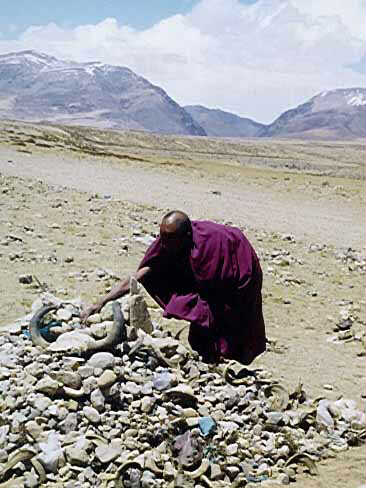
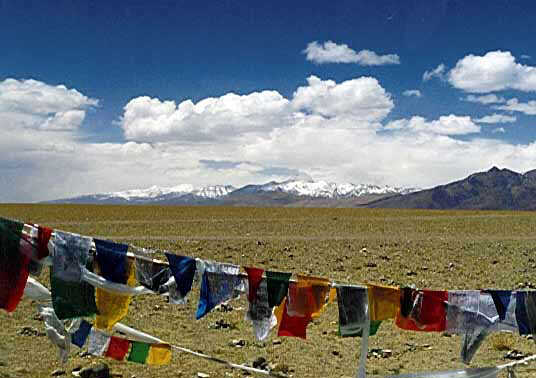
We break camp at 9:15am and once again have a long day on the road, which is very bad once again. Some parts are the worst we have traversed to date. After a couple of hours, we crest the Mayun La pass (5171m, 16,100 feet) where there is the usual "maypole" with streamers of prayer flags, mani stones, and carved yak skulls.
Shortly afterwards we pass a man and woman with touring bicycles trying to ford a stream. I thought it incredible that people could try the same journey on bicycles that we are doing in trucks and land cruisers. Their bikes are loaded with camping gear.
When we stop for lunch, we find that the truck has picked up a Tibetan pilgrim on the road, a lama intent on performing the Kora of Kailash. The story of "our lama" as we come to think of him is interesting, so I will relate it now.
I never did learn his name, but he had travelled from the Yenang province of China, and had been on the road for over 6 months. Some days he had hitched rides, and other days he had walked. He was 67 years old, about 5'4" tall, and carried a backpack made of bamboo as well as a bamboo walking stick. Other than that and his clothes, his sole possessions were religious articles he carried in a sort of fanny pack around his waist.
In principle, foreign tourist groups are not allowed to pick up native hitchhikers, so our guides told him to stay in the truck when we passed any checkpoints. All went well at our first checkpoint of the afternoon, but at the second, the last before Darchen, the Chinese soldiers forced him to dismount from the truck, and we went on without him.
Three days later, we see him on the Kora, and hear what had happened with the Chinese. He had shown them his travel permit, a well folded flimsy piece of paper. However, they had searched all of his positions, and had found a tiny picture of the Dalai Lama in his fanny pack. This discovery caused further interrogations and abuse. Finally he had stated "I'm 67 years old and prepared to die. So you can either kill me or let me go." The Chinese didn't have a ready response to this choice, and eventually they let him take the road to Kailash once again.
On the second day of the Kora, I walked along with him for several miles in silent companionship, occasionally offering him a drink of water. However, I must now confess that this small old man with his heavy pack and worn canvas shoes soon left me in the dust as I plodded heavily along leaning on my hiking poles for security.
On the day we finished the Kora, we saw him a final time arriving back in Darchen just as we were leaving. He was apparently planning multiple circuits before undertaking the long trek back home.
First View of Mt. Kailash
In mid afternoon, we mount a small ridge marked with prayer flags and mani stones. This point is the first from which Mt. Kailash is visible. The buddhist members of our party as well as many of the guides prostrate themselves and chant mantras. Some add prayer flags to the already loaded ropes. Our lama bustles about chanting while neatening up the pile of mani stones which surrounds the prayer flagpole.
We still have several hours driving to get arrive in Darchen, but this initial glimpse is reassuring; we have not come all this way in search of a myth.
We drive several more hours, passing two more checkpoints. At the last, our lama is removed from the truck, and after about 30 minutes of delay we are allowed through. Another hour brings us to the town of Darchen, the starting and ending point for the Kora. Darchen is a cluster of mud brick buildings and some enclosed spaces for livestock. Outside of the town proper is a tent city of pilgrims who are awaiting the festival of Sakya Dawa, the first full moon after Buddha's birthday.
Our lodgings for the next two nights are in a sort of guest house consisting of a ground-level corridor with bedrooms arranged along one side. Each of the rooms contains three beds, a dresser, and a thermos for hot water. Although we all sleep in our sleeping bags on top of the beds, being under a roof rather than in a tent makes for a nice change. The crew sets up the cook tent outside the guest house, and our dining room is in the crew's bedroom.
Page 8
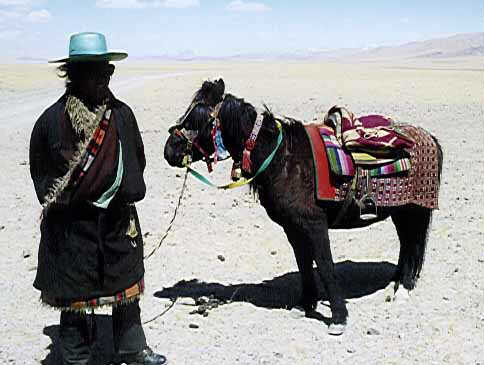 In mid morning we meet the nomad pictured here. He says that he has been scouting pasture for his family, and that they are about to move their herds to the new pasture. They have several hundred sheep and goats. He is quite accomodating, and all of us tourists get busy snapping photos of him and his horse. Note the authentic clothing and horse equipment, but his hat is plastic! Then, he walks away towards the distant hills leading the horse by the bridle. Later I learn that there is a Tibetan aphorism, "A horse that will not carry a man uphill is no horse. A man who rides a horse downhill is no man."