Diamond
 Introduction
| Diamond is one of the allotropes of carbon. It is the hardest known substance. Diamonds are believed to have been formed in the earth from carbon containing material subjected to great pressures and high temperatures. Diamonds exhibit a wide range of transparency and colour. All good gem diamonds are transparent and colorless stones. Colour in diamonds is caused by the presence of minor elements other than pure carbon. |
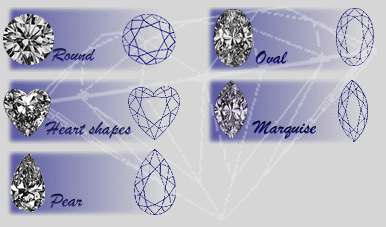
Different shapes of diamond
Formation
| A crystal of diamond contains millions of carbon atoms. In diamond, all the carbon atoms are sp3 hybridized, joining into a three dimensional network by strong, rigid and directional C-C covalent bonds. Each carbon atom is tetrahedrally bonded to four neighbors by strongσ covalent bonds. Diamonds were born in dying volcanoes. As the molten lava in the necks of these volcanoes solidified, the tremendous heat and pressure acted on carbon that was present in the lava. The heat and pressure forced the carbon atoms to line up in eight- sided crystals. It is this shape that gives diamonds special qualities. Not all volcanoes contained carbon in their lava.This is why diamonds were formed in only a few volcanic regions. |
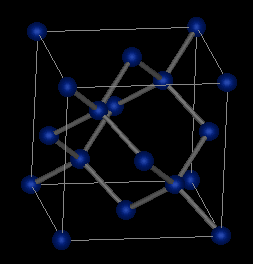
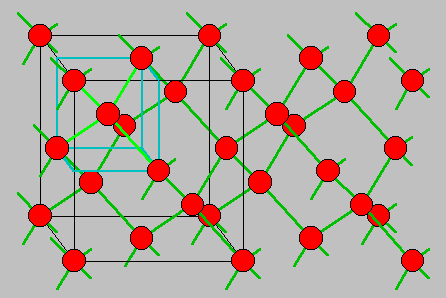
The unit cell of diamond
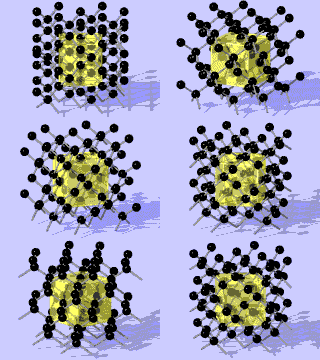
Rotating model of diamond
Extraction
1. Mined by digging out weather lava soil from volcanoes 2. Recovered from gravel deposits in streambeds |
Properties
1. Atoms cannot slip over another(due to strong C-C bonding pattern in diamond).This accounts for its stability and extreme hardness 2. Very stable(created deep underground under conditions of extreme pressure and temperature) 3. Has high values of melting point, boiling point and latent heat(melting and boiling require significant disruption of the strong covalent bonds in the network, considerable energy is required) 4. Non-conductor of electricity(electrons are localized inσbonds) 5. Excellent conductor of heat and so make them cold to touch 6. Heat does not melt diamond or distort their shape. However, extreme heat will turn diamonds into graphite in the absence of oxygen. 7. Not corrode or tarnish(diamonds do not react with other substances at ordinary temperatures) |
Applications
1. Mechanical parts that must resist wear or undergo sudden temperature changes 2. Deep drilling equipment for oil and other minerals 3. Low-friction bearings for precious watches and instruments 4. Making diamond cutting tools 5. Polish hard metal |

A real diamond

 Send email to us if you have problems.