RANELLIDAE
common name: tritons
Characteristics:
External
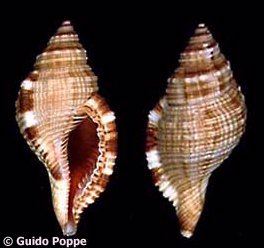
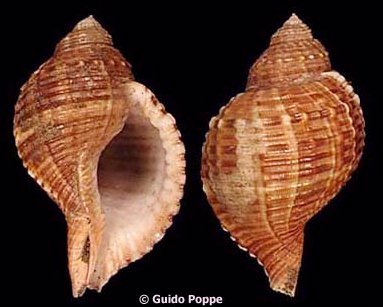
1. most have columellar folds and prominent varices
2. teeths and/or folds on outer lip
3. hairy periostracum in most ranellids
Internal
1. salivary ducts passing through nerve ring (similar to Cassidae)
2. long tapering penis (?)
Habitat: widely distributed in warm, tropical seas. On rocky shores, coral reefs and sand habitats.
Feeding:
The diet of ranellids are the most extensively studied of the tonnoideans. Ranellids are generalist feeders, preying on such items as polychaetes, gastropods, bivalves, cirripeds, echinoiderms and ascidians (Day 1969; Houbrick & Fretter 1969; Laxton 1971). Cymatium pileare is a voracious feeder of ostreid bivalves, and are a major pest in oyster farms (Littlewood 1989). Linatella caudata fed on a wide variety of prey items in aquarium conditions but attacked mainly bivalves (Morton 1990). The intertidal ranellid Gyrineum natator, common on our local shores, consumes algae, in addition to other prey items. Algal feeding is not exhibited by other ranellids, or tonnoideans for that matter. This enigmatic gastropod, in addition to algal pieces, had sponge spicules, hydroid bodies, polychaete setae, amphipod fragments bryozoans and holothurian spicules in gut samples (Taylor 1977; Taylor & Morton 1996). Various types of algae, sponges and bivalves were eaten by G. natator when introduced in aquarium experiments (Neo 1999; Neo et al. 2000). Other prey items were not tested in aquaria and thus were not confirmed if these items are its true diet.
The mode of feeding of the ranellids are similar to bursids in some ways. For example, it also uses acidic secretions to paralyse prey. Taylor (1998) observed Gyrineum natator dissolving a large hole in the shell of the rock oyster Saccostrea cucullata in aquaria. Erosion of shells by another ranellid, Argobuccinum argus, were also documented by Day (1969).