Petrópolis - RJ
click here for more about the Bauernfest'99
esta página em  |
In kürze diese Seite in  |
-
Welcome ! Like all home pages, this one is also in a permanent process
of building. Therefore, if you were patient enough to get here, you could
easily spend some more pulses (or tones) and leave here
your criticism (many ones) and suggestions (I'm looking for many ones).
I won't bore you with details such as my favorite football team, the name
of my dog, family photos and any similar things.
-
Nevertheless, I can't avoid inviting you to visit the city where I live,
Petrópolis (RJ), "Brazil's Imperial Capital" ! It's worth it. If
you have never visit it, click the photos and check it yourself !
-
All photos by Marcos Pinto
-
-
The City Council
-
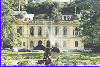 - The building
(also known as "The Yellow Palace") was built in 1850 and has two floors.
Its owner was José Carlos Mayrink da Silva Ferrão, and before
being acquired by Petrópolis'City Council (in 1894), it was owned
by the Baron of Guaraciaba.
- The building
(also known as "The Yellow Palace") was built in 1850 and has two floors.
Its owner was José Carlos Mayrink da Silva Ferrão, and before
being acquired by Petrópolis'City Council (in 1894), it was owned
by the Baron of Guaraciaba.
-
Both garden and the statue situated in front of it, compose an attractive
architectonic assemblage. Inside the building, a marble flight of stairs
and fine details in wood make the building even more attractive.
-
Address : Rua (Street) Visconde de Mauá, s/n - Centro
-
It isn't opened for visiting.
-
-
Saint Peter of Alcântara's Cathedral
-
 - Its building
began in 1884 under the auspices of D. Pedro II and Princess Isabel, and
was only inaugurated in November 29, 1925.
- Its building
began in 1884 under the auspices of D. Pedro II and Princess Isabel, and
was only inaugurated in November 29, 1925.
-
Its front is in french Gothic style of the XVIII century and a
remarkable work in granite masonry.It is a building of 70 meters in length
and 22 meters in breath. It is high and its tower rises 70 meters above
the ground. It's dedicated to the saint patron of the city, Saint Peter
of Alcântara, whose image can be found inside the church, and which
was built by the Frenchman Jean Magrow. The four bronze bells were molten
in Passau (Germany), and they weigh 9 tons. In the center of the chapel
you can find a mausoleum of the Emperor D. Pedro II and the Empress Thereza
Cristina, a magnificent work in Carrara Marble, weigthing almost 3 tons.
The sculpture of the Princess Isabel and Earl D'Eu are also situated inside
the Cathedral.
-
-
The Crystal Palace
-
 - Built in pre-molded iron,
at the workshops of S.A Saint-Sauver-Les Arras, (1879) in France, and inaugurated
in 1884, the Crystal Palace is made of a metallic structure and plates
of french glass. There is a square central body connected to other two
rectangular ones, and there are also two other semi-circulars, united to
the central body. The Palace was built simultaneously to the Eiffel Tower,
and it is one of the examples of how the Industrial Revolution had influenced
the architectonic styles. The building was raised by the Brazilian engineer
Bonjean. It was Brazil's first pre-molded building.
- Built in pre-molded iron,
at the workshops of S.A Saint-Sauver-Les Arras, (1879) in France, and inaugurated
in 1884, the Crystal Palace is made of a metallic structure and plates
of french glass. There is a square central body connected to other two
rectangular ones, and there are also two other semi-circulars, united to
the central body. The Palace was built simultaneously to the Eiffel Tower,
and it is one of the examples of how the Industrial Revolution had influenced
the architectonic styles. The building was raised by the Brazilian engineer
Bonjean. It was Brazil's first pre-molded building.
-
The building of the Crystal Palace was suggested by Earl D'Eu and supported
by the Princess Isabel; and it was destinated to the headquarters of the
Petrópolis' Horticultural and Agricultural Association. By the time,
it has two purposes; an exhibition place for plants and fruits, and an
assembly room. In April 1, 1888, the Princess Isabel gave to 103 slaves
their "Set Free Letter", in a ceremony celebrated at the Crystal Palace.
-
Address : Rua (Street) Alfredo Pachá, s/n - Centro
-
Visiting schedule : from Tuesday to Sunday
-
from 09:00 to 17:00
-
-
Santos Dumont's House ( The Enchanted)
-
 - Santos Dumont's
summer resort was projected by him in 1918, but its plan is signed by Eduardo
Pederneiras, since Santos Dumont wasn't an architect. The house is a chalet
in the Alpine french style and with a roof of tin plates.
- Santos Dumont's
summer resort was projected by him in 1918, but its plan is signed by Eduardo
Pederneiras, since Santos Dumont wasn't an architect. The house is a chalet
in the Alpine french style and with a roof of tin plates.
-
This curious house shows exactly the genius its owner was. In the first
floor it is situated the inventor's workshop; in the second floor a living
room and a bathroom. On the top of the house there is a belveder which
was used as an astronomy observatory.
-
The most interesting attractions of the house are the small details, which
demonstrate all creativity of the " Aviation's Father ". As soon
as you enter the house, the visitor is obliged to go upstairs in a way
that the person is forced to begin the climbing with the right foot. Inside
the house every place is exploited in an intelligent way. Among other things,
there is also an alcohol-heating shower which the water temperature
is controlled by two threads, that control the mixture of hot and cool
water.
-
The house, called by Santos Dumont as " The Enchanted " and which was used
by the inventor as a summer resort, had all its furniture bestowed to the
Petrópolis City Hall in 1946.
-
Address : Rua (Street) do Encantado, 22 - Centro (Close to the Flower Clock,
another beautiful attraction to see)
-
Visiting schedule : from Tuesday to Sunday
-
from 09:00 to 17:00
-
-
Imperial Museum
-
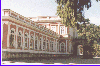 - A Summer
Imperial resort ordered by the Emperor D. Pedro II to the
- A Summer
Imperial resort ordered by the Emperor D. Pedro II to the
-
The garden which was created after the building of the palace, was planned
by the botanist Jean Baptiste Binot. It was inaugurated in March 16, in
the year of 1943, paying homage to the commemorative foundation date of
Petrópolis.
-
The architecture of the building follows the neoclassic style and wasn't
considered a luxury place, once it was the residence of sovereigns, but
it was perfect as a cottage, in sprite of being elegant.
-
The building is made of a central body, with two floors and a terrace above
the portico, and with two wings with twelve windows each. In its central
front there are the Empire Arms.
-
The Imperial Museum's heap assembles pieces which belong not only to the
summer palace itself, but there are others objects which belonged to the
Paço Imperial (Imperial Palace) in Rio de Janeiro; and besides that,
there is a series of objects related to many historical passages from the
Brazil Empire. There are many objects and documents of great historical
value, among which is the Imperial mantle, the cocked hat, made of felt
which has belonged to D. João VI, the Sévres safe from the
Princess of Joinville, and the crowns of both emperors.
-
The crown of D. Pedro I had its precious stones extracted and used in his
son's crown.
-
Address: Rua (Street) da Imperatriz, 220 - Centro
-
Telephone number : (051-0242-427012)
-
Visiting schedule: from Tuesday to Sunday
-
from noon to 17:00
-
Soon the museum will have his own home page.
-
Watch here an image of the Imperial Museum before
there was its garden.
-
-
The Quitandinha's Palace
-
 - It was built
in 1944 to become the biggest South America's casino-hotel; in Norman style
is one of the most striking architectonic monuments in Petrópolis,
with its 50.000 square meters and six floors, and saloons with ten meters
high.
- It was built
in 1944 to become the biggest South America's casino-hotel; in Norman style
is one of the most striking architectonic monuments in Petrópolis,
with its 50.000 square meters and six floors, and saloons with ten meters
high.
-
There are 440 flats and other 13 big saloons. Inside one of these saloons,
the ceiling is a striking piece of engineering : a dome with 30 meters
high and 50 meters of diameter, which produces an intersting echo sound,
(if you are in the apropriated "echo point") where your voice can
be even repeated 14 times ! the project followed the norman style,
which is quite remarkable in Petrópolis, due its German colonization.
Besides that, there is also a mechanized theatre with a revolving stage,
leisure areas (table-tennis, bows, roller-rockey and a warming pool among
other attractions).
-
In the past, the palace was the biggest casino of Latin America, during
the time gambling was allowed in Brazil, between 1930 and 1946 (it seems
to me that soon, the good times will be back!). although nothing can be
officially confirmed, it is said that there were people who lost everything
gambling, and after that tried to commit suicide jumping in the lake, which
has a tiled bottom.
-
Today the lake is used for leisure with boats and pedal boats.
-
Address: Avenida (Avenue) Estados Unidos, 2
-
Telephone number : (051-0242-421012)
-
Visiting schedule : from Tuesday to Sunday
-
from 09:00 to 17:00
-
Physical and Geographical Aspects
The climate is tropical, with temperatures raising 23º C in the
hottest months, and 14º C in the coldest months. The County, whose
area raises 853 Km² is divided into 5 Districts: Petrópolis,
Cascatinha, Itaipava, Pedro do Rio e Posse. It has an average population
of 285.000 inhabitants.
Principal Distances:
Rio de Janeiro-------- 53 km.
São Paulo------------- 456 km.
Belo Horizonte------- 375 km.
Vitória---------------- 570 km.
Main events:
Farming and cattle raising exposition; Italian Party and the famous
Bauernfest (German settler's Festival).
-
Did you like it ? Send me
your opinion !
-

hits here! Thank you all!
-
-
This page hosted by
 Get your own Free Home Page
 - The building
(also known as "The Yellow Palace") was built in 1850 and has two floors.
Its owner was José Carlos Mayrink da Silva Ferrão, and before
being acquired by Petrópolis'City Council (in 1894), it was owned
by the Baron of Guaraciaba.
- The building
(also known as "The Yellow Palace") was built in 1850 and has two floors.
Its owner was José Carlos Mayrink da Silva Ferrão, and before
being acquired by Petrópolis'City Council (in 1894), it was owned
by the Baron of Guaraciaba.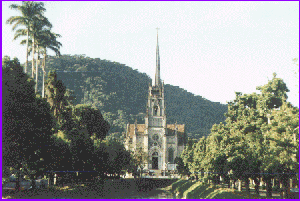 - Its building
began in 1884 under the auspices of D. Pedro II and Princess Isabel, and
was only inaugurated in November 29, 1925.
- Its building
began in 1884 under the auspices of D. Pedro II and Princess Isabel, and
was only inaugurated in November 29, 1925. - Built in pre-molded iron,
at the workshops of S.A Saint-Sauver-Les Arras, (1879) in France, and inaugurated
in 1884, the Crystal Palace is made of a metallic structure and plates
of french glass. There is a square central body connected to other two
rectangular ones, and there are also two other semi-circulars, united to
the central body. The Palace was built simultaneously to the Eiffel Tower,
and it is one of the examples of how the Industrial Revolution had influenced
the architectonic styles. The building was raised by the Brazilian engineer
Bonjean. It was Brazil's first pre-molded building.
- Built in pre-molded iron,
at the workshops of S.A Saint-Sauver-Les Arras, (1879) in France, and inaugurated
in 1884, the Crystal Palace is made of a metallic structure and plates
of french glass. There is a square central body connected to other two
rectangular ones, and there are also two other semi-circulars, united to
the central body. The Palace was built simultaneously to the Eiffel Tower,
and it is one of the examples of how the Industrial Revolution had influenced
the architectonic styles. The building was raised by the Brazilian engineer
Bonjean. It was Brazil's first pre-molded building.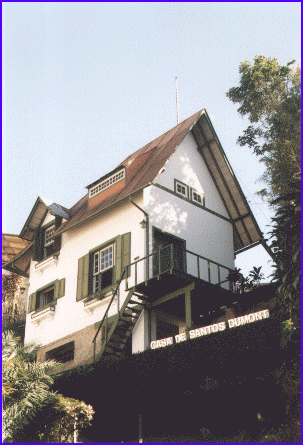 - Santos Dumont's
summer resort was projected by him in 1918, but its plan is signed by Eduardo
Pederneiras, since Santos Dumont wasn't an architect. The house is a chalet
in the Alpine french style and with a roof of tin plates.
- Santos Dumont's
summer resort was projected by him in 1918, but its plan is signed by Eduardo
Pederneiras, since Santos Dumont wasn't an architect. The house is a chalet
in the Alpine french style and with a roof of tin plates. - A Summer
Imperial resort ordered by the Emperor D. Pedro II to the
- A Summer
Imperial resort ordered by the Emperor D. Pedro II to the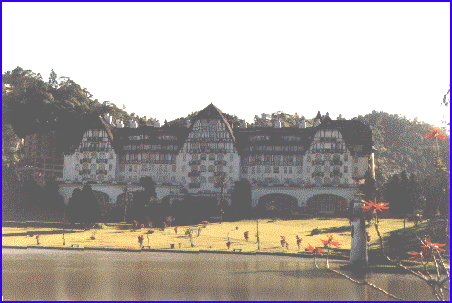 - It was built
in 1944 to become the biggest South America's casino-hotel; in Norman style
is one of the most striking architectonic monuments in Petrópolis,
with its 50.000 square meters and six floors, and saloons with ten meters
high.
- It was built
in 1944 to become the biggest South America's casino-hotel; in Norman style
is one of the most striking architectonic monuments in Petrópolis,
with its 50.000 square meters and six floors, and saloons with ten meters
high.