

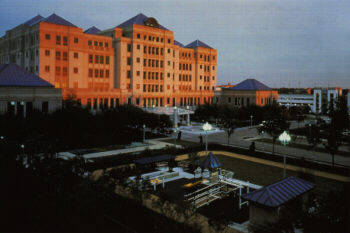
Cook Children's Medical Center cares for patients from birth through age 21, and offers a spectrum of over 40 pediatric specialties, from transplants to tonsillectomies. Services include bone marrow transplants, open heart surgery, and neurological rehabilitation.
There are many differences that separate pediatric health care from adult health care. Children respond differently to both illness and treatment, depending on growth and development. Children can suffer from different types of illnesses than the ones experienced by adults. Children also come in all sizes, from infants to teens, and they need services and equipment tailored to fit their smaller size. Very young children are limited in their ability to communicate their symptoms, so they require more assurance during treatment to avoid trauma.
Cook Children's is also active in advocacy efforts, from child safety laws to immunizations and wellness concerts, and reaches out to serve all children, regardless of a family's ability to pay.
Their Hematology & Oncology Center is one of only a few programs in this region that offers a complete spectrum of pediatric hematology/oncology services, specializing in many illnesses such as leukemia, brain and other solid tumors, sickle cell anemia, hemophilia, and acute and chronic hematologic disorders.
Cook Children's bone marrow transplant program is the largest and most diversified pediatric transplant program in Texas and adjacent states. They perform both autologous and allogeneic transplants and have the capability to harvest, T-cell deplete, purge, store marrow and stem cells from other sources, and has sucessfully performed cord blood transplants. They are designated as a donor center, collection center, and transplant center for the National Marrow Donor Program (NMDP), which enhances patients' access to national and international marrow registries. Their transplant program applied to become, and was approved as a Children's Cancer Group (CCG) transplant center.
Seventy percent of newly diagnosed patients are expected to survive their primary malignancy. Crucial to treatment is a long-term follow-up program to focus on the needs of the children who have completed their therapy.
Orthopaedic Oncology
Tumors of bone and the soft tissues of the spine
Neuro-Oncology
Tumors of the brain and central nervous system
Leukemia
Hematological
Blood disorders -- including hemophilia/thrombocytopenia/disorders of hemostasis, sickle cell anemia/hemoglobinopathy, chronic anemia/neutropenia, immunodeficiency, Gaucher disease, and metabolic disorders.
Wilms' Tumor
This is the most common abdominal cancer of early childhood and represents a malignancy of embryonic renal tissue. The survival rate has improved to over 80 percent thanks to the collaborative research of the National Wilms' Tumor Study (NWTS), which began in 1969.
Acute Non-Lymphocytic (Myeloid) Leukemia
(A.M.L., A.N.L.L.)
This type accounts for approximately 20 percent of acute leukemia diagnoses, and prognosis is more guarded. Overall survival is 30 percent based upon current national experience (for the year 1995). Once a patient with A.N.L.L. has relapsed, conventional therapy holds little hope for cure, and partially matched bone marrow transplants may offer the only real hope for controlling the disease.
Cook Children's is an active member of the Pediatric Oncology Group (POG), an international, cooperative cancer study group, which undergoes scientific and ethical review by the National Cancer Institute.
While there are too many areas of specific research being conducted at Cook Children's to mention here (more than 90 were approved previous to 1995), a few of the 20 new studies approved at the Cook Children's Institutional Review Board (IRB) in 1995 were: frontline therapeutic studies for acute lymphocytic and myelogenous leukemias, chronic myelogenous leukemia, large cell lymphoma, metastatic and localized Ewing's sarcoma, osteogenic sarcoma, and rhabdomyosarcoma; therapeutic studies for relapsed acute lymphocytic leukemia and Wilms' tumor; and non-therapeutic biology and natural history studies of blood disorders and cancer.
Candlelighters provide support and counseling to patients and parents, and share a common bond in that all involved have been touched by cancer or a blood disorder.
Camp Sanguinity gives patients and their siblings an opportunity to attend a summer camp which is equipped for children with special needs and has on-site medical attention.
Teen Group offers teenagers on or off therapy a chance to relax and socialize each month through planned activities
Child Life specialists offer a program designed to minimize the healthcare experience by providing therapeutic play, pre-operative education, and preparation for medical procedures.
Family Services offers social workers who help obtain family counseling and find financial assistance.
The Ronald McDonald House provides a home for families traveling from out of town and is within walking distance of the medical center.
Circle of Friends raises funds and accepts donations for projects benefiting children with cancer and blood disorders.

 ~Entrance~ |

|
 ~Cook Children's website~ |

 Get your own Free Home Page