•Roswell, New Mexico, 1947•
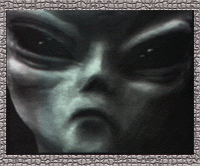
The story of the Roswell crash began on 2 July 1947, when sheep rancher Mac Brazel heard a powerful explosion in the middle of an electric storm. The following morning, Brazelm who operated the Foster ranch about 120 km northwest of Roswell and 32 km southeast of the tiny town of Corona, went to check on a water pump. On the way he discovered an area 1 km long strewn with debris which, when he folded it several times, unfolded spontaneously. There were also peices of what was later described as small I-beams with very unusual laneder coloured symbols along the inside of the I. The beams had a weight of balsa wood but could not be broken or burned.
On Sunday, 6 July, Brazel made the long cross-country trip with some of the wreckage in his old pick up truck. He took ot to Roswell sherrif, George Wilcox, who cintacted the Army base and spoke with the intelligence Officer, Major Marcel. He in turn checked out the material, and noted it was strange and inlike any debris seen during his service in World War II. As the intelligence Officer for the worlds only atomic-bomb unit, Marcels judgement could be relied upon. The Roswell base commander, Colonel William Blanchard, instructed Marcel and Sheridan W.Cavitt, a Counter-Intelligence Officer, to follow the rancher out to the remote field and collect debris.
Marcel's frist hand account : "Wen we arrivedat the crash site, it was amazing to see the vast amount of area it covered. It was nothing that hit ground or exploded (on) the ground. Its something that must have exploded above ground, travelling perhaps at a high rate of speed ... It was quite obvious to me, familiar with air activities, that it was not a weather balloon, nor was it a plane or a missile".
The two men filled their vehicals with as much of the debris as they could hold, leaving a lot behind. On the way back to the Roswell base. Marcel stopped off at his home to show some of the wreckage to his wife and their son, Jesse junior. The next morning, Colonel Blanchard ordered the erea near Corona sealed off. A large group of soldiers and military police were sent to the ranch and a detailed search was made of the area. Back at the RAAF, press Officer Lieutenant Haut issued a press release indicating that a flying disc had been captured. The news made the local radio and appeared in the evening editions of the local papers. Meanwhile, Major Marcel was instructed to get a B-29 crew to take him and the wreckage to Wright Field (now known as Wright Pattersons Air Force Base) in Ohio. On the way, he stopped at Fort Worth, Texas, headquaters of the Eighth Air Force.
By this time, the Acting Director of Stratigic Air Command in Washington, General Clemens McMullen, had heard about the press release. He contacted Colonel Thomas Jefferson DoBose, the Chief of Staff at Fort Worth, and told him to invent a cover story and hand over running of the incident to General Rodger Ramey, the base commander.
When Marcel touched down in Fort Worth, he was met by Ramey and told, "Dont say anything. Ill take care of it." Weather balloon and a reflector. made of foil and wooden sticks, were brought in with Irving Newton, the base meteorologist. Marcel posed with the bogus wreckage and the press was told that a mistake had been made, that it was not a flying saucer, but a radar reflector. Afterwards, Marcel was sent back to Roswell.
The cover story went out about 5 p.m. central time, to late for the newspapers, except the last edition of the Los Angeles Herald Express. The subtitle of the headline was "General Beleives it is a Radar Weather Gadget" The clean-up of the Foster ranch and surrounding area took one week, during which time Marcel was forbidden to speak to anyone. The search for debris was expanded and, after two days, the main body of the saucer was found close to Foster ranch. And just over 1.6 km from the craft, dead alien bodies were found.
In 1990, Stanton Friedman interviewed an Army Air Force's photographer (wishing to be known as FB) who claims to have seen bodies in the field near Corona. FB says he was stationed at the Anacostia Naval Air Station, Washington D.C., when he and a fellow photographer were ordered to fly to the RAAF. When they arrived at Roswell, the two men were taken to a tent in a field and told to photograph its contents. "There were four bodies I could see", recalls FB, going on to describe their heads as appearing too large for their small bodies.
Since January 1995, more than 30 countries have broadcast portions of a supposed alien autopsy. And while the alien in the film appears to be similar to a few eyewitness descriptions, the supposed cameraman claims to have taken the footage on 31 May 1947 near Socorro, New Mexico. Could there have been a third UFO crash?
According to Ray Santilli, the music producer who claims to have bought the film from the cameraman, a number of military personnel from 1947 recognize the alien as the creature recovered from the saucer crash in New Mexico. But can this footage shed new light on the real events in July 1947?