•Roswell, Investigated•
The headlines were spectacular: "RAAF Captures Flying Saucer on Ranch in Roswell", "Army Finds Air Saucer on Ranch in New Mexico", "Army Declares Flying Saucer Found". It was the 8th July 1947, and lieutentand Walter Haut, Public Information Officer at the Roswell Army Air Field, had just isued the most important press release of the century. The timing of the story was crucial. It was released at noon, New Mexico time, but, because of the timing differences in the US, it was to late for more important papers. It did however make it into some evening editions. The sherriff's office and local newspapers were inundated with queries from the media and the public. Then suddenly amid the excitment the Air Force changed its story. It was not a UFO after all, it was just a balloon. The headlines the next day killed the story: "Reports of Flying Saucers Dwindle; New Mexico "Disc" is only a weather balloon." Pictures of the "Wreckage" appeared in many papers over the next few days, and then essentialy nothing more was heard about the incident for 30 years.
The crashed saucer story would have remained untold had it not been for a chance meeting in 1978 between nuclear physicst Stanton Friedman and a TV station manager in Louisiana. While waiting to be interviewed about his UFO work, Friedman struck up a conversation with the station manager, who told him that he ought to talk to a man named Jesse Marcel. The next day friedman contacted Marcel and found out that he had been the Intelligence Officer at the RAAF when a flying saucer was supposed to have crashed on a sheep ranch near Corona, 120km from Roswell. Marcel said that his orders were to collect the crash wreckage and deliver it to Wright Field in Ohio, where the US Army usually stockpiled captured enemy equipment. As Marcel was taking the debris to Ohio, Press Officer Walter Haut officially announced the story. Later that day it was decided to cover up the true events and a second statement was made to the press: the wreckage was just peices of a weather balloon.
Marcel could not recall the exact dates but Friedman shared the information with UFOlogist William Moore, who had agreed to help in the investigation. In trun Moore came across a story that gave the events a time frame. In the first issue of "Flying Saucer Review" TV personality Hughie Green reported that, while driving near Philidelphia, he had heard a news broadcast announcing that a UFO had been recovered by the Army. Green tried to find out more, but never heard the story mentioned again. It was not much, but at least he had a date: late June or early July 1947.
Moore did a search of the university of Minnesota Library and found the newspapers from 8 July 1947 covering the Corona-Roswell event. The papers gave names for the rancher, the sherrif, the RAAF personnel and a time frame. Friedman and Moore went into high gear and by 1980 they had talked to 62 people concerned with the event, including Bill Brazel, son of the rancher who found the wreckage, neighbours who also handled some debris, such as Loretta Proctor and Jesse Marcels son, Jesse junior. Amazingly, Lieutenant Walter Haut, the Press Officer who released the story was still living in Roswell. He had a base yearbook and was helpful in tracking down people and filling in details.
By 1986 Friedman and Moore had tracked down 92 people and published six papers. Friedman had convinced the producers of "Unsolved Mysteries" to do a segment about Roswell in there NBC-TV programme enabling him as a consultant to seek other witnesses. In August 1989, while filming in Roswell, Friedman met with mortician Glenn Dennis. He had worked for Ballard Funeral Home, which provided mortuary services to the base. For the first time ever Glenn spoke about strange activity at the Army base hospital in the summer of 1947. Not only had the army asked him how to deal with small bodies, but he was forcibly thrown out of the hospital on his next visit.
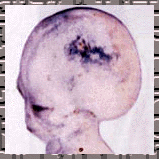
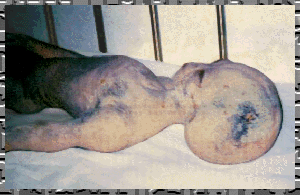
Could alien bodies have been recovered from the crash? Dennis believes so. He claims to have met with a nurse at the base who told him about very smelly bodies she had seen being autopsied by two doctors. The bodies had brownish-grey skin, big heads with slits for nose, ears and mouth, and four slender fingers with no thumbs, and no hair. After meeting with Dennis a few times the nurse simply disappeared, apparently moving to England. When he tried to contact her, Dennis's mail was returned, stamped 'Deceased'.
Despite some of the enverifiable details of the Roswell crash, the broadcast of "Unsolved Mysteries" in September 1989 was a great success, being seen by 28 million people in the US. There followed a great rush of books, TV shows and attacks by debunkers. By now the researchers had seperated into two warring factions - while they agreed that at least one UFO had crashed on the Foster ranch, one group of researchers, which included Friedman, beleived that there had been a second crash on the plain of San Augustin, New Mexico. The second-crash theory relies heavily on the testimony of two key witnesses. The first, Gerald Anderson contacted Friedman after seeing a 1990 re-run of "Unsolved Mysteries". By this time, the other witness Grady Barnette had died, but he had told his story to two friends Laverne and Jean Maltais, who passed the information to Friedman.
Independantly, both men told stories about discovering alien bodies in or around saucer debris. And according to Andersons claims, one of the aliens survived the crash. Unfortunatly because Barnette had died he could not be quizzed about what he saw. As a result many UFOligists express rservations about the crash at San Augustin.
The facts surrounding the Corona crash however, have become almost universally accepted. By the time Friedman's "crash at Corona" was published in 1992, most of the blanks in the story had been filled in.