 Chandigarh,designed by the French architect Le Corbusier, is the
capital of the Indian states of Punjab and
Haryana. Though Simla was chosen as temporary
headquarters, the need for a permanent capital, resulted in the birth of
a new city at the foothills of the Shivalik hills. Chandigarh, then became
the new capital of Punjab and Haryana. But the administration of the capital
itself was neglected, which was solved, by making it a Union Territory
under the Central Government on 1 November 1966.
Chandigarh,designed by the French architect Le Corbusier, is the
capital of the Indian states of Punjab and
Haryana. Though Simla was chosen as temporary
headquarters, the need for a permanent capital, resulted in the birth of
a new city at the foothills of the Shivalik hills. Chandigarh, then became
the new capital of Punjab and Haryana. But the administration of the capital
itself was neglected, which was solved, by making it a Union Territory
under the Central Government on 1 November 1966.
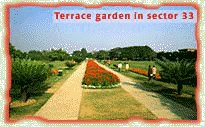
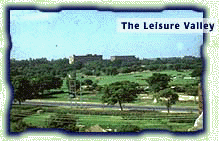
Covering an area of 56 square kilometres, Chandigarh is the first `planned' city of India. The city has neatly laid out roads and parks, buildings ranging against mountain peaks, boulevards and streets lined by endless rows of trees and shrubs. The city is named after the Goddess Chandi Devi, whose white - domed temple stands on the slope of a hill in the north east of Chandigarh, on the edge of the Shivalik hills. Spread over an area of 114 sq. kms, it is a modern city, built in 47 sectors (excluding the unlucky number 13). Each sector consists of market places and shopping centers. All the sectors are interconnected by State Transport buses, auto-rickshaws and taxis. This city has its population drawn from every community and region in India,and ranks second in literacy among the country's states and union territories.
Chandigarh has about 15 medium and large scale industrial units. These include soft drinks, electric meters, antibiotics, electronic components and equipment, bio-medical equipment, tractor parts, cement pipes and tiles, and washing machines.
Sightseeing
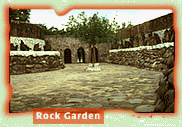
Chandigarh, with all its charms, is literally a treasure - trove for
the travel - buff. The Rock garden, a famous tourist spot, is an
architectural wonder, covering an area of 6 acres. It was built by Nekchand
Saini, with multicoloured pieces of stones and other discarded objects.
The Sukhna Lake is an artificial lake, spread over an area of 3
sq. kms. Boating facilities are available here, and walking around the
perimeter of the lake is a very refreshing experience. The Museum-cum-Art
Gallery is another marvellous place to see. It houses an extensive
range of paintings and sculptures by contemporary Indian artists, as well
as a collection of old Indian miniatures of the Mughal, Kangra and Rajasthani
school.
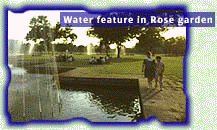
In sector 16, is Asia's largest rose garden, Zakir Gulab Bagh, spread out over 30 acres of land, boasting of 50,000 rose-trees of 1600 different species!! The Secretariat and High Court buildings, located at sector 1, are veritable proofs of the architectural expertise of Le Corbusier. One can enjoy an excellent view of the city from the roof of the Secretariat. The High Court has a double roof, which provides protection from the sun. What is peculiar is its shape, which resembles the shell of an enormous tortoise!! The Super Market or shopping centre is at sector 17 . Other places of interest include the State Library, Shanti Kunj, Moonlight Garden, Bougainvillea Garden, Bidhan Sabha and University - each a fine specimen of modern art.
Access
Chandigarh is 248 kilometres from Delhi and can be reached by bus or train.
While visiting Chandigarh, one is reminded of Pandit Jawaharlal Nehru's words, delivered in 1952, "Let this be a new town, symbolic of the freedom of India, unfettered by the traditions of the past - an expression of the nation's faith in the future."


