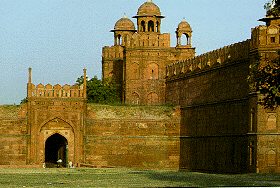
The largest of Old Delhi's monuments is Lal Quila or Red Fort whose thick red sandstone walls, bulging with turrets and bastions, have withstood the vagaries of time and nature. The Lal Quila rises above a wide dry moat in the northeast corner of the original city of Shahjahanabad. Its walls extend from two kilometers and vary in height from 18 metres on the river side to 33 metres on the city side.
Mughal Emperor Shahjahan started construction of the massive fort in 1638 and work was completed in 1648. The fort contains all the expected trappings of the centre of Mughal government: halls of public and private audience, domed and arched marble palaces, plush private apartments, a mosque and elaborately designed gardens. Even today, the fort remains an impressive testimony to Mughal grandeur, despite being attacked by the Persian Emperor Nadir Shah in 1739 and by the British soldiers during the war of independence in 1857.
Entrance to the fort is through the imposing Lahore Gate, which takes its name from the fact that it faces Lahore, now in Pakistan. This gate has a special significance for India since the first war of independence and important speeches have been made here by freedom fighters and national leaders of India.
The main entrance opens on to the Chatta Chowk, a covered street flanked with arched cells that used to house Delhi's most talented jewellers, carpet makers, weavers and goldsmiths. This arcade was also known as the Meena Bazaar, the shopping centre for the ladies of the court. Just beyond the Chhata Chowk is the heart of the fort called Naubat Khana or the Drum House. The musicians used to play for the emperor from the Naubat Khana and the arrival of princes and royalty was heralded from here.
The Fort also houses the Diwan-i-Am or the Hall of Public Audiences where the Emperor would sit and hear complaints of the common folks. His alcove in the wall was marble-paneled and was set with precious stones, many of which were looted after the mutiny of 1857. The Diwan-i-Khas is the hall of private audiences where the Emperor held private meetings. This hall is made of marble and its centre-piece used to be the Peacock Throne, which was carried away to Iran by Nadir Shah in 1739. Today, the Diwan-i-Khas is only a pale shadow of its original glory, yet the famous Persian couplet inscribed on its wall remind us of its former magnificence: "If on Earth be an Eden of bliss, it is this, it is this, none but this."
The other attractions within this monument are the Royal Baths or hammams, the Shahi Burj, which used to be Shahjahan's private working area and the Moti Masjid or the Pearl Mosque, built by Aurangzeb for his personal use. The Rang Mahal or the "Palace of Colours" housed the Emperor's wives and mistresses. This palace was crowned with gilded turrets, delicately painted and decorated with an intricate mosaic of mirrors, and a ceiling overlaid with gold and silver that was reflected in a central pool in the marble floor.
Even today, the Lal Quila is an eloquent reminder of the glory of the Mughal era and its magnificence leaves many wonder-struck and breathless. It is still a calm haven of peace which helps one to break away from the frantic pace of life outside the walls of the Fort and transports the visitor to another era of time.



