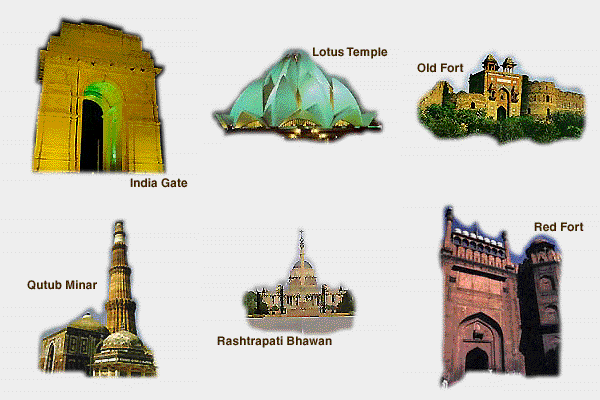
History is alive and throbbing in Delhi, the capital of India. It is often said that the history of India is the history of Delhi. New Delhi, the capital of India, has always occupied a strategic position in the country's history, as Hindu and Islamic dynasties have ruled from here, leaving their imprint in the form of relics, which recapture those bygone times. Delhi, is today, one of the fastest growing cities of India. Here, remnants of the past survive cheek - by - jowl with skyscrapers, residential colonies and bustling commercial complexes. The city houses some of the finest museums in the country. Its boutiques and shopping arcades offer access to a wealth of traditional and contemporary crafts, from all over the country. It has speciality restaurants to please the gourmet, open parks and gardens ablaze with flowers, and in winter months, particularly, an amazing plethora of cultural events. Its multi - layered existence is tantalizing, and can entice the curious traveller into a fascinating journey of discovery.
Geographically, Delhi forms an enclave inside the eastern frontier of Haryana in North India, while sharing an eastern boundary with Uttar Pradesh. Its dry climate is a result of its proximity to the Rajasthan desert, and the Gangetic plains of Uttar Pradesh.
Delhi's history dates back to the first millenium B.C., when it was known as Indraprastha. The Tomar Rajputs built Lal Kot, the core of the first of Delhi's seven cities. It was annexed by Prithviraj Chauhan, who extended it, to create the Qila Rai Pithora. Qutub-ud-Din-Aibak made Delhi his capital in 1206, and built Quwwat ul Islam Mosque, which is a fine example of Indo-Islamic architecture. He also built the towering minaret, the Qutab Minar, one of Delhi's great landmarks.
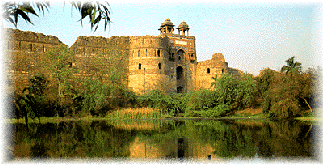
Purana Qila
 Around
1311, Allaudin Khilji established Siri, the second city, north east of
the Qila, and dug a vast reservoir at Hauz Khas. The Tughlaqs who ruled
the city after the Khiljis, built the third city of Tughlaqabad to the
extreme south of Delhi. The fourth city of Jahanpanah has practically disappeared
now, but the fifth city Firoz Shah Kotla rises off Bahadur Shah Zafar Marg,
and is famous for its Ashokan pillar. When the Mughals replaced the Tughlaq
dynasty in the early 16th century, Babur concentrated on developing Agra,
and made it his capital. But his son, Humayun, constructed a new capital
in Delhi, on the banks of the river Yamuna, and called it Din Panah. Shah
Jahan created Shahjahanabad along the river, as the well - planned, seventh
township of Delhi. It remained the Mughal capital until 1857. The monument
that remains as a proud reminder of their glorious rule, is the majestic
Red Fort
Around
1311, Allaudin Khilji established Siri, the second city, north east of
the Qila, and dug a vast reservoir at Hauz Khas. The Tughlaqs who ruled
the city after the Khiljis, built the third city of Tughlaqabad to the
extreme south of Delhi. The fourth city of Jahanpanah has practically disappeared
now, but the fifth city Firoz Shah Kotla rises off Bahadur Shah Zafar Marg,
and is famous for its Ashokan pillar. When the Mughals replaced the Tughlaq
dynasty in the early 16th century, Babur concentrated on developing Agra,
and made it his capital. But his son, Humayun, constructed a new capital
in Delhi, on the banks of the river Yamuna, and called it Din Panah. Shah
Jahan created Shahjahanabad along the river, as the well - planned, seventh
township of Delhi. It remained the Mughal capital until 1857. The monument
that remains as a proud reminder of their glorious rule, is the majestic
Red Fort
Delhi came under British rule after 1857, and in 1911 they decided to make it their capital. The area south of Shahjahanabad, was chosen as the site for the imperial capital, and was built on a regal scale by January 1931. Lutyens and Baker designed much of the architecture along the stretch between India Gate at one end, and Rashtrapati Bhavan (the President's residence) at the other; with the adjoining administrative buildings of North and South Block, Parliament House and Connaught Place nearby.
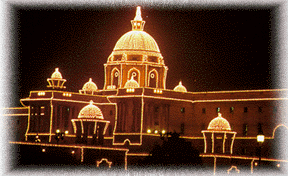
An illuminated Parliament House
Delhi was made a Union Territory on November 1, 1956. With the 69th Constitutional amendment, Delhi got a Legislative Assembly when the National Capital Territory Act was enacted in 1991. Following state assembly elections in Delhi, Mr. Madan Lal Khurana became the first Chief Minister of Delhi. Mr. Sahib Singh Verma took over from Mr. Khurana as the Chief Minister in early 1996.
Delhi, besides being the seat of the Central Government, has an economy supported by agriculture, tourism, commerce and a growing industry. With the development of infrastructure facilities, Delhi plays host to a number of national and international events including sports - related events, conferences and seminars.
Apart from the national festivals celebrated in Delhi, the occasions celebrated with much zest are Lohri (in January); Republic Day (January 26th - a spectacular parade down Rajpath, by the Defence Services and programmes displaying India's rich cultural heritage); the Delhi Rose Show (in January at Safdarjung's Tomb); the Delhi Flower Show (in February at Purana Quila); Urs (April/May and November/December - at Hazrat Nizamuddin Aulia's tomb); Phool Walon ki Sair (September/October - a festival of flower sellers) and Dussehra (October).
Delhi has several shopping areas like Chandni Chowk (Old Delhi), Sadar Bazaar, Janpath, Connaught Place, Palika Bazaar, Shankar Market (Connaught Place) and Nehru Place. These remain closed on Sundays. On the other hand, Ajmal Khan Market, INA market, Defence Colony, Khan Market, South Extension, Lajpat Nagar remain closed on Mondays. Greater Kailash, Green Park, Hauz Khas, Vasant Vihar, Safdarjung Enclave remain closed on Tuesday. This staggered closure provides seven day a week shopping opportunity.
Among the places of special interest to tourists in Delhi are the Red Fort, Jama Masjid, Coronation Durbar Site, Raj Ghat, Jantar Mantar, Lakshmi Narayan Temple, Qutab Minar,India Gate, Secretariat Building, Rashtrapati Bhawan, Parliament House, National Museum, National Gallery of Modern Art , Nehru Museum, Rail Transport Museum, International Dolls Museum, Crafts Museum, Dilli Haat, Gandhi Darshan, Purana Qila, the Zoo, Safdarjung's Tomb, and Bahai House of Worship.



