| ||||||||||
 |
| Student to Student | |||
| Campus Guide | |||
| |||

| |||
| |||
| Antje Baumann |
 |
Andrew Breavington looks for primates in Harvard's Peabody Museum and reports his findings for his Peoples and Cultures of Mesoamerica (Mexico and Guatemala) course (Anthropology 273)
Peabody Museum Assignment
1.
The first primate display that I noticed was Huxley's Skeleton Group of Primates. In 1863 Thomas Huxley studied and compared the skeletons of primates (gorilla, chimp, orangutan and gibbon) with that of man. He saw many similarities including the same number of teeth and opposable thumbs. The apes differed, however, in that they also had opposable thumbs on their longer, lower limbs. This points towards their arboreal nature and their lack of bipedalism. The display stated that Huxley arranged the skeletons in "natural poses" to elicit the best comparisons. I found this ironic as there is nothing natural about a bunch of skeletons behind a glass case.
Huxley's work was very important as it helped support Darwin's theory that we shared a common ancestor with the Great Apes, published around the same time. This notion was seen as scandalous at the time as people still firmly believed in the creation myth of the bible. Huxley's observations helped the scientific world embrace Darwin's radical ideas.
The next primate display that I noticed was called "Man like Apes, Pongidae". In this display the same primates—gorilla, chimp, orangutan and gibbon—were discussed and compared to monkeys. Although still very dead, these specimens were slightly more "natural" in that they still had fur and were not stripped to their bare bones as in Huxley's display. Forgive my facetiousness, but I find museums with row upon row of stuffed, dead animals to be a bit sickening.
This display pointed out that apes were different to monkeys in that they had no tail, longer limbs and a broad flat trunk. Additionally they have relatively big brains (and therefore more cognitive ability), are dexterous and show a high level of social organization.
Anthropologists are interested in studying the behavior of non-human primates (especially chimps who, I believe, have 98% of the same DNA as us) as this can give clues to the development and social organization of early hominids. And interesting display which seemed rather misplaced in the Mesoamerica Hall, talked about the studies done on various chimp culture groups in Africa and how each group had distinctly different cultures. This shows how man was able to develop in different ways in different parts of the world.
The Paleo-Indian had a variety of faunal food sources, from smaller prey such as rabbits and various waterfowl such as loons and cormorants to bigger animals such as rabbits. They occasionally hunted larger prey such as the Northern White Tail Deer, the most common in East USA. The most prized kills were Buffalo and the nearly extinct American Bison. It took a great deal of social organization to kill prey this big, and there is evidence of these early peoples coordinating vast drives to ensnare huge amounts of Buffalo in pits. It is thought that the seasonal living patterns of these early hunter gatherers closely followed the migratory patterns of the game they were seeking.
Although big-game was highly sought after, it was probably not the staple diet of Paleo-Indian as a constant supply was hard to ensure. Midden evidence shows that for those living by the coast, mollusks and fish formed the bulk of the diet, whereas for those groups more inland, smaller animals and wild grains and tubers were the norm.
2A.
By 1000BC independent civilizations had arisen in Mesoamerica and they came to be quite advanced. In fact, Classic Maya cities (200-900AD) were as large as those of the Ancient Greeks. All Mesoamerican cultures relied agriculturally on the triad of maize, squash and beans. They also had shared values and a common history which led them to develop a huge trade network. This is evidenced by the presence of goods from far away in burials all around the region. Additionally, very precise astronomy was developed with the path of the sun and the four cardinal points seen as very important. These practices are still followed today as Vogt's ethnography on the Zinacantecans shows us.
Technologically, Mesoamerican societies were far behind Europeans. Metallurgy was not developed, except for use in costumes, and lithic technology was still widespread. One of the reasons the Spanish were able to conquer the region is that the Aztecs were using wooden clubs with pieces of glass imbedded in them against the swords and the guns of the conquistadors. Although pottery was present, the ceramic industry developed without the use of the wheel or glazing.
Although not very technologically adept, early Mesoamerican societies show many signs of a truly developed civilization. Monumental construction and the organization of human labor to build things, complex burial practices, and the stratification of society and labor specialization were all evident.
B.
There was a lot of evidence of labor specialization in the museum exhibit.
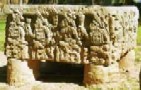
1. The beautifully carved stelae such as the reproduction of Altar Q at Copan shows how highly skilled these carvers must have been.
2. Intricate mural painting such as the one shown from Bonampak show further artistic specialization.
3. Pottery, although executed without a wheel shows advanced designs that must have taken some training to complete. The various cylinder tripod vessels of the Teotihuacán style that were found in burials were beautiful examples
4. Midwifery was practiced by the Aztecs, as seen from the description given to Bernadino de Sahiagan, an early ethnographer, before 1560.
5. The elaborately constructed temples and ball courts show a high degree of construction and labor organizational skills.
Evidence of the stratification of society.
1. A hierarchy of the dead: more burial goods and ornate trapping for the elite classes, with the commoners buried below their houses with little or no goods.
2. Differences in houses: elite houses closer to the ceremonial centre and more ornate with carvings and murals, with common houses further away and more simply constructed with thatch roofs.
3. Elaborate costumes and headdresses that indicated different statuses and gender amongst elites.
4. Rituals performed by elites only in public ceremonial places. Through rituals such as bloodletting the elites claimed that they were the intermediateries between the commoners and the gods, thus cementing their elite status.
5. The ball game, an elite only activity with the themes of warfare, ritual and human sacrifices—all themes of elite action.
C.
The most interesting part of the exhibit for me was that which dealt with the ritual ball game. This game was played with very elaborate costumes with the losing team often sacrificed. It is thought that the game was developed to symbolize the actions of the ancestral hero twins who challenged the Lord of the Underworld. Through the twins' actions the sun and the moon were created. There are many different types of ball courts and it seems that the style of the game changed over time. What did not change, however was that the game represented cyclical motion and duality (2 teams)—key Maya concepts. It must have been very hard to play; the teams had to keep the 18 pound ball in constant motion without using their hands or allowing the ball to touch the ground. And all of this with the threat of death hanging over you if you lost. I have visited the ball court at Chichen Itza and there, the players had to maneuver the ball through a stone ring about 15 feet of the ground and attached to the wall. This seems almost impossible if you could use your hands, let alone trying to attempt it without them.