 |
 |
|
 TYPE-8
PERSONNEL SHUTTLECRAFT
(Schofield,
Remington, Webley, LeMatt, Schmidt)
| Type: |
Light
long-range warp shuttle. |
| Accommodation: |
Two flight
crew, six passengers. |
| Power Plant: |
One 150
cochrane warp engine, two 750 millicochrane impulse engines,
four RCS thrusters. |
| Dimensions: |
Length, 6.2 m.
beam, 4.5 m.
height 2.8 m. |
| Mass: |
3.47 metric
tons. |
| Performance: |
Warp 4. |
| Armament: |
Two Type-V
Phaser emitters. |
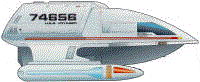 Based
upon the frame of the Type-6, the Type-8 Shuttlecraft is the
most capable follow-up in the realm of personnel
shuttles. Only slightly larger, the Type-8 is equipped
with a medium-range transporter and has the ability to
travel within a planet’s atmosphere. With a large
cargo area that can also seat six passengers, the shuttle is
a capable transport craft. Slowly replacing its elder
parent craft, the Type-8 is now seeing rapid deployment on
all medium to large starships, as well as to Starbases and
stations throughout the Federation. |
TYPE-9
PERSONNEL
SHUTTLECRAFT
(Rossi,
Martini, Krag, Snider, Spencer, Greener)
| Type: |
Medium
long-range warp shuttle.
|
Accommodation:
|
Two
flight crew, two passengers.
|
Power Plant:
Performance: Warp
6.
Armament: Two
Type-VI Phaser emitters.
|
One
400 cochrane warp engine, two 800 millicochrane impulse
engines, four RCS thrusters.
|
| Dimensions:
|
Length,
8.5 m.
beam,
4.61 m.
height
2.67 m.
|
| Mass:
|
2.61
metric tons.
|
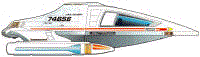 The
Type-9 Personnel Shuttle is a long-range craft capable of
traveling at high warp for extended periods of time due to
new advances in variable geometry warp physics. Making
its debut just before the launch of the Intrepid-class, this
shuttle type is ideal for scouting and recon missions, but
is well suited to perform many multi-mission tasks.
Equipped with powerful Type-VI Phaser emitters, the shuttle
is designed to hold its own ground for a longer period of
time. Comfortable seating for four and moderate cargo
space is still achieved without sacrificing speed and
maneuverability. As is standard by the 2360’s, the
shuttle is equipped with a medium-range transporter and is
capable of traveling through a planet’s atmosphere.
With its ability to travel at high-warp speeds, the Type-9
has been equipped with a more pronounced deflector dish that
houses a compact long-range sensor that further helps it in
its role as a scout. The Type-9 is now being deployed
throughout the fleet and is especially aiding deep-space
exploratory ships with its impressive abilities. |
TYPE-11
PERSONNEL SHUTTLECRAFT
(Mauser,
Henry, Winchester, Marlin)
| Type: |
Heavy
long-range warp shuttle.
|
| Accommodation: |
Four
flight crew, six passengers.
|
Power Plant:
|
One
400 cochrane warp engine, two 800 millicochrane impulse
engines, four RCS thrusters.
|
| Dimensions:
|
Length,
16 m.
beam,
9.78 m.
height
4.25 m.
|
| Mass: |
28.11
metric tons.
|
| Performance: |
Warp
6.
|
| Armament: |
Four
Type-V Phaser emitters, two micro-torpedo launchers (fore
and aft), aft-mounted veritable purpose emitter.
|
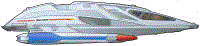 With
an ultimate goal towards creating a useful all-purpose
shuttlecraft, the designers of the Type-11 Personnel Shuttle
set out to create a craft that was equipped with all the
systems of a starship within the shell of a relatively small
shuttle. Allocation of the larger Danube-class
runabout to starships in the field proved too costly, and
with the expressed need by the Sovereign-class development
team for a capable shuttle, the Type-11 was born. Its
overall frame and components are a meshing of lessons
learned in both the Type-9 and Danube-class vessels.
Impressive shielding, several Phaser emitters, micro-torpedo
launchers and a capable warp propulsion system makes this
shuttle capable of performing a multitude of tasks.
Both the ventral and dorsal areas of the shuttle feature a
new magnaclamp docking port that is capable of linking up to
other ships similarly equipped. A two-person
transporter and a large aft compartment with a replicator
adds to the shuttle’s versatility. The end hope is
that these all-purpose shuttles will replace the more
specific-purpose crafts already stationed on starships,
reducing the amount of space needed for shuttle storage in
already-cramped bays. The Type-11 is now seeing
selective deployment outside the Sovereign-class to further
assess its capabilities in the field. |
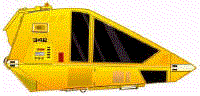
WORK
BEE
 |
 |
| TYPE:
|
Utility
craft.
|
| Accommodation: |
One
operator.
|
| Power Plant: |
One
micro fusion reactor, four RCS thrusters.
|
| Dimensions: |
Length,
4.11 m; beam, 1.92 m; height 1.90 m.
|
| Mass: |
1.68
metric tons.
|
| Performance: |
Maximum
delta-v, 4,000 m/sec.
|
| Armament: |
None
|
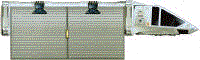
| The
Work Bee is a capable stand-alone craft used for inspection
of space borne hardware, repairs, assembly, and other
activities requiring remote manipulators. The fully
pressurized craft has changed little in design during the
past 150 years, although periodic updates to the internal
systems are done routinely. Onboard fuel cells and
micro fusion generators can keep the craft operational for
76.4 hours, and the life-support systems can provide
breathable air, drinking water, and cooling for the pilot
for as long as fifteen hours. If the pilot is wearing
a pressure suit or SEWG, the craft allows for the operator
to exit while conducting operations. Entrance and exit
is provided by the forward window, which lifts vertically to
allow the pilot to come and go.
A
pair of robotic manipulator arms is folded beneath the main
housing, and allows for work to be done through
pilot-operated controls. In addition, the Work Bee is
capable of handling a cargo attachment that makes it ideal
for transferring cargo around large Starbase and space borne
construction facilities. The cargo attachment features
additional micro fusion engines for supporting the increased
mass. |
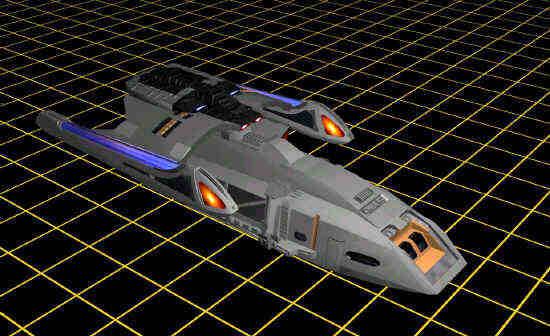
Blackhawk
Class Marine Assault Runabout
(Gatling,
Maxium)
Technical
Specifications
| Classification:
Runabout |
 |
| Design::
Blackhawk Class |
| Deck:
One |
| Structure: |
Duranium
with added Ablative Armour Matrix. |
| Length: |
25
meters |
| Height: |
12.3
meters |
| Width: |
17.2
meters |
| Warp
Systems: |
| Power: |
Matter/Antimatter
Reactor (dilithium mediated) |
| Nacelles: |
2 |
| Cruising
warp: |
Warp
4.3 |
|
Maximum
Warp |
Warp
8.4 |
| Impulse
Systems |
| Power: |
Fusion |
| Engines: |
2 |
| Low
Power Flight Mode |
VTL
System |
| Tactical
Systems |
| Micro
Torpedoes: |
Type:
Mk II, variable yield |
| Location: |
forward
(2) aft (1) |
| Casings: |
26 |
| Main
Phasers: |
2
Type-X Phaser arrays. |
| Shields: |
Grid-projected
(TDS)/Distance-projected, double-layered |
| Crew
and Auxiliary Systems |
| Crew: |
2
(maximum 27 with Marines aboard) |
| Transporters: |
1×6
personnel/cargo |
Vimy
Ridge class Assault Runabout
(Vimy Ridge)
| The
Vimy Ridge Assault Runabout is a version of the reliable
Danube Class that has been modified for use by the
Federation Marine Corps. They are an extended range craft
designed for the deployment and defense of ground assault
resources. The development of the Vimy Ridge class Runabout
was to provide a heavy lift capacity for the SFMC. Its
design and role are to compliment the existing Danube and
Blackhawk designs, not replace them. Capable
of reaching long range targets, assault runabouts are easily
re-configurable depending on mission parameters. The Vimy
Ridge is of a modular design that uses quick changeable
mission pods.
The
troop carrier pod can carry up to 50 combatants for example. The Vimy Ridge
class would also provide transport capability for Marine assault vehicles such
as the Heinz Gudarian class GAAV (Grav Armored Assault Vehicle).
An access way is present to link the vehicle to the attached pod.
Two hatches are also present to either side of the forward compartment.
Pintle mounts for mounted medium to heavy weapons are deploy able from
these once they are opened.
Equipped with universal docking collars, these craft can attach
themselves magnetically to an enemy vessel and then cut through the hull
enabling boarding parties to enter at any location, even those guarded by
transport jammers.
Technical
Specifications: |
| Classification: |
Runabout |
| Design: |
Vimy
Ridge Class |
| Decks: |
One
deck |
| Structure: |
Duranium
with added Ablative Armor Matrix. |
| Dimensions: |
| Length: |
36
meters |
|
Height: |
12.3
meters |
| Width: |
17.2
meters |
| Warp
Systems: |
| Power: |
Matter/Antimatter
Reactor (dilithium mediated) |
| Nacelles: |
2 |
| Cruising: |
Warp
5 for 3 months. |
| Maximum: |
Warp
7 for 12 hours |
| Impulse
Systems: |
| Power: |
Fusion |
|
Engines: |
2 |
|
Atmosphere
Capable:
|
Yes |
| Low
Power Flight Mode: |
VTOL
System |
| Tactical
Systems: |
|
Dorsally mounted Micro-Torpedoes launcher forward: |
variable
yield/Payload |
|
Location: |
Forward |
| Casings: |
12 |
|
Main Phasers: |
Type:
(2) Type VII Phaser emitters. |
| Shields: |
Grid
projected (TDS)/Distance projected, double layered |
| Crew
and Auxiliary Systems: |
| Crew:
4; |
1
Pilot, 1 Operations Officer, and 2 Auxiliary Personnel |
| Passengers: |
Transport
Configuration: 50, Cargo Configuration: 0 |
| Transporters: |
1
x 6 personnel/cargo |
| Mission
Pods: The Vimy’s multi mission pods make it a quite
versatile craft.
Each of the pods is designed to store along the ceiling of the craft’s
hanger bay. Below
are the pods that are in general service. New
pods are in development, and certain unique pods have been
developed by units in the field. |
|
a) Troop Pod: carries 50 fully outfitted Marines and necessary short-term
supplies. This
pod is capable of being dropped while the Runabout is
airborne from an altitude of 10 m. and flying at speeds no
more than 60 kmph.
The pod has ventral mounted repulsor pads that slow its decent and
cushion it’s landing. A
main drop ramp is located in the rear, with access doors to
each side.
Pintle mounts are present at each access way for the mounting of a heavy
support weapon. These
accesses have to be open though for these weapons to fire.
(Similar to the “door-guns” on certain types of 20th
century Choppers). This
pod is also equipped with deploy able floatation collar for
landing in liquid surfaces.
Note: this pod may double as a cargo unit. |
|
b) Med Pod: this is a portable field Medical Unit.
A fully equip surgical station and bio-beds for twelve ICU level patients
are present. This
pod comes with is own fusion generator, and emergency fuel
cell backup.
The unit is entirely environmentally self-contained with triple physical
seals around all accesses, besides bio-containment fields.
This makes the unit an excellent choice in responding to Bio-medical
emergencies. Replicators
are present for the use of the staff and patients, though
the supply of replicator matter is limited. One-way
umbilical ports are present for the transfer of materials.
This includes a hard linked transporter, in which a hard line from a
normal transporter is connected to the pod for a sealed
transfer of persons/materials. |
| c)
Fire support pod, type 1: This pod is designed with the
mission of supporting deployed Marine forces rather than
ship-to-ship combat.
The Pod’s weapon’s package is a rotary feed Micro-torpedo launch
system. A
grouping of four launch chambers that rotate into firing
position allow for rapid firing of the micro-torpedoes. It
is fed from three 50 rd armoured magazines. These
magazines are designed with blow out sections to vent the
blast of an internal explosion away and outward from the
craft.
The magazines are also eject able to facilitate rapid reloading.
The launcher and its associated firing system, is both capable of direct
and indirect fire. The
Vimy Ridge becomes in effect a one craft artillery battery
capable of rapid deployment and rapid evasion of
counter-battery fire. |
| d)
Fire support pod, type 2: this pod allows the Vimy to
function as a Precision bomber. The
pod contains a cellular transporter system. Each
armored cell contains a single conformal trans-pad and a
trans-bomb.
In combat environments in which jamming is not present or has not started
to take effect, the precision placement of the bombs has
devastating results.
Forty-eight armored cells and the needed transporter systems are
contained in the pod. This
pod unit also has the capability to deploy mines in a rapid
fashion over an area limited only by the range of its
transporters. This
area denial capability is quite useful in areas of natural
obstructions and/or threats. |
|
Micro-torpedoes
In
recent years, operations in the Alpha Quadrant have seen the development of the
13.3 cm Micro-torpedo. The
Micro-torpedo is equipped with a miniature fusion thruster and can be loaded
with a variety of explosives or other warhead materials, such as gases or
biological agents. In science mode
the miniature class-1-S sensor probe package.
The Star Fleet Marine Corps quickly caught on to the Micro-torp and its
adaptability for use as an ordnance delivery vehicle.
The Corps quickly developed a series of “tactical” models of the
Micro-torp for situations in which the normal Blast/explosive package was
inappropriate.
|
|
Micro-torpedoes:
|
| Type
A: |
standard
blast/explosive warhead. |
| Type
B: |
“Beehive”
warhead for use against battlefield targets such as exposed
personnel, soft vehicles, and un or lightly armored
Aerospace vehicles.
The warhead carries a load of approximately 4,800 3.1-gram
kinetic-penetrating darts capable of saturating an area the
size of a football field. The
optimum distribution pattern of the Flechettes can be
determined at the moment of launch, depending on the primary
target. |
| Type
C: |
“cluster”
warhead containing ‘brilliant’ self-targeting
sub-munitions, which are of the Combined Effects type.
This being that each is Armour Piercing with secondary Fragmentary and
incendiary effects. Each
“cluster” warhead will cover an area of 1000 square
meters.
The sub-munitions can also be programmed to land on the surface of the
target area and act as mines in an area denial role. |
| Type
D: |
Chemical/Bio
agent delivery vehicle. This
warhead is most commonly used for the delivery of
Particulate smoke and non-lethal Chemical agents, but more
lethal substances such as blister/blood/nerve agents and
Bio-agents of persistent and non-persistent varieties. |
Danube
Class Runabout
(Colt, Walker)
|
The
Starfleet Runabout is a development of the warp capable shuttle craft which have
been in use since the earliest days of the Federation. The first requirement for
the Runabout, issued in 2342, called for a vessel based on the Type 5 cargo
shuttle but capable of short and medium range interstellar operations carrying
out limited spatial and planetary surveys.
The
Runabout proved reasonably successful in service, though the small cabin size
limited its operations somewhat. Starfleet has gradually enlarged and improved
the Runabout concept over the next twenty years or so, culminating in the Danube
class Runabout first fielded in 2367. This is a much larger, more capable craft
than previous designs. It features a large front cabin for the pilot and
co-pilot / navigator plus up to three mission specialists. A four-person
transporter is at the rear of the cabin, with a small cargo area and engineering
spaces behind this. A short passageway to one side connects the front cabin to
the cargo bay and rear area. This incorporates six bunks, each of which can be
closed off behind a privacy screen. The rear cabin is thirty feet long and
fifteen feet wide; it can be fitted out according to the mission type with
scientific instruments, extra weapons, a first aid station, evacuation support
system, or other such equipment. Below the main spaces are the warp core and
power transfer conduits, impulse drive system and fuel tanks. The nacelle
supports contain two small escape pods, a group of emergency communications
beacons and various other equipment.
|
| Technical
Specifications
|
| Classification: |
Runabout |
| Design: |
Danube
Class |
| Decks: |
One
deck |
| Structure |
Duranium
with added Ablative Armour Matrix. |
| Length: |
23.1
meters |
| Height: |
12.7
meters |
| Width: |
5.4
meters |
| Warp
Systems |
| Power: |
Matter/Antimatter
Reactor (dilithium mediated) |
| Cruising
warp: |
Warp
4 |
| Maximum
warp: |
Warp
5.4 |
| Nacelles: |
2 |
| Impulse
Systems |
| Power: |
Fusion |
| Engines: |
2 |
| Low
Power Flight Mode |
VTL
System |
| Tactical
Systems |
| Micro
Torpedoes: Type: |
Mk
II, variable yield |
| Location: |
forward
(1) |
| Casings: |
26 |
| Main
Phasers: |
2
Type-VII phaser banks. |
| Shields: |
Grid-projected
(TDS)/Distance-projected, double-layered |
| Optional: |
Weapons
roll bar unit containing four full sized torpedo casings
(Photon/Quantum/Tri-cobalt/Probe)
|
| Crew
and Auxiliary System |
| Crew: |
2
(maximum 12) |
| Transporters: |
1×4
personnel/cargo |
Orion
Class
(Sharps)
|
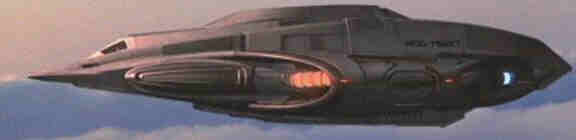
| The
Orion class Scout ship was began in 2369. Command
felt that a small ship, piloted by 1 or 2 Officers was
needed. The ship is exactly the same size as a Danube Class
Runabout, but better armed and shielded, faster, and has a
more advanced sensor suite. The Orion Class scout can be
flown by just one person, this way as few lives as possible
placed in a hazardous situation. |
| Technical
Specifications for Orion class scout |
| Classification: |
Runabout/Scout |
| Design: |
Orion
Class |
| Decks: |
One
deck |
| Structure:
|
Duranium
with added Ablative Armor Matrix. |
| Length: |
24.3
meters |
| Height: |
6.7
meters |
| Width: |
16
meters |
| Warp
Systems |
| Power: |
Matter/Antimatter
Reactor (dilithium mediated) |
| Nacelles: |
2 |
| Cruising
speed: |
Warp
4 |
| Maximum
speed: |
Warp
6.4 |
| Impulse
Systems |
| Power: |
Fusion |
| Engines: |
2 |
| Tactical
Systems |
| Phasers: |
4
x Type V Phaser arrays, total output 500 TeraWatts (located
on warp nacelle housings) |
| Torpedoes: |
2
x Micro photon torpedo tube + 30 torpedoes (1 forward under
nose, 1 aft between impulse engines) |
| Crew
and Auxiliary Systems |
| Crew: |
2
(maximum 8) |
| Transporters: |
1×4
personnel/cargo |
CAPTAIN'S
YACHT
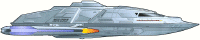 Mounted
in a recessed docking port in the underside of the primary
hull, the Sovereign-class
Captain’s Yacht serves dual purposes. A situation to be
dealt with by the captain of a starship does not always
require the entire ship to accompany him or her, or the ship
may have a more important mission to accomplish. In these
cases, the Captain’s Yacht provides a long-range craft
that is capable enough to function without its primary
vessel. Be it a simple excursion to get away from the
stresses of command, or a run to retrieve or deliver VIPs,
the yacht serves as an extendable arm of the Sovereign
class. Facilities
include six sleeping bunks and a comfortable passenger cabin. A replicator and
flight couches provide for the needs of the passengers and a two-person
transporter allows for beaming of personnel or cargo when needed. Atmospheric
flight capabilities allow this shuttle type to land on planetary surfaces.
|
| Type: |
Sovereign
Class Integrated Craft |
| Accommodation: |
4
flight crew, 20 passengers. |
| Power Plant: |
One
5,220-millicochrane warp engine, two 750-millicochrane
impulse engines, four RCS thrusters. |
| Dimensions: |
| Length: |
50m |
| Width: |
22.5m |
| Height: |
12m |
| Performance: |
| Cruise: |
Warp
4.5 |
| Max
Cruise: |
Warp
5 |
| Max
Warp: |
Warp
5.5/12hrs |
| Armament: |
5
Type-V Phaser Strips, Pulse Emitter, Micro-Torpedo Launcher |
|
|
 |
|