



Many aspects of Maya civilization developed slowly through a long Preclassic period, from about 2000 BC to AD 300. By the beginning of that period, Mayan-speaking Native Americans were settled in three adjacent regions of eastern and southern Mexico and Central America: the dry, limestone country along the north coast of Mexico's Yucatán Peninsula; the inland tropical jungle in the Petén region of northern Guatemala; and an area of volcanic highlands and mountain peaks in southern Guatemala near the Pacific Ocean. The earliest Maya were farmers who lived in small, scattered villages of pole and thatch houses. They cultivated their fields as a community, planting seeds in holes made with a pointed wood stick. Later in the Preclassic period, they adopted intensive farming techniques such as continuous cultivation involving crop rotation and fertilizers, household gardens, and terraces.
In some areas, they built raised fields in seasonal swamps. Their main crops included maize (corn), beans, squash, avocados, chili peppers, pineapples, papayas, and cacao, which was made into a chocolate drink with water and hot chilies. The women ground corn on specially shaped grinding stones and mixed the ground meal with water to make a drink known as atole or to cook as tortillas (flat cakes) on flat pottery griddles. The Maya also drank balche made from fermented honey mixed with the bark of the balche tree. Rabbits, deer, and turkeys were hunted for making stews. Fishing also supplied part of their diet. Turkeys, ducks, and dogs were kept as domesticated animals.
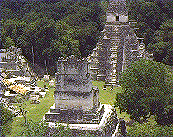
Tikal. Pre Classical Mayan City
When they were not hunting, fishing, or in the fields, Maya men made stone tools, clay figurines, jade carvings, ropes, baskets, and mats. The women made painted pottery vessels out of coiled strands of clay, and they wove ponchos, men's loincloths, and women's skirts, out of fibers made from cotton or from the leaves of the maguey plant. They also used the bark of the wild fig tree to make paper, which they used primarily for ceremonial purposes. Since the Maya had neither draft animals nor wheeled vehicles, they carried goods for trade over the narrow trails with tumplines (backpacks supported by a strap slung across the forehead or chest) or transported them in dugout canoes along the coasts and rivers.
The early Maya probably organized themselves into kin-based settlements headed by chiefs. The chiefs were hereditary rulers who commanded a following through their political skills and their ability to communicate with supernatural powers. Along with their families, they composed an elite segment of society, enjoying the privileges of high social rank. However, these elites did not yet constitute a social class of nobles as they would in the Classic period. A council of chiefs or elders governed a group of several settlements located near one another.
The council combined both political and religious functions. Like other ancient farming peoples, the early Maya worshiped agricultural gods, such as the rain god and, later, the corn god. Eventually they developed the belief that gods controlled events in each day, month, and year, and that they had to make offerings to win the gods' favor. Maya astronomers observed the movements of the sun, moon, and planets, made astronomical calculations, and devised almanacs (calendars combined with astronomical observations). The astronomers' observations were used to divine auspicious moments for many different kinds of activity, from farming to warfare. Rulers and nobles directed the commoners in building major settlements, such as Kaminaljuyú, in the southern highlands, and Tikal, in the central lowlands of the Petén jungle. Pyramid-shaped mounds of rubble topped with altars or thatched temples sat in the center of these settlements, and priests performed sacrifices to the gods on them.
As the Preclassic period progressed, the Maya increasingly used stone in building. Both nobles and commoners lived in extended family compounds. During the Preclassic period the basic patterns of ancient Maya life were established. However, the period was not simply a rehearsal for the Classic period but a time of spectacular achievements. For example, enormous pyramids were constructed at the site of El Mirador, in the lowlands of Guatemala. These pyramids are among the largest constructions in the ancient Maya world. By about 400 BC El Mirador was a major population center that served as the seat of a powerful chiefdom.
The highland and the lowland regions were in close contact at this time. Obsidian, a smooth volcanic rock used to make weapons and tools, from highland Guatemala has been found at El Mirador, and a sculptural style that originated in the Pacific lowland region of Chiapas and Guatemala was common in the southern highlands. Kaminaljuyú was the most powerful chiefdom of the highlands, and it probably controlled the flow of obsidian to the lowlands. Control of this important resource allowed Kaminaljuyú to dominate trade networks. Economic and political institutions during this period were more advanced in the southern highland area.