|
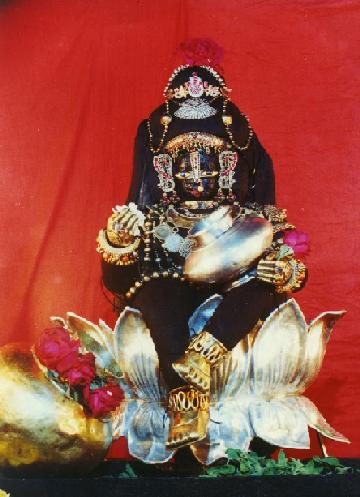
There were twelve Alvars
who appeared in South India. Not all at the same time, but over a period
of several centuries. They established the basis of the Krsna Bhakti
cult in the Kali-yuga. The appearance of such great devotees in the
Kali-yuga is predicted in the Srimad-Bhagavatam. Srimad-Bhagavatam was
spoken at the beginning of the Kali-yuga, and when Krsna left this
planet then he took with Him dharma. The Vedic dharma at that point
disappeared, or became invalid, and spiritual knowledge was also
obscured. But it says in the same verse that Lord Krsna left the Srimad
Bhagavatam for the people in Kali-yuga to get light out of. Now still,
the book Bhagavata was there but they also needed the person Bhagavata,
or one who lives the Srimad-Bhagavatam. In other words, they needed the
spiritual master. So in the initial stage of Kali-yuga, the first few
centuries, these twelve Alvars appeared in South India, and actually
established the basis of what would later on become the four Vaisnava
sampradayas. The four sampradayas all had their origin in South India,
and the founders of these sampradayas each in their own way drew, to a
greater or lesser extent, from this tradition of the Alvars, especially
in the Laksmi sampradaya, but it is also there in our sampradaya too,
and in the others. Goda, the famous woman Alvar, is said to have been
married to the Deity Ranganath of the Sri Rangam temple. Tondaredipodi
Alvar (Bhaktanghri Renu in Sanskrit) expresses in his Tirup Palliyeducci
(Paramatmar Jagarana in Sanskrit) tat to serve and love God one's
spiritual body is the summom bonum of one's service to God.
Kalidvamsa
Kalidvamsa,
or Nila, was one of the Alvars. His story is particularly relevant to
us, because his background was very, very fallen before he became a
devotee of the Lord. How he became a devotee is also very interesting.
Kalidvamsa means "destroyer of the influence of Kali." He was
known by this name after he became a devotee. But previously he was
known as Nila which referred to his very dark complexion. He was fifth
class, mleccha. He was of the Dravidan race, a South Indian race which
can be extremely black-skinned.
But
he was also of very strong body, very tall and very muscular. He had
learned in his youth all the arts of fighting. Sword, spear, wrestling,
boxing, he was extremely formidable. And he gathered around him a crew
of particularly dangerous persons, who became like his gang. In those
days, at the beginning of the Kali-yuga, mystical powers were a lot more
prominent. One of his mates had the ability to hide in his own shadow.
Another
one had the ability to pick any kind of lock or defensive mechanism, and
he could do this very quickly. He had the ability to understand, just by
looking, how the mechanism worked, and by a few deft movements of the
hand it would come apart. And he could enter that place, steal whatever
he wanted, and upon leaving he could reassemble the lock so that no-one
would know that someone had been there. The third friend had the ability
to silently kill anyone. By secret means, very silently, he could take a
person's life. So these were Nila's friends.
They
formed a very fearsome crew, and people were very afraid of them. The
king of that region decided that the best policy with Nila was to employ
him. So they engaged him as being the tax-collector for that district,
and he was very effective. No-one dared hold back when Nila and his boys
came to collect taxes for the government. Now, just outside that village
where Nila was staying, there was one bathing tank, one pond and this
was a place that was very beautiful, very special. So special that from
time to time damsels from heaven would come down and also bathe there.
So one day one young girl, who had come down with some other ladies from
the heavenly planets, she was left there. One doctor from the village
who was walking by saw this very beautiful young girl. He could
immediately understand, due to her exquisitely beautiful features, that
she wasn't from the region, and he asked, "Who are you?" And
she answered," I don't know." Apparently she had suffered some
kind of amnesia, and couldn't return to the heavenly planets. So the
doctor asked the little girl to come with him, and he took her home, and
introduced her to his wife, who was automatically very much taken by the
little girl. She said, "Let us raise her as our daughter." So
they kept her at home, and since she was a young lady, she did not go
out of the house. If she wanted to go outside, she would just go up to
the roof. That was the system in those days, because unmarried girls
should not mix with society. So one day she was up on the roof, and Nila
happened to come down the street, in front of the house, on his way
somewhere. One point about Nila was that he was very much engaged in
sense gratification, a very rowdy fellow, a boozer and a woman hunter.
He was carousing around on the street below, and when he happened to
look up he saw this very beautiful girl. Immediately he was smitten with
love for her, and he knocked on the door of the doctor's house. The
doctor appeared at the door of the house and saw Nila standing there.
"Oh," he said, "what can I do for you?" Nila
replied, "I have just seen your beautiful daughter, and I want to
ask her to be my wife." The doctor said, "Well it's not really
in my power to give her to you as wife." Normally it's the father
turning over the daughter to the would-be husband, but the doctor said,
"It's not really up to me, because actually she's not my daughter.
It appears to me that she's come from heaven. But you could ask her
yourself if she would like to become your wife." So he brought the
girl down. Her name was Kemuda, which means, "lotus." Nila
proposed to her, "Let me take you as wife." He began to
describe some of his qualifications to the girl. "You see this
fist? This fist can punch and kill 500 people at once." Like this
he was praising himself, and she was giggling shyly to herself, and she
said, "I'm not interested in such things. If you want to marry me,
you have to become a Vaisnava." Because Nila was so much taken by
the girl, he said, "Yes yes, no problem. I will become a
Vaisnava." He had no idea of what a Vaisnava was, he had no idea
what the word meant, but he just knew vaguely that a Vaisnava had
something to do with the temple. He had never gone to the big temple
that was in that area, he had never had any interest in it, but he'd
heard this word Vaisnava used in connection with the temple. Declaring
he would immediately become a Vaisnava, he ran off in the direction of
the temple. He came in, and told the priest, the head Brahmin, "I
want to become a Vaisnava." The Brahmin said, "Ok, so you know
that a Vaisnava is completely surrendered to Lord Visnu." "Yes
yes yes," Nila said. "You know that a Vaisnava is only engaged
in service to Visnu and other Vaisnavas?" "Yeah yeah, no
problem," Nila replied. "Well all right," said the
Brahmin. "You're sure you want to be a Vaisnava?" "Of
course," Nila said. So then the priest took the garland from the
deity and placed it around Nila's neck, and Nila came back very proudly
to the doctor's house, and showed Kemuda that he wearing the garland
from the deity. "Now I am a Vaisnava," he said. But she said,
"It is not enough just to officially be a Vaisnava. You have to act
like one. If you want to marry me, then for one year you have to feed
1000 Vaisnavas every day, wash their feet, and drink the water."
"All right," he said. So then he went and got his mates.
"Got a job for you," he said. "Oh great! What is
it?" they said, rubbing their hands in anticipation. And then he
explained, "Each day for the next year I want you to go out and
fetch 1000 Vaisnavas, bring them here, and then we'll feed them. Then
you should wash their feet and bring the water to me so I can drink
it." His mates looked at him and said, "Are you feeling all
right." Nila said, "Well look, if you don't get into this
right now then you're not going to be feeling all right." So then,
just as they were accustomed to do any other job, they did this job in
the same fashion. They went running out onto the street armed with many
weapons, and whenever they saw a Vaisnava they would immediately grab
him by the scruff of his neck, and herd him into Nila's place, shouting,
"Come on, let's go! Move it!" And these Vaisnavas would be
saying, "What's happening?" "Now sit down there in a
line," Nila's boys would say. And then they would come with the
pots and slap the prasadam down in front of them. "Eat!" The
Vaisnavas would nervously take prasadam. "Eat more!" They
would make sure all the Vaisnavas were filled up. And then they would
come with foot washing paraphernalia. "Stick out your foot!"
And then they would bring a big barrel of caranamrta to Nila, and he
would scull it like a tankard. Pour it down his throat, wipe his mouth
with the back of his hand and throw the barrel. So gradually by
performing this service he began to transform. Actually, saintly
qualities began to manifest in his person. And furthermore, he became
very attached to this service to the Vaisnavas. In the end he did marry
Kemuda, but that was no longer his motivation for doing the service, he
just liked to do it. He found it very sweet and enlivening. He became so
enthusiastic for making arrangements for feeding 1000 Vaisnavas every
day. You can just imagine his service was naturally increasing. The
feast was becoming more and more opulent, the foot bathing ceremony
became more and more opulent. In this way he was liberally spending
money, until eventually he was out of cash, and he still hadn't
completed his years service. In any case, he had no intention to stop
after a year now. He just wanted to go on and on. So what to do, he had
no more money with which to arrange
for the feasts. But he had recently gathered together tax revenue to
give to the king, and that was still at his place, a huge sum of money.
So he just started to spend that and continued on with his service. Now,
meanwhile the king was expecting the tax money to be brought to his
treasury house and it wasn't coming. So he was asking his ministers,
"What's going on? Why hasn't Nila brought the money?" And then
one minister said, "Well we have heard that this Nila is daily
putting on huge feasts for the Vaisnavas, and it's becoming quite an
opulent affair. Maybe that's where the money's going." The king was
flabbergasted. "What?" And he immediately called for his
commander-in-chief (senapati)
the great general of his army, and with some soldiers, the
commander-in-chief went to Nila's village to investigate and if
necessary arrest Nila, and recover whatever tax money had not yet been
wasted. So the commander-in-chief came and challenged Nila, announcing
the purpose of his arrival. "I have come to investigate your
doings," and he started to become very official with him. So one
thing led to another, and there was a big fight, in which Nila soundly
trounced the commander-in-chief and his soldiers. Because he was now, so
to speak, a saintly person, he did not kill them but he gave them a
severe beating. And he told the commander-in-chief as he was running
off, "You can tell your king to come here personally if he likes,
and I'll pay him the same tax as I paid you.!" So the
commander-in-chief reported this to the king, and the king very angrily
amassed his whole army and marched on that village. Nila met them in
battle, and defeated the whole army. At the end of the battle Nila was
standing on the king's chest, and the king was laying out on the
battlefield. Nila was on his chest looking down at him saying,
"That tax money I took, that was a loan, right?" And the king
said, "Right!" But the king's ministers were there, his
Brahmins, and they began to address Nila. "Certainly you are very
powerful. you can defeat the king and his whole army. But that doesn't
make what you are doing right. You have taken funds that were meant for
the king's use, and the king's property is sacred. It is not to be
violated by anyone for any purpose.
So because you
have done this you have broken the law and you must be punished."
So when the Brahmins were speaking to him in that way, because he had
become purified he surrendered to them. "OK, if I have done wrong
then I must be punished. What sort of punishment should I receive?"
The Brahmins said, "You should go in the jail." Nila
submitted. Although by force of arms he could not be captured, simply by
logical argument and sastric evidence he surrendered. So he entered the
prison of the king, but there of course he could no longer perform his
service, so he became very, very unhappy and he prayed to Lord Visnu,
"I just want to serve you. I don't see how I can do it here in
jail." So Visnu appeared to him and told him, "You meet with
the king and get him to transport you to Kancipuram, and at the
direction of Varadaraja you will find treasure, and this treasure will
be so much that you will be able to pay the king what you owe him, and
use the rest for your service." So then Nila spoke to the king, he
got the king's audience and explained the situation. The king sent him
under guard to Kancipuram, and somehow the deity guided him to a
particular spot and when he dug he found a great mass of treasure. So he
brought that back to the king and offered to give what he owed him, but
the king was so amazed that Lord Visnu Himself had shown Nila where the
treasure was, that he said, "Who am I to stand in your way? If Lord
Visnu is talking to you directly, then you must be a great soul."
And then he let him go. So then Nila embarked on a new scheme.
"There are so many rich vaisyas," he was saying to his mates,
"They've got so much money. I see them transporting their goods
here and there in caravans. And actually it's their duty to give
donations to the service of the Vaisnavas, but they are not doing this.
And here we are, we're having to worry about how
to fund our project of serving the devotees, and these vaisyas are just
going here and there, using their wealth as the they like, so let us get
it from them. We will stop these caravans on lonely stretches of highway
in the forest. We'll be nice, we'll ask them first of all if they would
like to give a donation, but if they don't then we'll simply take
everything." So they began this new scheme, and of course attached
vaisyas never give donations willingly, so they always ended up having
to tie them up and plunder the caravan, strip everything, and that they
were utilizing as their wealth for serving the vaisnavas. So one night
they we re going to plunder, and down the road came a very big caravan
of 30 bullock carts, and at the head of the caravan was a very wonderful
looking young merchant, and also his wife who was very beautiful, and
they were dressed in all kinds of opulent finery, jewelry and crowns.
The bullock carts were also being driven by servants who were equally
opulent and wonderful in their appearance. So Nila stepped out on the
road and stopped the whole procession, and he saw the opulence for the
merchant and his wife
and their caravan, and he remarked, "Well my dear sir, you look to
be very, very wealthy." And the merchant smiled and said,
"Yes, actually all wealth is mine." So Nila kind of laughed
and turned to his mates, "Ha ha ha. We've really got a live
tonight! Well if all wealth is yours then you won't mind parting with
some of it." And the merchant smiled and said, "Yes, but my
wealth is only engaged in Vaisnava-seva." So then they said,
"Well that's very nice because I am a vaisnava. So I'm sure you'll
be happy to give me your wealth." The merchant smiled again and
said` "Well, I won't give you." "So you want to
fight?" Nila asked. "No, you just take, said the merchant.
"You are free to take, but I am not going to give." "All
right," said Nila, "Let's go." So they tied them all up,
as they normally did, and they stripped the bullock carts, and not only
that but they also took all the finery from the merchant and his wife
and their servants, all the jewels, everything. And the wife's foot, on
her toe, there was one ring with a valuable gem in it. So Nila was
trying to personally pull this ring off her toe, but it wouldn't come
off. Finally he had to kneel down and bite the ring, to change it's
shape a little bit so it would slip off. And while he was doing that,
his consciousness was flooding with all sorts of wonderful ecstatic
realizations. But he was so much absorbed and determined to get this
ring off that he really didn't take much note of it. And then he finally
pulled the ring off, and all the wealth was piled together, and he and
his men were going to carry it off, but they couldn't lift it. It was so
heavy. So then he turned to the merchant and said, "I think you
must have some mantra by which you move your wealth about, because
obviously it is somehow charmed that it cannot be moved." And then
the merchant said, "Yes, there is a secret mantra."
"You'd better tell me," Nila demanded. "All right, just
come close," the merchant said. So then he whispered in Nila's ear,
"Om namo narayanayah." And when Nila heard this mantra he
realized that this merchant and His wife were none other that Laksmi and
Narayana, and he saw them in their original forms. So then he fell down
at Their lotus feet, but because he was so furiously engaged in his
devotional service, Nila quickly sprang up and said, "All right,
look, we've gotta go. We'll see you tomorrow, OK" And then They
said, "All right, you come here tomorrow. We can talk
further."
So
then Nila ran off with the wealth, and continued with his service. The
next day he came back to that place in the forest, and Laksmi and
Narayana were there, and he worshipped Them. They were very pleased with
him for his service to the Vaisnavas, but he declared to Them, "I'm
always having trouble getting money to do this service, therefore I'm
always having to plunder merchants, and I don't know where all this is
going to lead. So do you have any suggestion where I can get wealth
from?"
And Lord Narayana
said, "Well actually, there are so many Buddha temples around, and
Buddha is My avatar, but He only came to preach to the atheists.
However, these Buddha temples have become quite opulent. So I don't mind
if you plunder these Buddhist temples." Nila was very happy.
"Well actually I was thinking the same thing myself. But if I get
Your permission, then that's wonderful."
"Yes, you
have my permission," the Lord said. So then, when his wealth again
ran out, then Nila and his monks went one night to a huge Buddhist
monastery where 1000 monks were living. And in that temple there was a
huge reclining Buddha made out of solid gold. His men were using their
various mystic powers to get them into the temple. Nila was standing
guard just outside the temple door, and his men were in there at work,
trying to dislodge the deity and bring it out. So, while doing this they
set off an alarm, and then the Buddhists came tumbling out of their beds
and rushing into the temple courtyard. They were all armed, and all very
expert at martial arts. So what ensued next was like something from a
kung-fu movie. All these Buddhist monks were jumping at Nila, and he was
kicking them back and fighting them off. And he was calling into the
temple, "Hey hurry up! Are you done in there?" But meanwhile
his men were having difficulty, because they found that the murti was
charmed, so as soon as they touched it to remove it, it started to spin,
faster and faster like a helicopter propeller, from the middle point,
and a huge heavy golden idol spinning like that, they couldn't get close
to it. So then they were calling out to Nila, "We can't take this
because it's spinning. It's charmed." So then Nila, while he was
fighting off these men, he called out, "Well, just pass
urine!" So they passed urine in there, and this broke the spell.
The murti stopped, and they could shoulder it. They were obviously very
strong persons, and they ran out with it. Nila was fighting with the
Buddhists, and then they went running through the night with the
Buddhists pursuing them. Nila and his men went to Sri Rangam, a great
Visnu temple. There is a great wall around it like a fortress, and they
closed the door so the Buddhists couldn't enter. The Buddhists then went
to the king and complained. The king was again in a difficult situation
having to deal with Nila, so he called Nila in and said, "Nila, we
have a little problem here. These Buddhists have accused you of stealing
their murti. I'm the king here, I have to keep everyone happy. So I'd
really appreciate it if you could return this murti." Some of t he
Buddhist leaders were also standing there, looking at Nila rather
intensely. So Nila said, "Don't worry, don't worry. In two weeks
I'll return this murti to you, not less than a finger." Everyone
was happy. "All right, we can wait two weeks." So then two
weeks came, and the Buddhists gathered at the meeting place where Nila
was to return the murti, but when they arrived they saw only Nila and
his men there, and no murti. They became a little nervous. "Well,
where's our Buddha?" Nila reached into his pocket and pulled out a
finger, a golden finger. "Here it is," he said, "not less
than a finger." The Buddhists became very angry, and there was a
big fight. Nila defeated them and forced them to become Vaisnavas,
forcibly converted them. And what he had done with that golden murti is
that he had melted it down and used it t o cover the dome above Lord
Ranganatha. Nowadays you can go to Sri Rangaksetra, and if you talk to
the right people you can go up to a look-out place on top of the temple
and see this very ornate solid gold dome, very huge. This was melted
down from the Buddha murti by Nila. In this way Nila became a very
prominent Vaisnava of his time, and by force of arms if necessary he
drove out the influence of Kali-yuga in his area. Everyone had to become
a Vaisnava, he converted everyone. As he used to collect taxes, so
wherever he would go everyone would become a Vaisnava immediately. And
when there was a festival at Sri Rangaksetra, they would take the deity
in procession, and Nila would march in front of the deity with his sword
out, he would be looking from left to right at everyone. And when he was
asked, "What are you doing? You look so fearsome with your sword
out, looking so scrutinizing at everyone's face," and his answer
would be, "Yes. Any offender I see will be chopped." So it was
a rather intense mood in those festivals. He was the enforcer of
Vaisnava-dharma. In spite of the influence of Kali-yuga which is so
powerful to sweep away all proper religious principles, this devotee
Nila, in South India, by the force of his devotion as well as the force
of his strong arms and use of weapons, he instituted Vaisnavism. By
pleasing the Vaisnavas, he got the darsana of Laksmi-Narayana. Actually
this pastime when he was plundering their caravan, and in particular
taking the ring from the lotus toe of Laksmi, this is actually where the
Laksmi sampradaya started. Ramanuja later established the Laksmi
sampradaya with siddhanta, Vedantic conclusions, but the devotional line
actually starts here with Nila taking the ring from Laksmi's toe.
|