 |
| ANABANTIDAE & BELONTIIDAE |
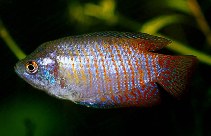
| I am a Dwarf Gourami (Colisa lalia), one of several species of fish that are collectively called labyrinth fishes. Read on to find out why we are unique and how to care for us! |
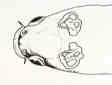
| This is the labyrinth. It is a spongey mass of tissue located just behind the eyes of all anabantids. It is how we are able to "breathe" atmospheric oxygen. It is also where we got our other common name: labyrinth fishes. |
|
| This is a male Siamese Fighting Fish (Betta splendens) flaring at a rival male. Anabantids are unique in that the male builds a nest out of plant material and mucus covered air bubbles to raise his young. He will place the fertilized eggs in the nest (sometimes the females help) and then guard eggs and young until they are old enough to hide and fend for themselves. |
 |
| Anabantids are very diverse, ranging from the Dwarf Gourami at 1.5 - 2.5" to the Spotted Climbing Perch (Ctenopoma acutirostre), a voracious predator that grows to 6 inches or more. We are native to South East Asia and Africa. My cousin, the Siamese Fighting Fish, lives in rice paddies where he provides an environmental benefit- ridding the waters of mosquito larvae and other potentially annoying insects! |
| In the aquarium, we anabantids can make interesting charges. Keep in mind that many of us will become aggressive towards our tankmates if we are brought into breeding condition by lots of good live food and a mate! We males tend to be a bit belligerent and like our own territories. If you want to keep more than one of us, try two or more females! |
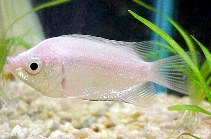
| Kissing Gourami (Helostoma temminckii) |
| Blue Spot Gourami (Trichogaster trichopterus) |
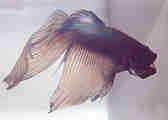
| Siamese Fighting Fish (Betta splendens) Photo by: Me! |
| Picture from: The Aquarium Fish Survival Manual by Brian Warn; Barrons |
| PERCIFORMES: |
 |
 |
| FISH FACT: Siamese Fighting Fish obtain over 90% of their oxygen directly from the atmosphere! |
 |