Kandy Sri Lanka
Population: 147,000
District: Kandy
Typical Weather: Cool
Dist. from Colombo: 116 km
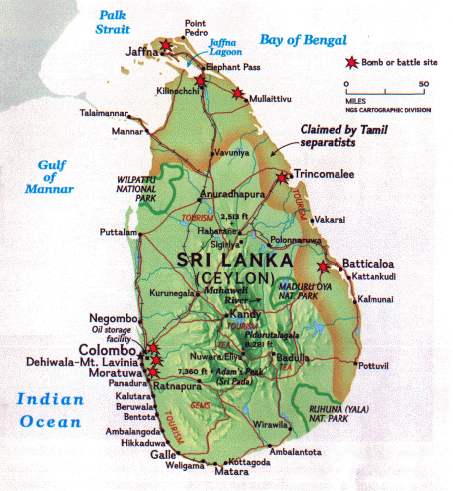
Sri Lanka's hill capital, stronghold of the Sinhala Kings, is our most beautiful town. It is 488 metres above sea level and next to Colombo is Sri Lanka's most visited place. The focal point of the town is, without doubt, the golden roofed Dalada Maligawa where the Sacred Tooth Relic of the Buddha is enshrined. Major restoration work is in progress here by the UNESCO - aided Central Cultural Fund. The highlight of the year is the Esala Perahera, when a replica of the relic casket is taken in procession accompanied by exotically costumed dancers, drummers and about 80 to 100 elephants during ten glittering nights in July/August. Visit Kalapuraya in the beautiful Dumbara valley 8 km. from Kandy, where descendants of the ancient craftsmen still create items of rare elegance in metal and wood. There are many shrines and temples in and around Kandy, where you will see rare paintings, frescoes, wood and stone carvings. Don't miss the Peradeniya Gardens begun as a pleasure garden by a Sinhala King, with its amazing variety of trees, plants and flowers.Sri Lankan History
Recent excavations show that even during the Neolithic Age, there were food gatherers and rice cultivators in Sri Lanka. Very little is known of this period; documented history began with the arrival of the Aryans from North India. The Aryans introduced the use of iron and an advanced form of agriculture and irrigation. They also introduced the art of government. Of the Aryan settlements, Anuradhapura grew into a powerful kingdom under the rule of king Pandukabhaya. According to traditional history he is accepted as the founder of Anuradhapura.
During the reign of King Devanampiya Tissa, a descendent of Pandukabhaya, Buddhism was introduced in 247 B.C. by Arahat Mahinda, the son of Emperor Asoka of India. This is the most important event in Sri Lankan history as it set the country on the road to cultural greatness. As a new civilisation flourished Sri Lanka became rich and prosperous.
In the mid 2nd century B.C. a large part of north Sri Lanka came under the rule of an invader from South India. From the beginning of the Christian era and up to the end of the 4th century A.D. Sri Lanka was governed by an unbroken dynasty called Lambakarna, which paid great attention to the development of irrigation. A great king of this dynasty, Mahasen (3rd century A.D.) started the construction of large `tanks' or irrigation reservoirs. Another great `tank' builder was Dhatusena, who was put to death by his son Kasyapa who made Sigiriya a royal city with his fortress capital on the summit of the rock.
As a result of invasions from South India the kingdom of Anuradhapura fell by the end of the 10th century A.D. Vijayabahu 1 repulsed the invaders and established his capital at Polonnaruwa in the 11th century A.D. Other great kings of Polonnaruwa were Parakrama Bahu the Great and Nissanka Malla both of whom adorned the city with numerous buildings of architectural beauty.
Invasion was intermittent and the capital was moved constantly until the Portuguese arrived in 1505, when the chief city was established at Kotte, in the western lowlands. The Portuguese came to trade in spices but stayed to rule until 1656 in the coastal regions, as did the Dutch thereafter. Dutch rule lasted from 1656 to 1796, in which year they were displaced by the British. During this period the highland Kingdom, with its capital in Kandy, retained its independence despite repeated assaults by foreign powers who ruled the rest of the country. In 1815 the kingdom of Kandy was ceded to the British and thus they established their rule over the whole island. Modern communications, western medical services, education in English, as well as the plantation industry (first coffee then tea, rubber and coconut) developed during British rule. By a process of peaceful, constitutional evolution, Sri Lanka won back her independence in 1948 and is now a sovereign republic, with membership in the Commonwealth of Nations and the United Nations Organisation.