|
|
|
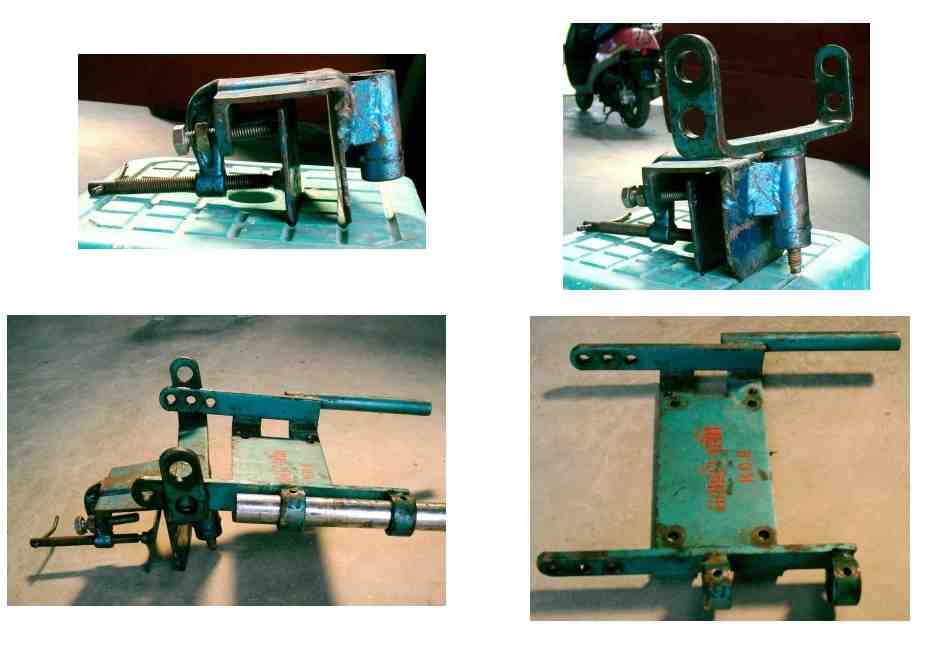
the long tail motor Author - Sean Walker designer of tongdee long tails, hovercrafts and airboats The Asian long tail set up is by far the best; they were invented here and have been well proven over many decades. They can last years with almost no maintenance. The Western setup isn’t as good and they cost a lot of money. If you want to vacation in Thailand, you can take the important parts home in your luggage. These parts are very inexpensive. However, you can construct the long tail set up for very little money if you are up to the task. The following is a description of a long tail setup. It is not a plan but there are a lot of questions answered so it is helpful. A proper design would be desirable but there are not any available. THE ENGINE MOUNT When building a motor swivel mount a lightweight one is desirable. Make it simple, strong and use as little metal as you can to conserve weight but don’t go too light or it may not be strong. Use ring mounts for the tiller handle to slide into also. It has to move up and down 30 degrees depending on the transom height and left and right at least 60 degrees in each direction. Hands off operation is the goal. This means while under motion if you remove your hands from the tiller the tail does not raise or fall but the boat runs along as desired. If this balance and thrust angle is not achieved it is too tiring to operate the boat, you will struggle to keep the prop at the correct depth and the boat will perform poorly. However, when sometimes going upstream or in rough water or at high speeds, it is still necessary to sometimes pull up on the tiller. The mount must be balanced out weight and thrust wise to facilitate the tail riding in the water at the desired depth. It is very important the tail be about seven feet long (about 2 meters), and the engine be as low as possible. A short shaft will cause too much of a shaft angle between the engine and the water. You want the shafts angle not to be very steep. See the picture below of my boat and me. A nearly parallel attitude would be ideal but the shaft would be very long and the engine very close to the water. A good compromise will suffice. Mount the engine as low as possible (see the picture below). If your transom is high make a longer shaft. When the shaft is fairly close to parallel to the boats attitude the turning and the power distribution is good because the thrust travels from the prop straight up the shaft to the pivot pin and then pushes the boat straight forward. If the shaft is at a steep angle the thrust power will not be used effectively. This is not like an outboard motor where the angle can be considered trim. When the angle is great the thrust pushes forward and the tiller handle pivots down, then you must pull up on the tiller or the prop will rise out of the water. However, you don’t need to understand this now, just keep the shaft long and mount the engine as low as possible. You will need to find the balance point where there is the right amount of weight at the propeller. To find this fulcrum point, place the engine attached to its mount plate on a low table that simulates the engines height when it is mounted on the boat. Next place a piece of angle iron under the engine that simulates the pivot pin balance place. Then place a weight scale under the tail at the propeller. Move the angle iron balance point back and forth until the scale reads 6 Kilos (13 lbs). This is the point where engine pivots up and down so drill three or more pairs of holes into the mount so you can move the engine back and forth from this pivot point to fine-tune the balance after you test the boat. Be advised, heavier and more powerful engines require more weight at the tail than 6 Kilos, if need be drill more holes. THE HUB You will need a welder, pipe and some plate steel to make the hub. The hub bolts onto the engine and has a ball bearing inside it that rolls the shaft (see pictures below). Use an appropriate size pipe and an engine mount plate to bolt the hub to the engine. Drill two holes for the grease can or automotive type grease fittings. Small construction engines 5-13 hp. rotate at a maximum of about 3,600 rpm. Use a high quality bearing that suits your engines rpm. THE SHAFT As far as the shaft goes: the outer tube is often made of galvanized water pipe and has an inside drive shaft of medium steel running on five wood or plastic bushings. The newer set ups use plastic bushings. The bushings are held in place in the outer tube with ordinary threaded metal screws and the shaft turns inside the bushings. The female threads are in the pipe and the screws protrude into the bushings only a little bit. The bushings should be fitted tightly into the tube housing. It is a very simple set up and the bushings can last years. The galvanized sleeve and inner shaft slides into the hub and is clamped down. The inner shaft slides into a slotted keyway inside the hub. Then there are grease fittings that lube the bearing, cool the unit and help keep water out. There is a steel tail rudder. It helps steer the boat and it curves around and stops just below the prop protecting it from damage. My 13 Hp. engine uses an eight and a half inch two blade prop that is quite weed friendly. Avoid too big of a prop, if you can’t reach the engines top rpm. your prop is too big for that boat and or that engine. THE ENGINE MOUNT CLAMP The engine mount, pivot pin and the mount that is clamped to the boat is pictured below. Suffice it to say that the clamp must be attached onto the boat as securely as possible and it provides the sleeve bushing that the pivot pin on the engine mount slides into, it resembles a vise. Make it strong as it supports the engine, it doesn’t have to be too heavy duty, unless the engine is say 20 hp. or more. The transoms on many of my boats are slanted at an angle. This is to facilitate having the engine on a transom farther forward and it provides a flotation chamber. A boats bow may rise too much and the boat may become off balance due to too much engine weight aft and there is the pilot’s weight to consider too. Good weight distribution in short long tails are a plus. If you want better performance mount the engine forward. This is not necessarily a hard thing to do. It may be as easy as attaching an engine mount plank 18 inches inboard from the transom. My boats are usually 12 feet long and weigh 50 kilos (130 pounds). If a boat is longer than 12 feet or somewhat bow heavy, mounting the engine a foot or more forward of the transom may not be a necessity. If you already have a boat with a regular transom, it will likely work but it may be good to keep ballast cargo forward. If your boat has an outward angled transom for an outboard set up you will have to weld the motor clamp and pivot pin to a different angle than pictured on my setup. Asian long tails don’t plane, however my long tails do. The Asian boats are long, very heavy and canoe like. I designed mine for shallow water (2 in. draft), portability and speed. At high speeds my boats are hardly in the water (see picture below). I have developed a type of boat and application; the long tail hydroplane. My eight foot boat will plane with one person aboard using a 5.5 Hp. engine but the boat, engine and prop are a precisely matched unit. Generally speaking with a long tail set up you won’t get enough power to plane a boat using less than eight horse power. The boat will have to be a good flat bottom performance hull too. Something like a small 50 Kilo. (130 lb.) 12 by 4 foot Garvy. The best engine I have found is a 13 hp. Honda GX 360. I tried a much bigger engine but the weight cancelled out the additional power and the performance was similar to the 13hp engine. The best small boat I make the Nitwing is a true hydroplane. It is five feet wide at the transom and ten feet long, the rear transom is only 8 ½ in high. A very important factor here is the proper size and pitch propeller. Matching the prop to the engine may be hard to get right outside of Asia where the set up is made. I would make friends with the owner of a boat yard and try out his used small outboard engine props to see what works.
|