Heater Markets Thermo Generator Markets
Fuel Cell Markets
Cogeneration
The remote power and cogeneration markets are the main targets of Global's fuel cell marketing strategy. Two thirds of the energy consumed today is used to heat and power buildings. While the remaining third is mostly used in transportation, of which automotive power is the major consumer. The future market for cogeneration was recently estimated at $100 Billion U.S. a year.
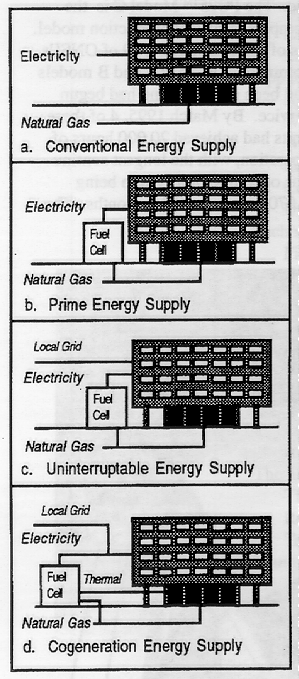
The diagram to the right describes the various types of configurations
that a building's power and heat requirements can take on, if fuel cells were
part of the equation. Household markets for fuel cells would initially take on
the cogeneration configuration. Cogeneration is the bottom picture.
This is a large market in North America, given that a simple replacement of a boiler with a fuel cell, tying into the existing household electrical system is a relatively simple retrofit. A large number of older buildings in pre-1960's North American cities use hot water heating. A fuel cell retrofit would be a simple method of switching over to an environmentally friendly heating system, from an oil fired or natural gas fired heating system. The buildings hot water piping and radiator system could remain.
Of course new heating systems would use more practical forms of heat dispersal. In the market today is a thin tough tubing system, it is installed below the under-padding of carpets in the home. The tubing is tied into the heating loop with a thermostat controlling the heat in each room.
Water based heating systems are more efficient than forced air because water transfers a greater volume of heat than air. The hot-water heating system is seen as a healthier environment compared to the forced air applications, forced air heating creates a dry environment and disperses germs throughout the building.
In order for the Electric Company to get electricity to your house, they must burn fuel at a rate of 29% efficiency. While they produce power at a high rate at the plant, the loss of generated power happens through transmission of the power through miles of thick copper cables. An SOFC can generate power at 60% basic efficiency at your house, when you utilize the high-grade heat produced, up to 90% efficiency can be reached. Cogeneration adaptable D.C. power conversion systems are now available for the modern home (replace the batteries with an SOFC).
Automotive
Global's strategic partnership with Delphi Automotive gives Global access to the automakers of the world. Global contracted with Delphi in April of 1999 to provide a prototype Auxiliary Power Unit (APU) for the modern automotive 42 volt electrical system. The APU will take over the electrical load of the modern car, relieving the Internal Combustion Engine (ICE) of more than 2kw of power demand. This will allow the ICE to concentrate on supplying the power to the drive train of the automobile, increasing mileage to over 80 mpg. The APU will be a part of the hybrid cars of the future. The automotive market for APUs is estimated to grow to $9 Billion a year.
A lucrative future market is the APU for trucks. This fuel cell application would supply the power to refer units that keep truck loads frozen, cool, or heated in the winter. Also the power and heat could be utilized to replace an alternator for electrical demands, increasing mileage. This would eliminate the need for trucks to idle while not in motion, reducing the polluting emissions of the diesel engine and saving on fuel consumption.
Telecommunications
Remote telecom sites require power to function. These sites house the electronic equipment, and the backup battery power (DC batteries). The back-up batteries require a charging system to maintain their charge. Inside the building the environment needs to maintain a relatively constant temperature, 20deg. C. In the summer air conditioning is required, in the winter heat. The solid oxide fuel cell could provide the power to recharge the batteries, run the electronic equipment, heat and cool the building. Global's SOFC would compliment the thermo generators they supply or possibly replace them.
The SOFC would significantly reduce maintenance and fuel costs related to on-site power, diesel or propane fired generators are used presently. The generators need to be serviced from time to time, this requires a technician to go to the site, do routine maintenance and engine overhauls. The replacement of back-up generators at sites that have grid power would also be cost effective for maintenance costs, these generators require a tech to run the diesel motor from time to time, and do routine maintenance. Of course conversion to an environment friendly fuel cell would be an advantage for us all.
Given the expansion of wireless technology, the number of telecom sites is projected to increase.
Telecommunications Conference Site
Military Applications
The military market has the potential to be quite lucrative, applications for the SOFC could range into military vehicles, portable power sources, on-site power and heat applications for army buildings and tents. The U.S. Navy is looking to outfit their ships with fuel cells, this will allow ships to put their energy sources where required. De-centralizing the power sources away from the engine-room, removes the possibility that a single hit to the engine-room could disable the ship.
TACOM of the U.S. military is currently looking for an SOFC .
*Note the following article was obtained through the library system, I received a rather faded photocopy from them. So I'm unable to deliver an actual website or legible copy for verification. The closest I can come is a search at the Army Times Site where I searched and found a summary reference to the article. If you wish type in" 06-07-99 AND fuel cells" into the search box, this is as close as I can get to the article. Membership is required to access the site.
Army Times Article: Fuel cells could enhance military capabilities
Allied Signal and the U.S. military have a SOFC Power Supply on the drawing board.